By continuing, you agree to LoansJagat's Credit Report Terms of Use, Terms and Conditions, Privacy Policy, and authorize contact via Call, SMS, Email, or WhatsApp
Disclaimer: The information published on LoansJagat is intended for general informational and educational purposes only and should not be considered financial, legal, or investment advice. Interest rates, loan terms, statistics, and other data may change over time and may vary by lender or source. Please verify the latest information and consult a qualified financial advisor or the respective Bank/NBFC before making any financial decisions.
Apply for Loans Fast and Hassle-Free
Subscribe Now
About the author

LoansJagat Team
‘Simplify Finance for Everyone.’ This is the common goal of our team, as we try to explain any topic with relatable examples. From personal to business finance, managing EMIs to becoming debt-free, we do extensive research on each and every parameter, so you don’t have to. Scroll up and have a look at what 15+ years of experience in the BFSI sector looks like.
Related Blog Post
Simplify All Your Loans Into One Affordable EMI

Customers Served

Debt Consolidated

1200+ Reviews

Locations in India
Club all Loans & Credit Card Bills into Single EMI

Quick Apply Loan
Consolidate your debts into one easy EMI.

Takes less than 2 minutes. No paperwork.

10 Lakhs+
Trusted Customers

2000 Cr+
Loans Disbursed

4.7/5
Google Reviews

50+
Banks & NBFCs Offers
Other services mentioned in this article
Key Takeaways
“Have you ever noticed how two competing companies suddenly become one powerful brand? That is exactly where the concept of a horizontal merger begins.
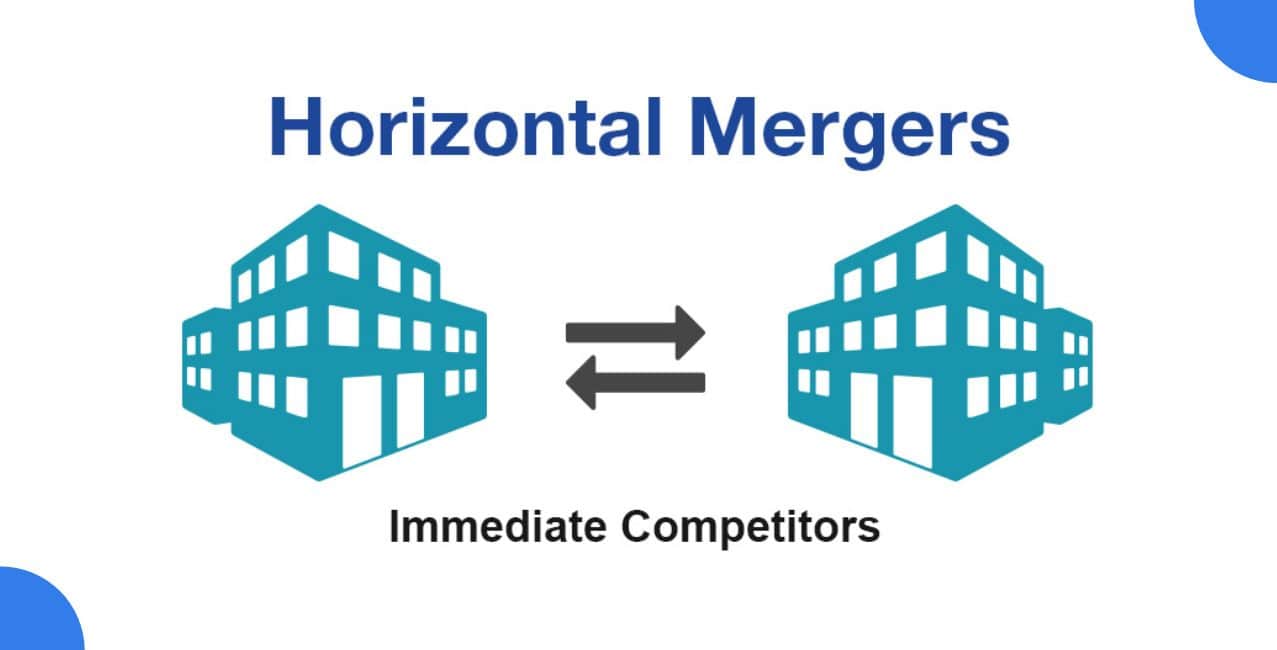
A horizontal merger is a type of business merger in which two companies operating in the same industry and at the same stage of production combine to form a single company. These companies usually produce similar products or services and may be direct competitors in the market. The horizontal merger definition economics describes the combination of firms that operate at the same level of production in the same industry.
The main objective of a horizontal merger is to increase market share, reduce competition, and achieve economies of scale by combining resources, operations, and customer bases.
For example, if I own a telecom company with 10 million users and I merge with a competitor that has 8 million users, the combined company may serve 18 million customers. This strengthens market share and reduces direct competition in the industry.
Bonus Tip: In March 2026, a proposed $110 billion Paramount–Warner Bros. merger faced antitrust scrutiny due to concerns about reduced competition in the entertainment industry.
The understanding of what is a horizontal merger becomes easier when you see how the merger process actually works.
Identify a company operating in the same industry and offering similar products or services.
Analysis of potential advantages such as increased market share, reduced costs, or stronger competitive position.
Discussion of valuation, ownership structure, and management roles between the two companies.
Review of financial records, operations, assets, and legal obligations before finalising the agreement.
Submission of the merger proposal to the competition authorities for approval.
Finalise the legal documentation and officially combine the two companies.
Merge departments, employees, technology systems, and product lines.
This process shows that horizontal mergers require careful planning, negotiation, and regulatory review before companies successfully operate as a single entity.
Companies often choose horizontal mergers to strengthen their market position and improve business efficiency, which also reflects the horizontal merger definition economics in real business situations.
These reasons explain why many companies pursue horizontal mergers as a strategy to grow faster and compete more effectively in the market.
A horizontal merger can create many opportunities for business growth. At the same time, it can also introduce certain risks that companies must carefully manage.
These benefits and risks show that horizontal mergers can support growth but require careful planning and management to succeed.
*T&C Apply
The horizontal vs vertical mergers help you see how companies expand and strengthen their market position. Both strategies involve business combinations, but they occur at different stages of the production or supply chain.
This table explains the difference between vertical merger and horizontal merger, which is a common topic when analysing horizontal vs vertical merger strategies.
When two companies in the same industry combine, they form a stronger organisation with a larger market reach and resources.
These examples show how horizontal mergers help companies grow larger, expand market share, and improve their competitive position within the same industry.
A horizontal merger helps companies grow by combining resources, customers, and market strength. It can improve efficiency and reduce competition, but it also requires careful regulation. This concept helps you better analyse business strategies and how industries evolve over time.
1. What is the difference between a horizontal merger and a vertical merger?
A horizontal merger happens when two companies in the same industry and at the same production level combine. A vertical merger occurs when companies at different stages of the supply chain merge, such as a manufacturer merging with a supplier.
2. Can you give a real-life example of a horizontal merger?
Yes. The merger between Vodafone India and Idea Cellular is a well-known example. Both companies were telecom operators in India. Their merger created Vodafone Idea, one of the largest telecom providers in the country.
3. Are horizontal mergers reviewed more strictly than vertical mergers?
Yes. Horizontal mergers are usually reviewed more strictly because they involve direct competitors. Regulators examine them carefully since they may reduce market competition and increase market power.
4. Why are vertical mergers challenged less often by regulators?
Vertical mergers usually involve companies at different supply chain levels. They do not directly remove a competitor from the market. Because of this, regulators challenge them less often compared to horizontal mergers.
5. How can a horizontal merger benefit consumers?
A horizontal merger can benefit consumers if it improves efficiency and reduces production costs. Companies may offer better services, wider product availability, and sometimes lower prices due to economies of scale.