By continuing, you agree to LoansJagat's Credit Report Terms of Use, Terms and Conditions, Privacy Policy, and authorize contact via Call, SMS, Email, or WhatsApp
Disclaimer: The information published on LoansJagat is intended for general informational and educational purposes only and should not be considered financial, legal, or investment advice. Interest rates, loan terms, statistics, and other data may change over time and may vary by lender or source. Please verify the latest information and consult a qualified financial advisor or the respective Bank/NBFC before making any financial decisions.
Apply for Loans Fast and Hassle-Free
Subscribe Now
About the author

‘Simplify Finance for Everyone.’ This is the common goal of our team, as we try to explain any topic with relatable examples. From personal to business finance, managing EMIs to becoming debt-free, we do extensive research on each and every parameter, so you don’t have to. Scroll up and have a look at what 15+ years of experience in the BFSI sector looks like.
Related Blog Post
Simplify All Your Loans Into One Affordable EMI

Customers Served

Debt Consolidated

1200+ Reviews

Locations in India
Club all Loans & Credit Card Bills into Single EMI

Quick Apply Loan
Consolidate your debts into one easy EMI.

Takes less than 2 minutes. No paperwork.

10 Lakhs+
Trusted Customers

2000 Cr+
Loans Disbursed

4.7/5
Google Reviews

50+
Banks & NBFCs Offers
Other services mentioned in this article
Key Takeaways
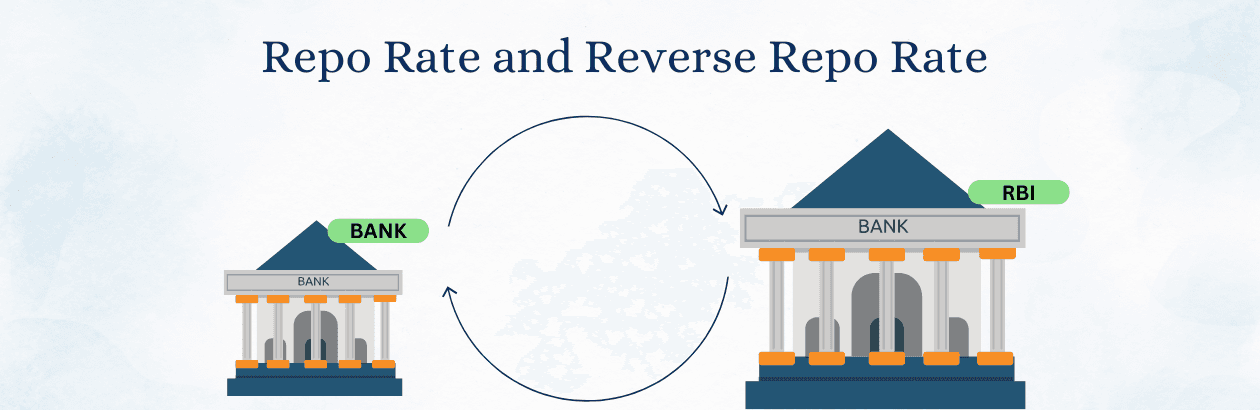
The repo rate refers to the interest rate at which the RBI gives money to commercial banks for a short period of time against government securities. Banks borrow this money from the RBI when they run out of funds. RBI adjusts this rate to control inflation and liquidity in the economy.
Let's understand this concept with a simple example:
If the RBI reduces its repo rate, then the commercial banks like SBI, HDFC, etc. will get funds at a lower rate, and the customers will also get home loans and other loans at a lower interest rate.
The Economic Times says that the repo rate is a monetary policy tool used by the RBI to regulate liquidity and inflation.
When commercial banks like SBI and HDFC wants longterm funds, the RBI lends money to banks without requiring collateral.
In the repo rate, banks need to provide securities, but in this case, they do not need to provide securities. As explained by the RBI policy glossary, the bank rate is part of India’s monetary policy framework and is usually slightly higher than the repo rate.
Read More : Repo Rate Up, Home Loan Cost Up
In the following table, we have mentioned the bank rate vs repo rate difference in simple terms:
The repo rate controls short-term liquidity, on the other hand, bank rate manages long-term monetary policies. Both of these help the central bank regulate interest rate and maintain economic stability.
The bank rate vs repo rate time period is one of the biggest differences between both of them:
This is the main reason why repo rate changes happen frequently during RBI policy meetings, while, on the other hand, bank rate changes are less frequent.
Most of the people have one question that
Required
*T&C Apply
Most of the time Bank Rate is higher than the repo rate. But why? Because:
According to the RBI data, the bank rate generally stays above the repo rate levels.
Also Read : Inflation Falls Below RBI Target Again
SBI Bank Rate vs Repo Rate (Examples)
When the RBI changes the repo rate, banks like SBI adjust lending rates quickly.
Example:
According to the news report, repo rate cuts directly reduce lending rates of public sector banks. So we can say that the repo rate not only affects the commercial bank but also impacts the customers.
No, there is no official bank rate vs repo rate calculator, but other financial calculators calculate loan EMI charges according to the repo rate movement. Retail loans are mostly repo-linked today.
Banks do not use public calculators for bank rate adjustments; they use their internal systems.
Bonus Tip
Do not track the bank rate if you want to predict future loan EMIs; always track repo rate announcements because the repo rate directly affects borrowing costs for customers.
With the help of the bank rate vs repo rate, you can easily understand how the RBI controls the Indian economy. The repo rate mainly manages short-term liquidity and directly impacts loans and EMIs, while the bank rate works as a long-term policy indicator. In most cases, the bank rate remains slightly higher because it involves unsecured lending. For common people, repo rate changes matter more because they influence home loans, car loans, and business borrowing quickly.
1. What is the main bank rate vs. repo rate difference? (GPT)
The repo rate is short-term secured borrowing, while the bank rate is long-term unsecured borrowing by banks from the RBI.
2. What is the difference between a bank rate and a REPO rate with respect to RBI? (Quora)
Bank Rate: This is the rate at which the Reserve Bank of India (RBI) lends money to banks without collateral for a long-term period.
Repo Rate: The rate at which the RBI lends money to banks with government securities as collateral for a short-term period.
3. Repo rate ( how it works )
First, the banks borrow short-term money from Reserve Banks India by giving securities as collateral at a fixed interest rate.
4. RBI reduces the repo rate to 5.25%. How will this impact the economy and the market?
Loans will become cheaper, spending and investment will increase, and the economy will get a boost.
5. Is it Repo rate or Bank rate through which commercial banks borrow money from RBI?
Commercial banks mainly borrow from the RBI through the repo rate, not the bank rate.