By continuing, you agree to LoansJagat's Credit Report Terms of Use, Terms and Conditions, Privacy Policy, and authorize contact via Call, SMS, Email, or WhatsApp
Disclaimer: The information published on LoansJagat is intended for general informational and educational purposes only and should not be considered financial, legal, or investment advice. Interest rates, loan terms, statistics, and other data may change over time and may vary by lender or source. Please verify the latest information and consult a qualified financial advisor or the respective Bank/NBFC before making any financial decisions.
Apply for Loans Fast and Hassle-Free
Subscribe Now
About the author

LoansJagat Team
‘Simplify Finance for Everyone.’ This is the common goal of our team, as we try to explain any topic with relatable examples. From personal to business finance, managing EMIs to becoming debt-free, we do extensive research on each and every parameter, so you don’t have to. Scroll up and have a look at what 15+ years of experience in the BFSI sector looks like.
Related Blog Post
Simplify All Your Loans Into One Affordable EMI

Customers Served

Debt Consolidated

1200+ Reviews

Locations in India
Club all Loans & Credit Card Bills into Single EMI

Quick Apply Loan
Consolidate your debts into one easy EMI.

Takes less than 2 minutes. No paperwork.

10 Lakhs+
Trusted Customers

2000 Cr+
Loans Disbursed

4.7/5
Google Reviews

50+
Banks & NBFCs Offers
Other services mentioned in this article
Key Takeaways
Bonus Tip: Banks now include cooperative borrowing under priority sector lending, expanding credit access for co-ops.
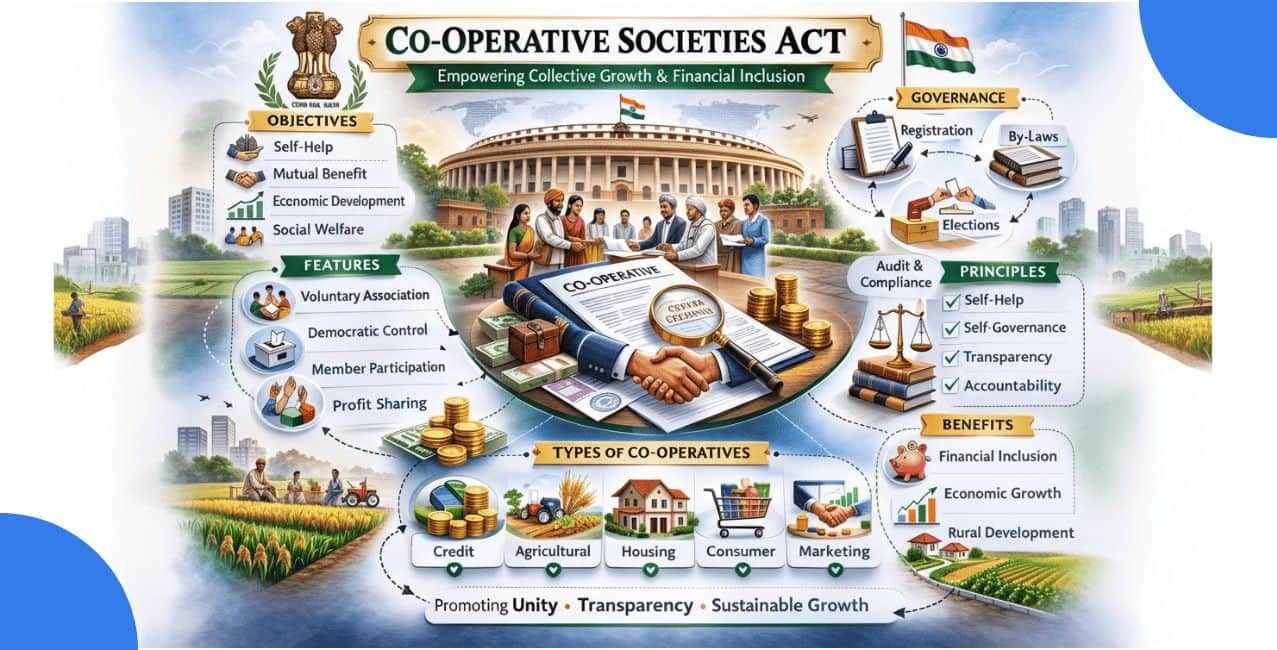
Dinesh is a Delhi government clerk. He wondered how housing societies or farmer unions run smoothly? He learned that the Co Operative Societies Act governs how cooperatives register, operate, and protect the interests of their members. The Co Operative Societies Act in India sets the rules for members to control their groups democratically.
Think of a co-op like a Delhi metro station. It is built by members, used by members, and run for the benefit of their members. The Indian Co Operative Society Act 1912 helps these stations of collective work remain democratic and efficient.
Dinesh joined his apartment’s credit co-op to avoid bank queues, just like taking the metro instead of paying rickshaw surge charges. They came under the Co Operative Society Act in India as well.
Before Dinesh could help his sister start a cooperative farming society in UP, he followed the steps below:
In conclusion, compliance with these steps helps co-ops thrive legally under the Co Operative Society Act in India.
The Co Operative Societies Act and its state versions constantly evolve to ensure fair member rights and transparent operations.
These updates strengthen cooperative societies by promoting transparency, inclusivity, easier credit access, and stronger governance across states.
The Indian Co Operative Society Act of 1912 aimed to make cooperatives democratic bodies for economic and social benefit. Over time, many state acts, like the Maharashtra Co Operative Societies Act, 1960, came up. These state acts, like the U P Co Operative Societies Act 1965 with rules 1968 tailored it locally.
In conclusion, ongoing reforms aim to make co-ops more inclusive and transparent for members like Dinesh.
The Co Operative Societies Act has roots in early co-op movements that aimed to reduce dependence on moneylenders. The Indian Co Operative Society Act, 1912, was the first central law to register and regulate societies nationally. Over time, states adopted their own acts.
*T&C Apply
From a colonial-era legal tool to modern cooperative governance, the Act has preserved the cooperative values. Local acts like the Maharashtra Co Operative Societies Act, 1960, reflect state needs as well.
The Co Operative Societies Act empowers democratic governance and member fairness in co-operative societies.
The Act ensures that cooperatives run like community teams, not chaotic auto-stands.
For Dinesh, the Co Operative Societies Act wasn’t just legal jargon. It was a roadmap to democratic governance, clear rules, and community benefit. After the initiation of the Indian Co Operative Society Act 1912, state laws also came into effect. State laws included the Maharashtra Co Operative Societies Act, 1960, the U P Co Operative Societies Act 1965 with rules 1968, etc.
These laws guide member rights and responsibilities. With constant reforms backed by priority credit access and transparency measures, co-ops are more empowering than ever. They let citizens “rule the roost” like Delhi’s own Political Chowk, only with ballots instead of ballots of paper. Embrace these laws to empower your cooperative journey.
What is a cooperative society under the Co Operative Societies Act?
It’s a voluntary group formed for mutual benefit, based on democratic control and limited liability.
Can a cooperative society be deregistered?
Yes, if it violates the bye-laws or the Act’s provisions, the registrar can cancel registration.
Do cooperative societies allow virtual Annual General Meetings?
Modern draft rules across states like Maharashtra allow online meetings for inclusive member participation.
Are transfer fees in cooperatives legal?
Society must follow model bylaws; unreasonable fees face a challenge in court.
Why do people still invest in cooperative societies despite RBI caution?
Many investors, including NRIs and senior citizens, value cooperative societies for community trust, tax efficiency, and member-centric benefits, while staying cautious as advised by the RBI.
What is the Co Operative Societies Act?
It’s the legal framework for forming and governing cooperative bodies in India, from national to state acts.
How do cooperative societies actually work in practice?
Cooperative societies work based on voluntary participation, where members jointly own and manage the enterprise, making work more meaningful and rewarding than working for profit-driven corporations.
What is the initial step to create a credit cooperative society in India?
Contact your state’s Registrar of Cooperative Societies, gather at least 25 members, and prepare bylaws for approval after a general meeting.