By continuing, you agree to LoansJagat's Credit Report Terms of Use, Terms and Conditions, Privacy Policy, and authorize contact via Call, SMS, Email, or WhatsApp
Disclaimer: The information published on LoansJagat is intended for general informational and educational purposes only and should not be considered financial, legal, or investment advice. Interest rates, loan terms, statistics, and other data may change over time and may vary by lender or source. Please verify the latest information and consult a qualified financial advisor or the respective Bank/NBFC before making any financial decisions.
Apply for Loans Fast and Hassle-Free
Subscribe Now
About the author

LoansJagat Team
‘Simplify Finance for Everyone.’ This is the common goal of our team, as we try to explain any topic with relatable examples. From personal to business finance, managing EMIs to becoming debt-free, we do extensive research on each and every parameter, so you don’t have to. Scroll up and have a look at what 15+ years of experience in the BFSI sector looks like.
Related Blog Post
Simplify All Your Loans Into One Affordable EMI

Customers Served

Debt Consolidated

1200+ Reviews

Locations in India
Club all Loans & Credit Card Bills into Single EMI

Quick Apply Loan
Consolidate your debts into one easy EMI.

Takes less than 2 minutes. No paperwork.

10 Lakhs+
Trusted Customers

2000 Cr+
Loans Disbursed

4.7/5
Google Reviews

50+
Banks & NBFCs Offers
Other services mentioned in this article
Key Insights
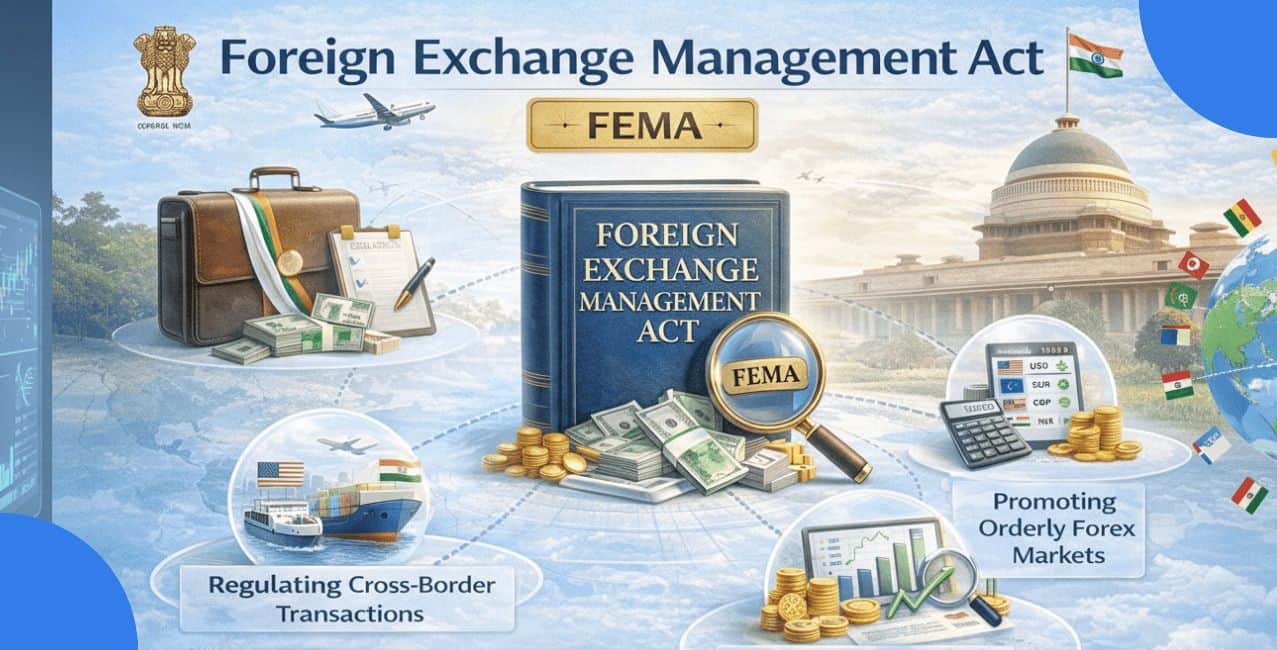
The Foreign Exchange Management Act FEMA is an important Indian law passed in foreign exchange management act fema 1999 to regulate external trade. It replaced the stricter FERA to simplify foreign exchange transactions. FEMA aims to manage foreign exchange to support stability and growth. The Foreign Exchange Management Act was passed in the year of 2000 1st day of June.
Foreign Exchange Management Act 2000 as the rulebook for India's financial borders. If you want to follow it, make sure your cross-border transactions match the Foreign Exchange Management Rules set by the Foreign Exchange Management Department. This is important for the Foreign Exchange Management Act UPSC syllabus and helps you stay appreciative without worry.
The Foreign Exchange Management Act 2000, is the main law that regulates foreign exchange in India. It would not be wrong to say that it is the financial guard for our country.
The Foreign Exchange Management Rules under this Act guide how all types of international financial activities, such as investments and remittances, should be carried out legally. Also, for the Foreign Exchange Management Act UPSC.
Example:
When an Indian startup gets foreign investment, it must follow FEMA’s reporting rules. The Foreign Exchange Management Department ensures these investments are recorded through approved banks as required, helping the company stay out of legal trouble.
Bonus Tip: A strong export sector helps India’s economy grow, increases foreign exchange reserves, and builds better trade relationships with other countries.
Stop searching for FEMA 2024-2025 updates on random sites. Here’s what’s changed: cross-border transactions are now simpler, and digital submission is smoother. Just handle your international finances without the usual headaches.
These are the changes under the Foreign Exchange Management Act. If you want to know what the Changes Under Discussion are, here is the information:
Between 2015 and 2020, major changes brought in more flexible and technology-friendly regulations to help build a modern, digital-first economy, before the 2025 updates.
The Parliament has enacted the Foreign Exchange Management Act,1999, to replace the Foreign Exchange Regulation Act, 1973. This Act came into force on the 1st day of June, 2000. The Central Govt. have established the Directorate of Enforcement with a Director and other officers, for the purpose of taking up investigations of cases under the said Act.
*T&C Apply
When FEMA was enacted in 1999, it marked India's shift from strict controls to a system that supports global economic involvement and better management of foreign exchange.
If you’re still unsure about what the Foreign Exchange Management Act does, imagine it as India’s guide for dealing with foreign currency.
Here are the features and importance of the Foreign Exchange Management Act:
Foreign exchange transactions under FEMA are classified into two main categories:
Current account transactions are regular international exchanges that do not involve changing the ownership of assets. They include trade in goods and services, investment income like interest and dividends, and transfers such as remittances and gifts. These transactions show how healthy a country’s economy is by tracking things like exports, imports, foreign travel, education, and business expenses.
A capital account transaction is when money moves across borders and changes the assets or debts of people or companies, such as through foreign investment (FDI/ODI), overseas loans (ECBs), or buying and selling property abroad. These transactions affect who owns financial assets and can change a country’s long-term financial position. This is different from current account transactions, which cover everyday trade.
The Foreign Exchange Management Act is the main law that shapes how India interacts with the global financial system. It replaces older restrictions with a more flexible system, supports foreign trade, helps keep markets stable, and boosts India’s role in the world economy.
How does FEMA affect businesses?
The Foreign Exchange Management Act (FEMA) oversees foreign investments and cross-border transactions in India to keep the rupee stable and support compliance-based economic growth. It impacts businesses by setting limits on foreign direct investment, controlling how profits are sent abroad, and requiring companies to follow Reserve Bank of India rules for foreign transactions.
Why does the Indian government label all residents in a way that negatively impacts their participation in foreign capital markets?
The Indian government controls how residents take part in foreign capital markets. This is mainly to manage foreign exchange reserves, keep the Indian Rupee stable, and make sure the capital account is not fully open.
What is foreign exchange management act?
The Foreign Exchange Management Act (FEMA), 1999, is an Indian law that oversees foreign exchange transactions. Its main goals are to support external trade, manage payments, and help the foreign exchange market grow in an organised way. FEMA took the place of the stricter FERA and changed the focus from strict regulation to better management of foreign exchange.
What is the objective of the FEMA Act?
The Foreign Exchange Management Act (FEMA), 1999, was created to update and combine laws about foreign exchange. Its main goals are to make external trade and payments easier and to help develop a stable foreign exchange market in India. FEMA also works to open up the Indian economy by making foreign exchange transactions simpler, while the Reserve Bank of India (RBI) continues to oversee and regulate these activities.
What benefits are available for students?
Students who go abroad for their studies are considered NRIs and can use all the facilities that NRIs get under FEMA. They can receive up to USD 10,00,000 per year from their NRE or NRO accounts or from profits on property.