By continuing, you agree to LoansJagat's Credit Report Terms of Use, Terms and Conditions, Privacy Policy, and authorize contact via Call, SMS, Email, or WhatsApp
Disclaimer: The information published on LoansJagat is intended for general informational and educational purposes only and should not be considered financial, legal, or investment advice. Interest rates, loan terms, statistics, and other data may change over time and may vary by lender or source. Please verify the latest information and consult a qualified financial advisor or the respective Bank/NBFC before making any financial decisions.
Subscribe Now
About the author

Vidhi Chauhan
Vidhi Chauhan is a copywriter and content writer with extensive experience creating high-quality, SEO-driven content across multiple industries, with a strong focus on fintech. She has written extensively on GST, banking, personal loans, business loans, credit cards, income tax, insurance, and other financial topics, helping Indian readers understand complex concepts through clear, accurate, and engaging content.
Related Blog Post
Simplify All Your Loans Into One Affordable EMI

Customers Served

Debt Consolidated

1200+ Reviews

Locations in India
Club all Loans & Credit Card Bills into Single EMI

Quick Apply Loan
Consolidate your debts into one easy EMI.

Takes less than 2 minutes. No paperwork.

10 Lakhs+
Trusted Customers

2000 Cr+
Loans Disbursed

4.7/5
Google Reviews

50+
Banks & NBFCs Offers
Other services mentioned in this article
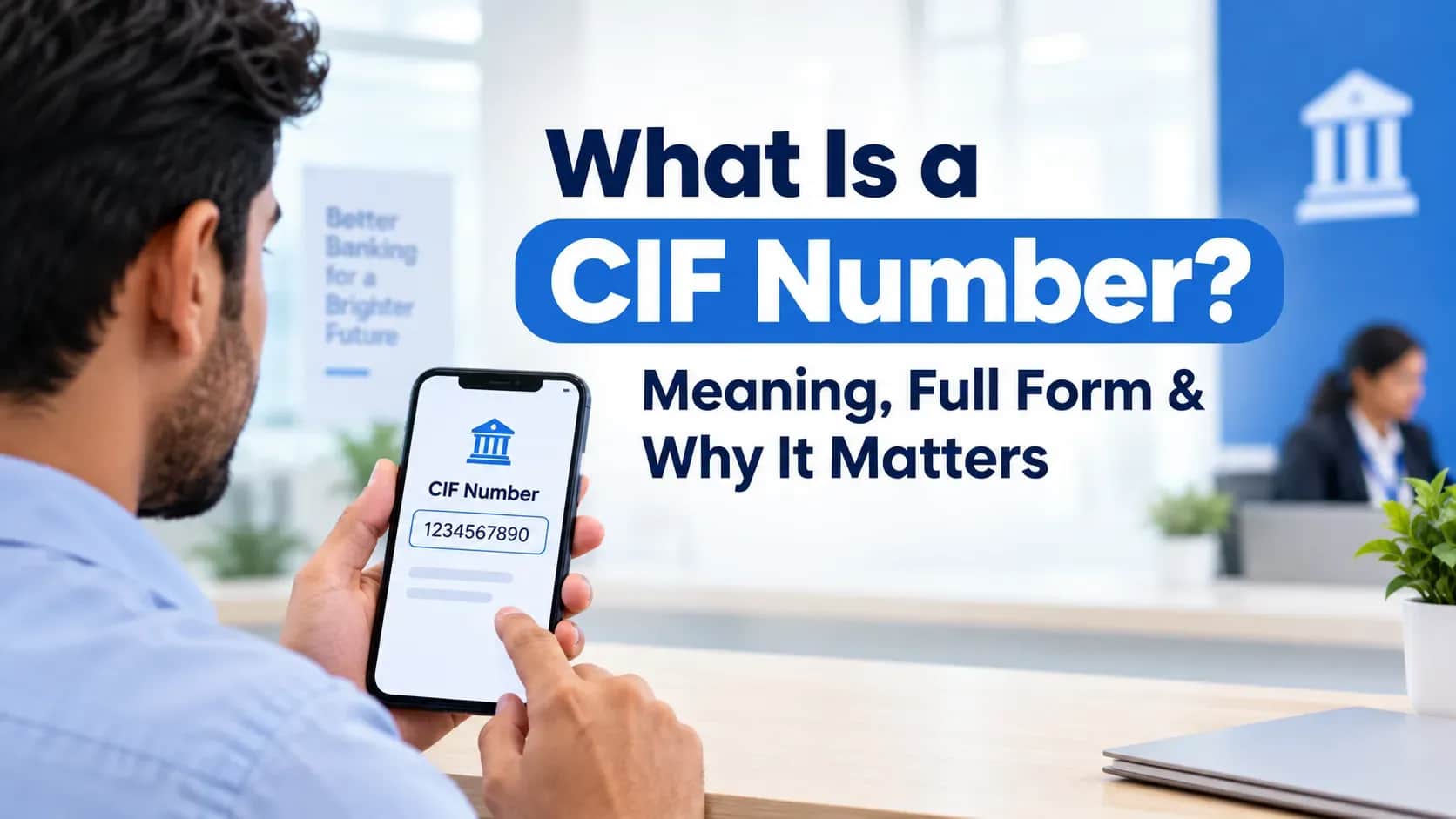
The CIF Number means Customer Information File Number, which is a unique number given to customers of a bank by the bank. The CIF number differs from the account number because while an account number refers to a specific account held with a bank, the CIF number refers to the customer and their dealings with the bank. Your savings account, fixed deposit account, or loan account could all belong to the same customer file under the CIF number provided by the bank. When you know your CIF number it would help you understand the way banks manage your information, carry out KYC procedures, and connect your banking accounts under the same customer profile. In this blog, we shall learn more about the CIF number, including its full form, meaning, importance, information, and differences from account numbers.
A CIF number refers to the identification number of the customer assigned to him/her by the bank.
The CIF number is used as the point of reference for the customer's profile at the bank. Rather than having each of the customer's banking instruments, such as savings account, fixed deposit, loan, and others, as being entirely distinct from each other, the bank can refer to the customer's CIF number for organisational purposes.
While the account number refers to a specific bank account, the CIF number refers to the customer at the bank.
For example, if you have a savings account, a fixed deposit, and a personal loan at the same bank, they may all be associated with the customer profile using the CIF number.
The full form of CIF is ‘Customer Information File’. This represents the customer’s file created by a bank. The CIF Number represents the identification number linked to this customer file.
There are millions of customers and many financial instruments handled by banks. One customer will have many accounts and use many other banking services. The CIF system will assist the bank in grouping all the data under one customer profile.
Some of the reasons why it is important for the CIF number include:
The CIF number will help the bank to identify the customer in its database.
The bank can identify and obtain data from the customer profile through the process of verification.
You might have different banking relations with the same bank.
The banking products that you might be using include:
Based on the system followed by the bank and your relationship with it, these banking products can be linked to your customer record.
This will help the bank in having a consolidated understanding of the relationship that it is maintaining with you.
When there is organised customer data at the bank, it helps to do some things much faster.
For instance, the customer data is needed for:
With the help of the customer ID, the bank can find the right customer data faster.
It is compulsory for the banks to keep up-to-date records about their customers and to maintain them whenever needed.
The customer information may consist of data pertaining to authentication, contact, and financial dealings. The CIF framework aids the bank in managing its customer records.
Information about the customer relationship with the bank may enable it to determine which banking products or services would be suitable for that particular customer.
For instance, after a customer opens a savings account, they might apply for loans, credit cards, or deposits. Maintaining a customer profile is beneficial for managing these customer relationships.
Nevertheless, it should be noted that product suitability depends on several factors.
The CIF number is basically just an identification number. But the information that may be available in your customer profile through the CIF number includes the following:
*T&C Apply
It depends on the bank, the nature of the relationship between you and the bank, and the applicable regulations. As the CIF number is part of your banking profile, it needs to be kept confidential.
Knowledge of the CIF number will assist you to gain a clearer picture of how banks classify and organise your customer details. While it may not be like an account number which is unique to one specific account, it helps you know more about your dealings with the bank, which may involve various banking products.
1. Is it possible for the CIF number to vary with time?
CIF number will always be linked to a particular customer as long as he or she remains a customer of the same bank. However, changes may depend on the bank's policies among others.
2. Does a CIF number have to be provided during each and every transaction made with the bank?
No, customers are not required to provide their CIF numbers when making transactions like withdrawing money or making any transfer. It is a unique number for use by the bank only.
3. Can two different individuals have the same CIF number?
CIF number is normally unique to an individual in the bank's database. Therefore, there cannot be two individuals with the same CIF number.
4. Is CIF number unique in all the banks?
The CIF number is kept separately by each bank and hence there is no CIF number which is universal and same for all the banks. In fact, a customer having an account relationship with different banks will have different CIF numbers at each of them.
5. Can there be more than one CIF number in a joint account?
There can indeed be more than one CIF number in a joint account as different customers can have separate customer CIF numbers for their account profiles.
6. Can I use my CIF number to log into my bank account?
CIF number may be asked from the customer for various banking purposes or digital banking services depending upon the bank. It usually cannot substitute user name, password, or any other authentication credential.
7. Where do customers normally find their CIF number?
The CIF number could be displayed in the account statement, passbook, or customer’s profile by the banks. It is possible for the customers to get their CIF number through the bank’s digital platforms or through the customer service department of the bank.
8. Is it possible for a bank staff member to search for my details using my CIF number?
An authorised bank staff member may use the CIF number to get hold of the particular customer profile.
9. Is it okay to share my CIF number with others?
It would not be wise to consider a CIF number as information that is free to be shared by anyone. Refrain from linking it to passwords, OTPs, PINs, or any other verification codes, especially when you receive unsolicited calls.
10. How can I fix my CIF information if it’s wrong?
In case of any discrepancies in your CIF information, contact your bank using its customer service line or walk into one of its branches and have your information fixed.