By continuing, you agree to LoansJagat's Credit Report Terms of Use, Terms and Conditions, Privacy Policy, and authorize contact via Call, SMS, Email, or WhatsApp
Disclaimer: The information published on LoansJagat is intended for general informational and educational purposes only and should not be considered financial, legal, or investment advice. Interest rates, loan terms, statistics, and other data may change over time and may vary by lender or source. Please verify the latest information and consult a qualified financial advisor or the respective Bank/NBFC before making any financial decisions.

Apply for Loans Fast and Hassle-Free
Subscribe Now
About the author
Diwaker Sharma
Diwaker Sharma is a finance content specialist with expertise in banking, personal finance, credit cards, loans, fintech, and financial news. An MBA in Finance with prior experience in the banking sector, he combines industry knowledge with SEO and content strategy to produce insightful, research-backed articles. Passionate about making finance accessible, he transforms complex financial concepts into clear, engaging content that empowers readers to make smarter financial decisions with confidence.
Related Blog Post
Simplify All Your Loans Into One Affordable EMI

Customers Served

Debt Consolidated

1200+ Reviews

Locations in India
Club all Loans & Credit Card Bills into Single EMI

Quick Apply Loan
Consolidate your debts into one easy EMI.

Takes less than 2 minutes. No paperwork.

10 Lakhs+
Trusted Customers

2000 Cr+
Loans Disbursed

4.7/5
Google Reviews

50+
Banks & NBFCs Offers
Other services mentioned in this article
First things first, figure out why your account got frozen. Usually it's a pending KYC update, sometimes it's a legal order instead. Fix the KYC part by handing in fresh documents at your branch, since RBI actually requires banks to give you a fair shot at updating things before they freeze anything.
If you've ever tried moving money and hit a wall because your account's blocked, you know exactly how frustrating that gets. This is for anyone in India dealing with a frozen account, whether it's a missed KYC update or some legal order from a government body. We'll cover why this happens, what actually fixes it, and how a KYC freeze differs from a legal one.
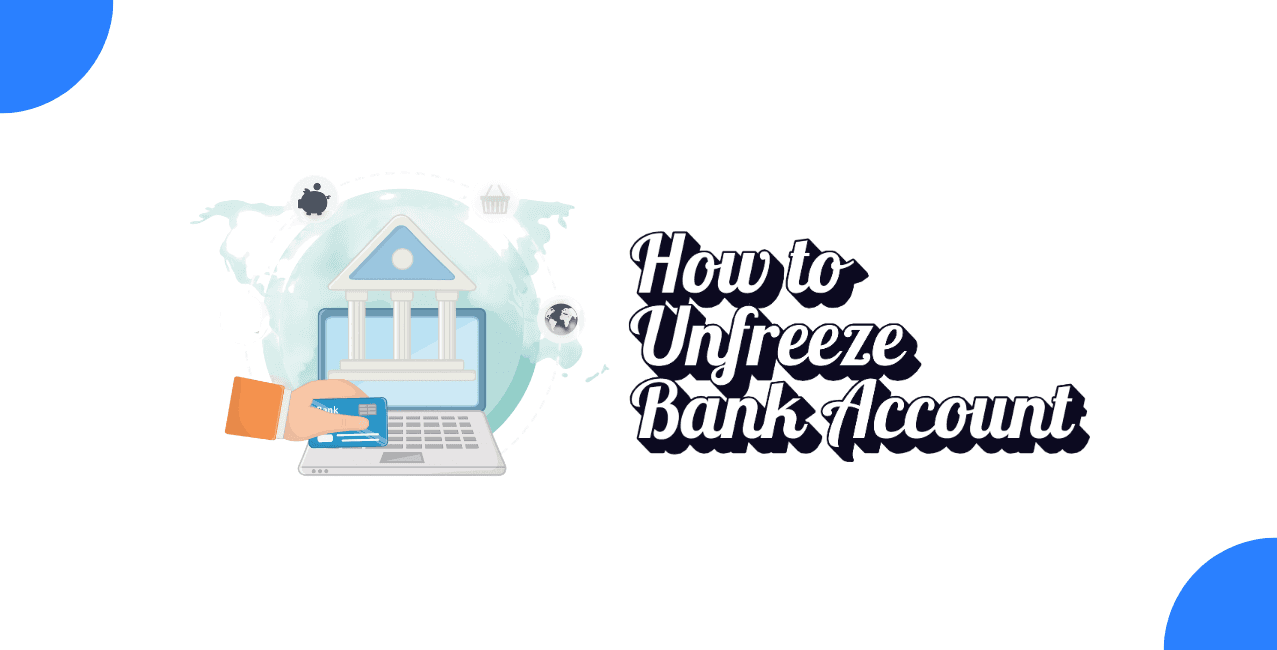
Basically, the bank puts restrictions on your account, sometimes blocking withdrawals only, sometimes blocking everything, and you can unfreeze a bank account.
Banks call it a partial freeze when money can still come in but can't go out, and a full freeze when nothing moves either way. RBI's own KYC rules spell out exactly this setup for accounts that fall behind on their periodic KYC. And no, frozen doesn't mean closed. Your money's sitting right there, safe, you just can't touch it freely until whatever caused the freeze gets sorted.
In order to determine how to unfreeze a bank account, one first understands the fundamental causes behind them. Mostly it comes down to 2 things, either you're behind on KYC, or some legal authority has told the bank to lock things down.
Here's roughly what triggers each situation:
Hand over updated ID and address proof at your branch, or do it digitally if your bank allows that.
Here's roughly how it goes:
Take Suresh, a shopkeeper in Nashik. His savings account got partially frozen after he ignored 2 KYC reminders. He walked into his branch with his Aadhaar and a recent electricity bill, handed them over, and had his account unfrozen in 3 working days, finally able to withdraw the ₹42,000 that had been sitting there untouched.
Here, you're sorting out the actual legal issue first, since the bank simply can't lift this kind of freeze on its own.
This is nothing like a KYC freeze. Banks have zero authority to reverse it themselves. What generally needs to happen or how you can unfreeze a bank account:
This route almost always takes longer than a KYC fix, simply because it's out of the bank's hands and depends entirely on someone else's timeline.
A KYC freeze is something you sort out directly with your bank. A legal freeze needs someone outside the bank to clear it first.
*T&C Apply
Getting your account unfrozen really starts with knowing why it happened in the first place, since a KYC problem and a legal order call for completely different fixes. Most KYC freezes clear up in days once you've handed over the right documents at your branch. Legal freezes, though, take longer and hinge entirely on sorting things out with whoever ordered the block.
Sorting out a frozen account really comes down to knowing the actual cause first. A quick document drop-off handles most KYC freezes, while a legal freeze needs outside resolution entirely. Best move going forward, keep your KYC updated well before it's due, and always double check with your bank exactly why the freeze happened before assuming you know the fix.