By continuing, you agree to LoansJagat's Credit Report Terms of Use, Terms and Conditions, Privacy Policy, and authorize contact via Call, SMS, Email, or WhatsApp
The information published on LoansJagat is intended for general informational and educational purposes only and should not be considered financial, legal, or investment advice. Interest rates, loan terms, statistics, and other data may change over time and may vary by lender or source. Please verify the latest information and consult a qualified financial advisor or the respective Bank/NBFC before making any financial decisions.
Subscribe Now
About the author

Ananya Shrivastava
Ananya Shrivastava is a Content Writer specialising in finance-focused news, blogs, and long-form articles on Indian markets, RBI policy, personal finance, and lending. She has authored over 450 blogs and 250 news pieces, combining technical knowledge with rigorous research to simplify complex financial concepts into clear, engaging content. With a marketing-driven lens and sharp editorial judgment, she consistently achieves top Google rankings while ensuring every claim is backed by verified data.
Related Blog Post
Simplify All Your Loans Into One Affordable EMI

Customers Served

Debt Consolidated

1200+ Reviews

Locations in India
Club all Loans & Credit Card Bills into Single EMI

Quick Apply Loan
Consolidate your debts into one easy EMI.

Takes less than 2 minutes. No paperwork.

10 Lakhs+
Trusted Customers

2000 Cr+
Loans Disbursed

4.7/5
Google Reviews

50+
Banks & NBFCs Offers
Sending ₹2,00,000 or more? Use the Union Bank RTGS form. Grab one at any branch, or skip the paper and file it through net banking with the IFSC code and account number in hand.
A trader in Ludhiana paying a supplier ₹3 lakh doesn't want to wait for a batch cycle. That's what this form is for, moving large sums the same minute, not the same day. Union Bank account holders use it, not walk-in customers off the street. Grab the form from the bank's website or from the counter itself. RBI drew the ₹2,00,000 line years ago, and everything under that still goes through NEFT or IMPS.
Also Read: How to Check Vidharbha Konkan Gramin Bank Account Balance in Various Ways
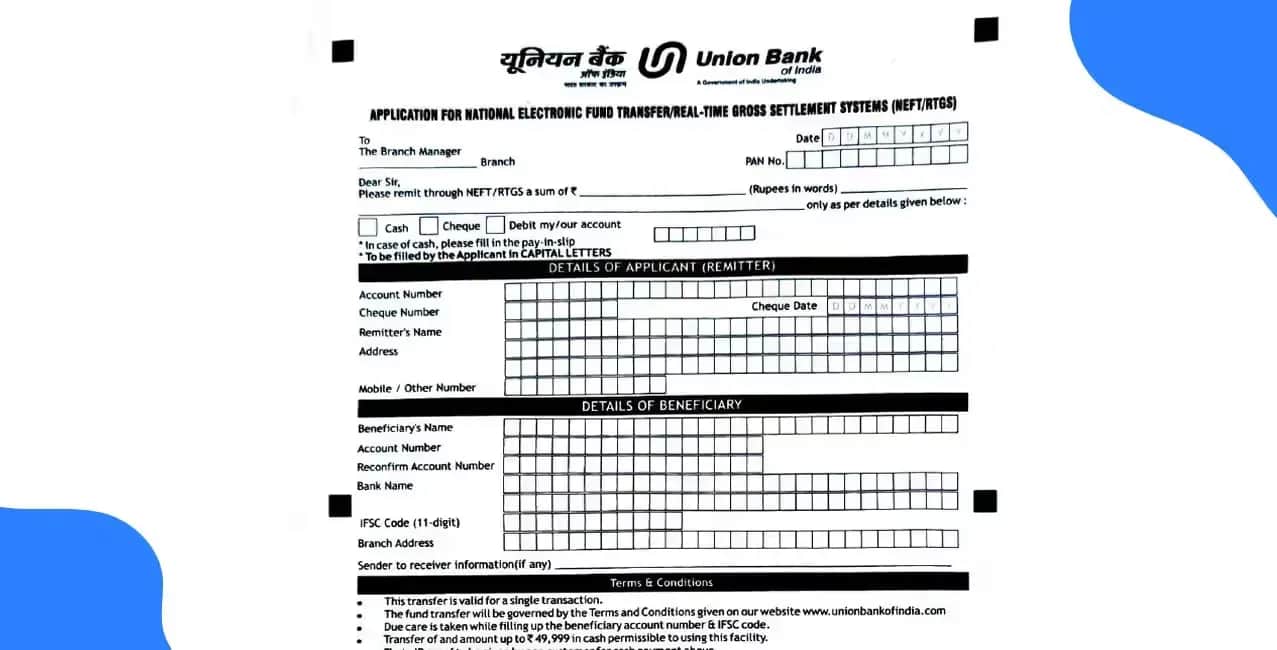
Just a transfer application, nothing fancier than that. You fill it, hand it in, and Union Bank of India pushes the money through RBI’s RTGS network, where each transaction clears on its own instead of waiting in a batch with a dozen others. The form requires remitter details, beneficiary details, an IFSC code, and the amount. RTGS transactions below ₹2,00,000 are not permitted. Transfers below this amount can generally be made through NEFT or IMPS. This cutoff comes from the Reserve Bank of India, not the bank itself.
Union Bank customers can use the RTGS facility by providing the required account and beneficiary details. The availability of branch-based RTGS services for non-account holders should be confirmed with the bank.
Savings, current, business- it doesn't matter which, as long as the transfer is ₹2,00,000 or more. No account, no branch RTGS, even if the payment can't wait. Open one first, or ask the receiving party to use a different channel.
Also Read: What is the IPPB Customer Care Number?
The fastest way is straight from the bank's site.
Branches keep printed copies at the counter as well. You can simply ask for one at the branch.
Miss a field, and the counter staff hands it right back. Follow this order instead:
The IFSC code and account number deserve a second look before you submit. Incorrect beneficiary details can cause the transaction to fail or may result in funds being credited incorrectly, so all details should be checked carefully before submission.
RTGS charges apply per transaction, based on the amount you send. Inward RTGS, meaning money coming into your account, costs nothing.
*T&C Apply
NEFT transfers initiated online through internet banking or mobile banking are free for savings bank account holders. These get revised now and then, so it's worth a quick check at the counter before you hand over cash.
The minimum amount for an RTGS transaction is ₹2,00,000, and there is no maximum limit prescribed by RBI.
Trying to send less? RTGS simply won't take it. Use NEFT or IMPS instead.
RTGS transactions at a branch are available during the branch's applicable working hours and are subject to branch working days and holidays. It's worth a quick call to your branch to confirm before you head out with the form.
Net banking skips all of this. It runs every hour of every day, weekends and holidays included, under RBI's round-the-clock RTGS system that came into force a few years back.
Conclusion
If the transfer crosses ₹2,00,000 and speed matters, this is the form to reach for. Online RTGS is available through eligible digital banking channels, subject to Union Bank's applicable transaction limits and service charges. Stick to the paper version only if branch banking suits you better, and give the IFSC code one last check before you hand it in.
Sending ₹2,00,000 or more between bank accounts in real time.
The bank's website or any branch counter.
Get the branch name, remitter and beneficiary details, IFSC code, and amount right, then sign it.
₹2,00,000, with no upper limit.
RTGS outward charges depend on the applicable Union Bank service-charge schedule and the transaction channel. Customers should check the bank's latest charges before initiating the transfer. RTGS Inward is free.
₹28.91 per transaction for ₹2 to ₹5 lakh, and ₹58.41 above ₹5 lakh, both figures inclusive of GST.
Not at the branch. Online RTGS through net banking works round the clock.
You should provide the remitter and beneficiary details required on the RTGS application form. Additional identification or documentation requirements, if any, should be confirmed with the branch.
No. Once it's processed, it can't be reversed.
If an RTGS transaction fails or cannot be completed, the funds are generally returned according to the applicable RBI and banking procedures. The timeline may vary.