By continuing, you agree to LoansJagat's Credit Report Terms of Use, Terms and Conditions, Privacy Policy, and authorize contact via Call, SMS, Email, or WhatsApp
Disclaimer: The information published on LoansJagat is intended for general informational and educational purposes only and should not be considered financial, legal, or investment advice. Interest rates, loan terms, statistics, and other data may change over time and may vary by lender or source. Please verify the latest information and consult a qualified financial advisor or the respective Bank/NBFC before making any financial decisions.
Apply for Loans Fast and Hassle-Free
Subscribe Now
About the author

LoansJagat Team
‘Simplify Finance for Everyone.’ This is the common goal of our team, as we try to explain any topic with relatable examples. From personal to business finance, managing EMIs to becoming debt-free, we do extensive research on each and every parameter, so you don’t have to. Scroll up and have a look at what 15+ years of experience in the BFSI sector looks like.
Simplify All Your Loans Into One Affordable EMI

Customers Served

Debt Consolidated

1200+ Reviews

Locations in India
Club all Loans & Credit Card Bills into Single EMI

Quick Apply Loan
Consolidate your debts into one easy EMI.

Takes less than 2 minutes. No paperwork.

10 Lakhs+
Trusted Customers

2000 Cr+
Loans Disbursed

4.7/5
Google Reviews

50+
Banks & NBFCs Offers
Other services mentioned in this article
Key Insights
In today’s competitive business world, companies are constantly looking for smarter ways to grow without directly taking on competitors.
Congeneric mergers take place when companies from related markets come together, even if they sell different products. A congeneric merger example in real life shows that these mergers help businesses reach more customers by offering products that complement each other.
This blog will explain the difference between horizontal and congeneric mergers. It will also help you understand the difference between vertical merger and congeneric merger in today’s business world.
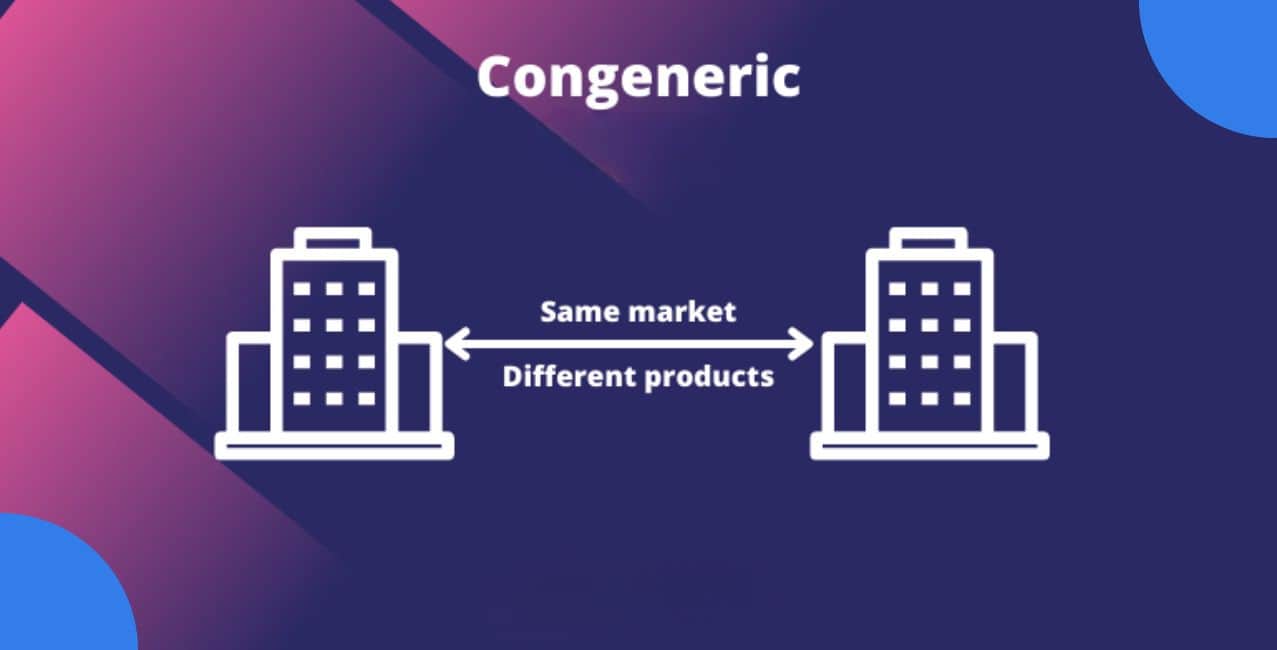
A congeneric merger meaning is when two companies that serve the same customers come together, even though they sell different but related products. They complement each other and create more value instead of competing with each other.
This type of merger helps businesses make better use of their existing customer base. Companies focus on offering more value to the customers they already have rather than entering new regions like a market extension merger.
For example, imagine a company that sells shoes merging with a company that makes socks. Both target similar customers, but their products are different. They can offer a complete solution and increase overall sales by joining forces. This is a simple congeneric merger example in real life.
This is different from a congeneric merger vs horizontal merger comparison, where a horizontal merger involves direct competitors. In contrast, a congeneric merger brings together businesses that complement each other rather than compete.
Example
A congeneric merger example in India could be a footwear brand acquiring a premium sock company. The brand strengthens its position with existing customers by offering related products instead of expanding into a new market like a market extension merger.
This approach avoids the risks involved in a congeneric merger vs horizontal merger, such as intense competition, and instead focuses on improving the customer experience.
Bonus Tip: Zomato’s Blinkit deal now drives growth, which shows how congeneric mergers expand services and boost customer value through shared logistics networks.
In a congeneric merger, both companies usually share similarities such as technology, production methods, or distribution channels. This makes integration smoother and more efficient. Once merged, one company’s products are added to the other’s offerings. This helps the combined business:
The goal is simple. Grow the business by offering more value to the same customers.
Besides congeneric mergers, companies can also merge through conglomerate, horizontal, or vertical strategies. Businesses often pursue mergers to grow, diversify their products, or reduce costs.
You can use smart merger strategies to help businesses grow, work more efficiently, and become stronger in the market.
One well-known example of a congeneric merger in India is Zomato's acquisition of Blinkit (formerly Grofers) in 2022. Both companies worked in the food and quick-commerce sectors. This deal helped Zomato use shared delivery technology and logistics, letting them offer 10-minute grocery delivery. This is considered a product-extension merger.
*T&C Apply
In India, congeneric mergers usually happen because companies want to combine their strengths in technology, marketing, and distribution to work more efficiently.
Congeneric mergers are a smart way for companies to grow by bringing together businesses that have the same customers but sell different products. Unlike horizontal or vertical mergers, these partnerships use existing relationships, technology, and distribution channels to offer more products and increase market share.
Merging businesses with different ownership histories, structuring equity step-ups or carve-outs, or giving up control in exchange for scale
When businesses with different owners merge, they need to agree on valuation, governance, and equity structures like step-ups or rollovers. This process creates a new, larger company and often means founders move from majority to minority control. Parent companies can also raise money by carving out or spinning off subsidiaries.
Is it that when we talk in terms of horizontal and vertical, we’re specifically referring to the supply chain?
In business, when people talk about growth, structure, or market strategy, the terms “horizontal” and “vertical” usually describe how a company relates to its supply chain or the industry value chain.
What are mergers?
A merger happens when two or more independent companies agree to join together and form a new company. This is usually done to gain a bigger share of the market, lower costs, or add new abilities. Most of the time, companies of similar size merge, often by exchanging stock. The new company aims to be more efficient, grow faster, and increase value for its shareholders.
What are the steps in a merger?
A merger involves several stages, such as developing a strategy, conducting due diligence, valuing the companies, getting legal approvals from authorities like the NCLT, and bringing the operations together. Important steps include preparing the amalgamation plan, getting approval from the board and shareholders, meeting regulatory requirements, and finally, combining the companies to work better together.
What are the two types of conglomerate?
A pure conglomerate is when companies with no business overlap join together, like a chemical company merging with a retail chain. A mixed conglomerate is when companies from unrelated industries merge to expand their products or markets, such as a tech company merging with a food company.




