Check AI Loan Optimisation Plans to Reduce Your EMI

Disclaimer: The information published on LoansJagat is intended for general informational and educational purposes only and should not be considered financial, legal, or investment advice. Interest rates, loan terms, statistics, and other data may change over time and may vary by lender or source. Please verify the latest information and consult a qualified financial advisor or the respective Bank/NBFC before making any financial decisions.
Subscribe Now
About the author

Diwaker Sharma is a finance content specialist with expertise in banking, personal finance, credit cards, loans, fintech, and financial news. An MBA in Finance with prior experience in the banking sector, he combines industry knowledge with SEO and content strategy to produce insightful, research-backed articles. Passionate about making finance accessible, he transforms complex financial concepts into clear, engaging content that empowers readers to make smarter financial decisions with confidence.
Related Blog Post

Pay Less EMI Every Month

1Cr+
Loans analysed by our AI

50Lacs+
Customers served

10,000+
Pincodes served

₹1,000Cr+
EMI savings delivered

1,400+ Google reviews

Quick Apply Loan
Consolidate your debts into one easy EMI.

Takes less than 2 minutes. No paperwork.

10 Lakhs+
Trusted Customers

2000 Cr+
Loans Disbursed

4.7/5
Google Reviews

50+
Banks & NBFCs Offers
Need cash urgently and think of using your Axis Bank credit card at an ATM? Most Axis Bank cardholders can do this, subject to their card variant and available cash limit. It does cost more than a regular card purchase, though. The bank usually charges a fee on the day you withdraw, interest typically starts the same day, and GST applies to both. Most Axis Bank credit cards charge 2.5% of the amount for cash withdrawal with a minimum charge of ₹500. Interest at 3.75% per month may be applicable from the day of withdrawal and 18% GST is added on top.
Key Takeaways
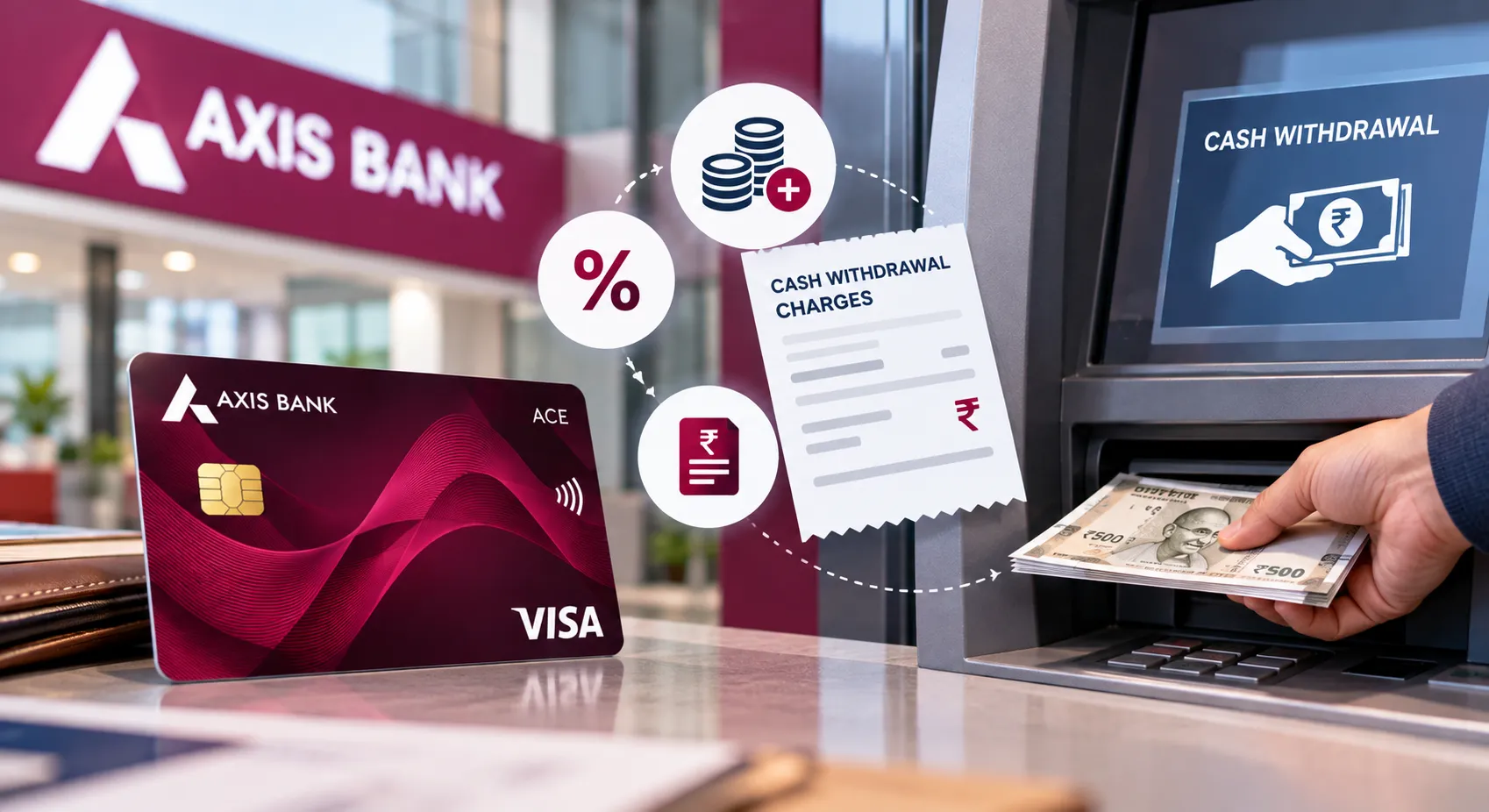
Axis Bank's cash withdrawal fee depends on the card you hold. Most cards follow the standard fee, while a few premium cards charge less or nothing at all.
Every Axis credit card cash withdrawal may attract three separate costs. Together, these make up the cash advance charges on your statement:
The minimum fee makes small withdrawals costly. Say you withdraw ₹4,000. The percentage-based fee would come to just ₹100, but Axis Bank charges the ₹500 minimum instead. That's 12.5% of the amount you took out.
So the percentage only starts to apply once you withdraw more than ₹20,000. Below that, you pay the flat ₹500.
On most Axis Bank cards, the annual interest rate on cash withdrawals is 55.55%. In the bank's example, this is charged at 3.75% a month, starting from the day you withdraw the cash.
When you pay your full bill on time, card purchases usually get 20 to 50 interest-free days, depending on when you made the transaction. Cash withdrawals don't get this break on most cards. Axis Bank charges interest on the withdrawn amount from the transaction date until you repay it. The exception is Burgundy Private – The One Card, which charges no interest on cash withdrawals until the payment due date.
The rate depends on your card. Here's what the Key Fact Sheet lists:
Repaying the cash within a few days keeps the interest low.
Five Axis Bank cards carry no cash withdrawal fee: Magnus, Magnus for Burgundy, Burgundy Private, Primus and Reserve. The Olympus card charges a lower fee.
Here's how the fee differs across cards, as listed in the Key Fact Sheet:
A nil fee doesn't always mean free cash. On most of these cards, interest still applies from the withdrawal date. Magnus and Reserve, for example, carry an annual rate of 42.58%. Burgundy Private – The One Card is the exception, as it charges no interest on cash withdrawals until the payment due date.
There's another catch for some premium cards. On Select, Reserve, Magnus and Magnus for Burgundy, cash withdrawals don't count towards the annual fee waiver spend target.
In Axis Bank's illustration in its Key Fact Sheet, a ₹4,000 cash withdrawal adds ₹648.20 in charges within 10 days. That's about 16% of the amount withdrawn.
In this example, a cardholder withdraws ₹4,000 on 2 April, and the statement is generated on 11 April. The bank works out the charges as follows:
Most of this cost comes from the flat fee and its GST. Interest grows every day until you repay. A 40-day delay would cost about four times the interest shown here by the same method.
Axis Bank cards usually come with a separate cash withdrawal limit. This limit forms part of your total credit limit and is typically lower than it.
According to the Key Fact Sheet, your cash advance limit is part of your overall credit limit. This means any cash you withdraw also reduces the amount left for card purchases.
Axis Bank doesn't publish one fixed cash limit for all cards. Your cash withdrawal limit depends on the bank's policy for your account. To check your cash withdrawal limit:
Add-on cardholders share the primary cardholder's credit limit. Any cash they withdraw also reduces the limit primary cardholders can use.
If you miss even the minimum amount due, Axis Bank may add a late payment fee on top of the interest. The fee depends on your outstanding amount.
Here are the late payment fee slabs from the Key Fact Sheet:
If you hold a Burgundy Private or Primus card, Axis Bank waives the late payment fee altogether. On other cards, the cost can keep growing if payments stay overdue. If you miss the minimum amount due for two billing cycles in a row, Axis Bank may add an extra ₹100 in each cycle until you clear the dues.
According to Axis Bank's Key Fact Sheet, your minimum amount due includes:
Since a cash withdrawal adds a fee, interest and GST, it can push up your minimum amount due for that month.

Repay the cash as early as you can, and avoid small withdrawals that trigger the ₹500 minimum fee. Both steps may cut the cost noticeably.
The following steps can help keep your Axis credit card fees down:
Following these steps can help you keep the cost of a cash withdrawal as low as possible, especially if you only need cash once in a while.
On most cards, you pay a withdrawal fee, interest from the day you take the cash and GST on top. Axis Bank's example shows how fast this adds up: ₹4,000 withdrawn on 2 April had built up ₹648.20 in charges by 11 April. Keep card cash for genuine emergencies, and repay it as soon as you can. If you need cash for a planned expense or for longer than a few weeks, a personal loan may work out cheaper. You can compare personal loan offers on LoansJagat from banks and NBFCs, and check each lender's rate and fees against your card's charges before deciding.
On most Axis Bank credit cards, the fee is 2.5% of the amount withdrawn, subject to a minimum of ₹500. You may also pay interest from the withdrawal date, along with 18% GST. Some premium cards charge a lower fee or none at all, so check your card's terms.
Cash withdrawn from an Axis Bank credit card does not get any interest-free days. The bank counts interest from the day you take out the cash, and it stops only when you repay.
Most Axis Bank credit cards list an annual interest rate of 55.55%. Axis Bank's example uses a rate of 3.75% a month.
Magnus, Magnus for Burgundy, Burgundy Private, Primus and Reserve credit cards carry no cash withdrawal fee. Interest may still apply on cash withdrawn using these cards.
The Axis Bank Olympus Credit Card charges a cash withdrawal fee of 2% of the amount. The minimum fee on this card is ₹300.
Yes, Axis Bank adds 18% GST to the cash withdrawal fee. GST at 18% also applies to the interest charged on the withdrawn amount.
You can check your cash withdrawal limit on your monthly Axis Bank credit card statement. You can also call Axis Bank customer care at 1800 103 5577.
Yes, a cash withdrawal reduces your available credit limit. The cash withdrawal limit is part of your overall credit limit on the Axis Bank credit card.
On Select, Reserve, Magnus and Magnus for Burgundy cards, cash withdrawals do not count towards the annual fee waiver spend target. Check your own card's terms for other variants.
Axis Bank may levy a late payment fee of ₹500 to ₹1,300 depending on the outstanding amount. Missing the minimum due for two cycles in a row may add ₹100 per cycle.
Start your journey today
Apply Now*T&C apply