Check AI Loan Optimisation Plans to Reduce Your EMI

Disclaimer: The information published on LoansJagat is intended for general informational and educational purposes only and should not be considered financial, legal, or investment advice. Interest rates, loan terms, statistics, and other data may change over time and may vary by lender or source. Please verify the latest information and consult a qualified financial advisor or the respective Bank/NBFC before making any financial decisions.
Subscribe Now
About the author

Diwaker Sharma is a finance content specialist with expertise in banking, personal finance, credit cards, loans, fintech, and financial news. An MBA in Finance with prior experience in the banking sector, he combines industry knowledge with SEO and content strategy to produce insightful, research-backed articles. Passionate about making finance accessible, he transforms complex financial concepts into clear, engaging content that empowers readers to make smarter financial decisions with confidence.
Related Blog Post
Simplify All Your Loans Into One Affordable EMI

Customers Served

Debt Consolidated

1200+ Reviews

Locations in India
Club all Loans & Credit Card Bills into Single EMI

Quick Apply Loan
Consolidate your debts into one easy EMI.

Takes less than 2 minutes. No paperwork.

10 Lakhs+
Trusted Customers

2000 Cr+
Loans Disbursed

4.7/5
Google Reviews

50+
Banks & NBFCs Offers
Other services mentioned in this article
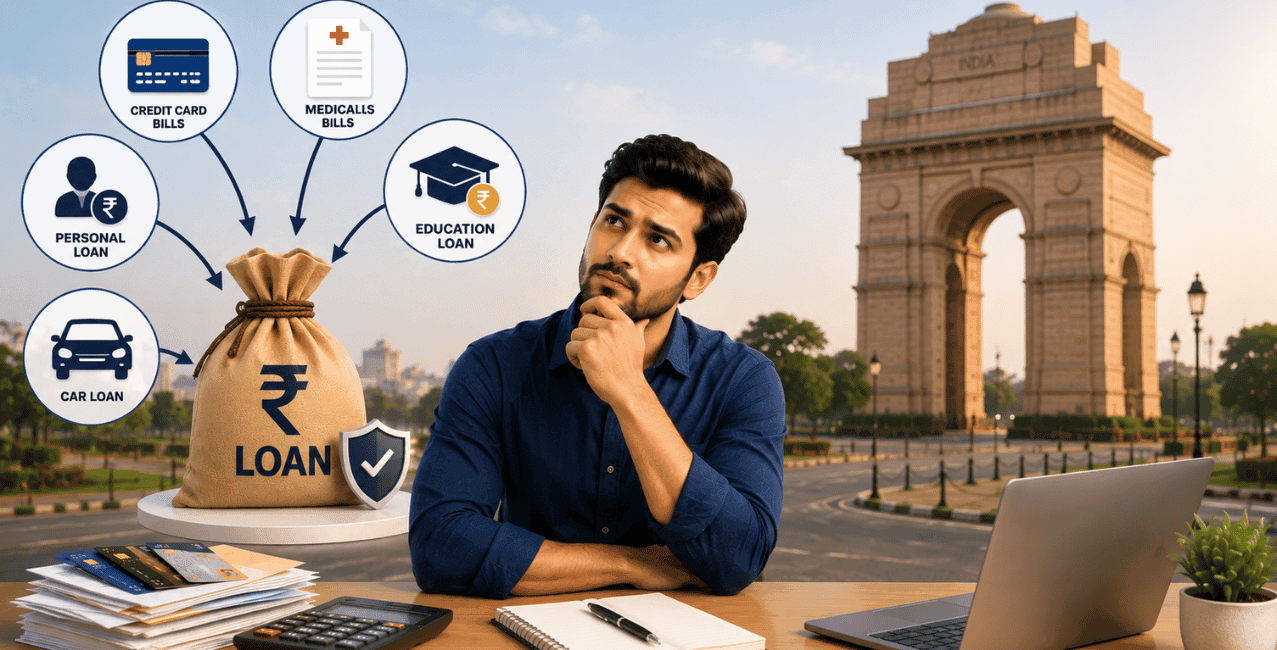
Paying two personal loan EMIs every month? Two EMIs mean two due dates, two interest rates and two lenders to follow up with. Yes, both loans can be combined. You can consolidate two personal loans by taking a debt consolidation loan, which pays off both existing balances. From the next month, you pay one EMI to one lender. Lenders approve this loan based on your income, credit score and past repayments.
Key Takeaways
Personal loan consolidation is the process of replacing two or more loans with a single new loan. After you close the old accounts, the new lender collects one EMI from you each month.
The new lender either pays your old lenders directly or credits the amount to your bank account. In the second case, you must close both loans yourself within the agreed time.
Consolidation doesn’t reduce what you owe, and it may increase the amount you borrow. The new loan has to cover the outstanding principal on both of your existing loans. Your old lenders may also charge foreclosure fees, which you may need to add to the new loan. If the new lender deducts its processing fee from the amount it pays out, you may need to borrow more to cover the full payoff.
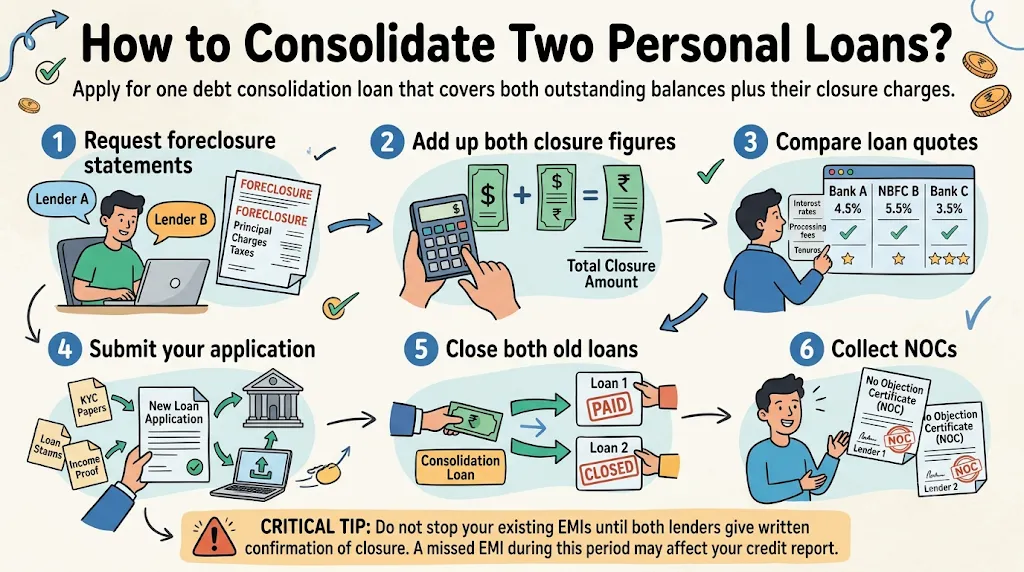
Apply for one debt consolidation loan that covers both outstanding balances plus their closure charges. Follow these steps:
Do not stop the existing EMIs until both lenders give written confirmation of closure. A missed EMI during this period may affect your credit report.
Will You Pay a Penalty for Closing Your Personal Loan Early?
Only if your loan has a fixed interest rate. A floating rate loan taken for personal use carries no such fee. Under RBI’s 2025 rules on pre-payment charges, lenders cannot charge this fee when an individual borrows at a floating rate for non-business needs.
Any loan sanctioned or renewed on or after 1 January 2026 falls under this rule. Fixed-rate loans are handled differently. Here, the lender can charge the foreclosure fee written in your loan agreement.
As per the same directions, lenders must state any prepayment charges in the sanction letter and the loan agreement. Where the lender is required to issue a Key Facts Statement (KFS), it must show these charges as well. Go through the sanction letter, agreement and KFS of each loan. These papers show the type of interest rate and the fee for closing the loan early.
Each old lender may charge you a foreclosure fee, and the new lender charges a processing fee. Banks add GST to both charges.
The table below lists personal loan foreclosure charges at three banks:
ICICI Bank’s processing fee is up to 2% of the loan amount, plus taxes. Ask both your current lenders for their exact charges, as these vary from bank to bank.
You save money only when the drop in interest is larger than the total charges you pay. A lower EMI does not confirm a lower total cost.
The example below uses these assumptions:
In this example, the EMI falls by about ₹2,615 a month. The total amount repaid, however, rises by about ₹25,700. The increase comes from the foreclosure charges, the processing fee and the 12 extra months added to Loan B.
Consolidation costs less when the new rate is well below the old rates, or when no foreclosure charges apply. Work out the numbers for your own loans before applying.
The effect on your CIBIL score depends mainly on how regularly you pay the new EMI. According to TransUnion CIBIL, a lender checking your report for a new loan application counts as a hard inquiry and impacts your score.
Applying with several lenders within a short period may add multiple hard inquiries to your report. On-time EMIs on the new loan can help build your repayment record. Confirm that both old loans are reported as “closed” and not “settled”.

Consolidation makes sense if it brings down your total cost, or if it replaces two EMIs with one at a similar total cost. See which of the following matches your loans:
Refer to the cost table above to check the foreclosure terms on your loans.
Managing the new loan well protects the benefit of consolidation. Use the following practices for the new loan:
A clean EMI record on the new loan can strengthen your next credit application.
Yes, you can replace two personal loans with one debt consolidation loan. Base your decision on the full amount you will repay, as a smaller EMI spread over a longer tenure may raise that amount. Get foreclosure statements from both lenders first. You can then compare offers from 50+ banks and NBFCs on LoansJagat and check your new EMI with its Debt Consolidation Calculator.
Yes, you can take a consolidation loan from the same bank or from a different lender to close both loans. Check with the bank whether foreclosure charges apply to early closure.
Yes, a consolidation lender can pay off loans held with two separate banks. You then repay one EMI to that lender.
Lenders generally ask for a CIBIL score of 700 or above to approve a debt consolidation loan. Applicants with lower scores may be rejected or offered a higher interest rate.
Lenders may hesitate to approve a consolidation loan if your credit report shows recent missed EMIs. Pay the overdue amount and keep up regular payments for a few months before you apply.
The time depends on the new lender’s verification and on how long both old lenders take to close the loans. Having your foreclosure statements and documents ready in advance can reduce delays.
A debt consolidation loan is a personal loan whose funds go towards repaying your existing debts. Many lenders offer it under their regular personal loan product.
Yes, many lenders allow credit card dues to be included with personal loans in one consolidation loan. This is useful when the card carries a higher interest rate than the loans.
Yes, the EMI drops with a longer tenure, but interest is charged for more months, which raises the total cost. Pick the shortest tenure whose EMI your monthly income can support.
Yes, banks generally add GST to foreclosure charges and processing fees on personal loans. Include GST when you calculate the total cost of consolidation.
Yes, you can close one loan with your savings and continue paying the other. Check the prepayment charges on that loan before you use your savings.
Start your journey today
Apply Now*T&C apply