By continuing, you agree to LoansJagat's Credit Report Terms of Use, Terms and Conditions, Privacy Policy, and authorize contact via Call, SMS, Email, or WhatsApp
The information published on LoansJagat is intended for general informational and educational purposes only and should not be considered financial, legal, or investment advice. Interest rates, loan terms, statistics, and other data may change over time and may vary by lender or source. Please verify the latest information and consult a qualified financial advisor or the respective Bank/NBFC before making any financial decisions.
Subscribe Now
About the author

Ananya Shrivastava
Ananya Shrivastava is a Content Writer specialising in finance-focused news, blogs, and long-form articles on Indian markets, RBI policy, personal finance, and lending. She has authored over 450 blogs and 250 news pieces, combining technical knowledge with rigorous research to simplify complex financial concepts into clear, engaging content. With a marketing-driven lens and sharp editorial judgment, she consistently achieves top Google rankings while ensuring every claim is backed by verified data.
Related Blog Post
Simplify All Your Loans Into One Affordable EMI

Customers Served

Debt Consolidated

1200+ Reviews

Locations in India
Club all Loans & Credit Card Bills into Single EMI

Quick Apply Loan
Consolidate your debts into one easy EMI.

Takes less than 2 minutes. No paperwork.

10 Lakhs+
Trusted Customers

2000 Cr+
Loans Disbursed

4.7/5
Google Reviews

50+
Banks & NBFCs Offers
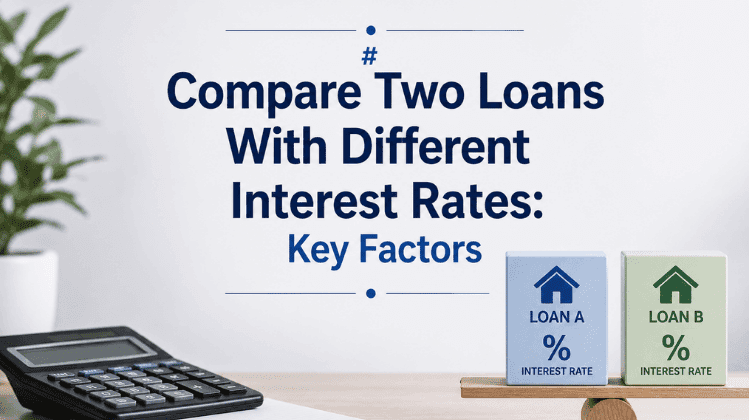
Comparing 2 loans with different interest rates means looking beyond the headline rate at the Annual Percentage Rate, or APR, since this figure includes processing fees and other charges alongside interest. Since April 2024, RBI has mandated that every lender issue a Key Fact Statement showing APR upfront, which makes side-by-side loan comparison possible.
Anyone weighing 2 loan offers from different lenders runs into a confusing situation. 1 loan has a lower interest rate, but the other has lower fees, so which actually costs less? This guide is for borrowers across India who want a clear way to compare loans with different interest rates, using official disclosures and calculators rather than guessing based on the rate alone.
You compare 2 loans with different interest rates by looking beyond the number itself. APR, total interest over the tenure, and every fee involved matter far more than the rate alone.
The advertised interest rate is just 1 piece of what a loan actually costs. Here's what else adds to your real cost of borrowing:
2 loans with identical interest rates can still cost meaningfully different amounts once these extras get factored in. The reverse holds. A loan with a slightly higher rate but lower fees can end up cheaper overall than one advertising a lower rate on its own.
APR, or Annual Percentage Rate, is the true annual cost of a loan. It folds the interest rate together with every other mandatory charge into 1 comparable figure.
Comparing APR figures directly, rather than the bare interest rate, is the single most reliable way to judge which loan costs less.
A Key Fact Statement, or KFS, is a standardised document every lender must now provide, showing your loan's APR, fees, and repayment terms in simple, comparable language.
RBI's notification confirms this requirement covers all new retail and MSME term loans sanctioned on or after October 1, 2024, including fresh loans to existing customers. The whole point of the KFS is to make comparing lenders actually possible. It skips the legal jargon so you're not stuck decoding a full loan agreement just to figure out what you'd owe. Here's what the KFS covers:
Since lenders can't charge you anything beyond what's disclosed in this document, requesting and comparing the KFS from 2 different lenders side by side gives you an apples-to-apples comparison.
Loan tenure changes total interest significantly, so 2 loans with different interest rates can only be fairly compared once matched to the same tenure.
If you're comparing a loan at 10% interest over 5 years against one at 11% interest over 3 years, the rate alone won't tell you which actually costs less, since the shorter tenure loan might carry lower total interest despite its higher rate.
Use official EMI calculators, like HDFC Bank's personal loan calculator or ICICI Bank's EMI calculator, and enter the same tenure for both offers. That's what shows you the real total interest difference, rather than comparing mismatched numbers.
Besides interest rate, you should compare processing fees, prepayment charges, foreclosure penalties, and any insurance tie-ins, since these directly affect your real cost of borrowing.
Here's what to check across both loan offers:
The KFS also requires disclosure of contingent charges like these, meaning you shouldn't need to hunt through a full loan agreement to find them anymore.
LoansJagat lets you compare loan offers from 50 plus partnered banks and NBFCs in 1 place, so you don't have to individually check APR, fees, and tenure across multiple lender websites yourself.
*T&C Apply
This matters specifically when you're weighing loans with different interest rates, since the platform surfaces the comparison you'd otherwise have to build manually from separate KFS documents and EMI calculators.
Take a borrower weighing a ₹5,00,000 personal loan from 2 different lenders, offered at different rates and fees.
On paper, Loan A already looks like the better deal, since it carries the lower rate. Running both through an official EMI calculator at the same 3 year tenure confirms this instinct holds.
Loan A's lower rate outweighs its higher processing fee, saving the borrower roughly ₹850 over the full tenure compared to Loan B. This is why checking the actual numbers matters more than assuming a lower processing fee automatically means a cheaper loan, since here the rate difference did the heavier lifting.
Comparing this many offers manually takes real effort, which LoansJagat simplifies by showing multiple lender offers together in 1 place.
Comparing 2 loans with different interest rates comes down to looking past the headline rate, checking the APR disclosed in each lender's Key Fact Statement, matching tenures before comparing total interest, and accounting for every fee involved. Since RBI's own 2024 mandate requires this disclosure from every lender, you now have the tools to make a genuinely informed comparison rather than guessing based on rate alone. Using a platform like LoansJagat to compare offers from 50-plus banks and NBFCs together saves you from manually cross-checking documents across multiple lenders one at a time.
Look at the APR, total interest at a matched tenure, and all fees, rather than judging based on the interest rate number alone.
APR, or Annual Percentage Rate, combines the interest rate with all other mandatory charges into a single figure representing the true annual cost of the loan.
A standardised document every lender must provide since October 2024, showing your loan's APR, fees, and repayment terms in simple language.
Yes, if its fees and charges are significantly lower than a competing loan with a lower rate, its APR can end up lower.
Longer tenure changes total interest paid, so comparing loans fairly requires matching them to the same tenure first.
Processing fees, prepayment or foreclosure charges, insurance tie-ins, late payment penalties, and switching charges should be compared besides the interest rate.
No, RBI's notification confirms lenders cannot charge additional amounts beyond what's disclosed in the KFS.
All new retail and MSME term loans sanctioned on or after October 1, 2024, including fresh loans to existing customers.
Use an official EMI calculator from the respective bank, entering the same tenure for both loans to make a fair comparison.
LoansJagat compares offers from 50 plus partnered banks and NBFCs together, letting you see rate, fee, and tenure differences in 1 place instead of checking each lender separately.