Check AI Loan Optimisation Plans to Reduce Your EMI

Disclaimer: The information published on LoansJagat is intended for general informational and educational purposes only and should not be considered financial, legal, or investment advice. Interest rates, loan terms, statistics, and other data may change over time and may vary by lender or source. Please verify the latest information and consult a qualified financial advisor or the respective Bank/NBFC before making any financial decisions.
Subscribe Now
About the author

Diwaker Sharma is a finance content specialist with expertise in banking, personal finance, credit cards, loans, fintech, and financial news. An MBA in Finance with prior experience in the banking sector, he combines industry knowledge with SEO and content strategy to produce insightful, research-backed articles. Passionate about making finance accessible, he transforms complex financial concepts into clear, engaging content that empowers readers to make smarter financial decisions with confidence.
Related Blog Post
Simplify All Your Loans Into One Affordable EMI

Customers Served

Debt Consolidated

1200+ Reviews

Locations in India
Club all Loans & Credit Card Bills into Single EMI

Quick Apply Loan
Consolidate your debts into one easy EMI.

Takes less than 2 minutes. No paperwork.

10 Lakhs+
Trusted Customers

2000 Cr+
Loans Disbursed

4.7/5
Google Reviews

50+
Banks & NBFCs Offers
Yes, one can also get a debt consolidation loan without a salary slip. This is because not all people are salaried employees; some have their own businesses or are self-employed. Several banks in India offer debt consolidation loans without a salary slip but require proof of income through sources like freelancing, bank statements, etc. Many people are not aware of it and can get confused about these parameters for eligibility. This is the major reason why LoansJagat provides well-explained and researched information to people, which is expert-verified.
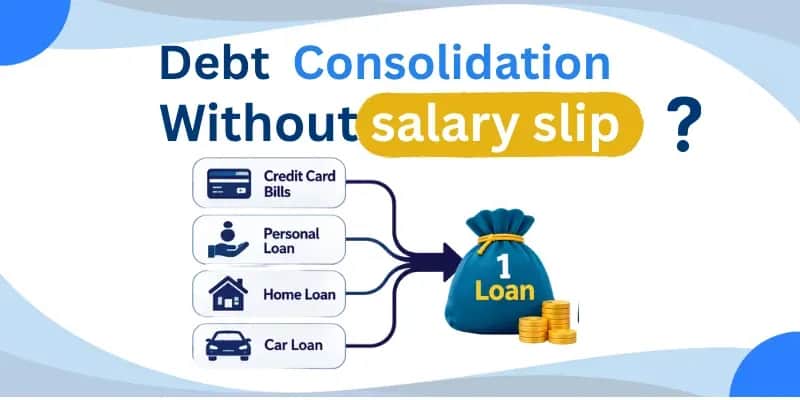
Debt consolidation means taking one new loan to clear several existing debts, so you repay a single EMI. A salary slip is not always mandatory. Some lenders may accept alternative income documents, such as bank statements and ITRs, instead of salary slips. However, eligibility and documentation requirements vary by lender. Lenders use these documents to check whether you can repay the new loan.
Key Takeaways

A salaried job isn’t always required for a debt consolidation loan. Some lenders also offer it to self-employed people, such as doctors, independent professionals, freelancers and business owners. In these cases, lenders usually ask for income tax returns, business bank statements and proof that the business or practice is running. Eligibility rules and rates can differ from those for salaried borrowers, so check each lender’s terms before applying.
There is one condition, though. The conditions become different if salary slips are not provided. You need to provide other income proofs to the lender.
Lenders are more careful when salary slips are missing. Here are 2 reasons behind this:
Because of this, you may be offered a smaller amount or a higher rate than a salaried applicant with full papers. Some lenders offer separate secured loan facilities against eligible financial assets, such as shares, mutual funds and certain insurance policies. However, these products have different eligibility and documentation requirements.
You may qualify for a debt consolidation loan if you meet the lender's income, credit score and other eligibility requirements. The table below shows the borrowers who most often apply without salary slips:
Eligibility criteria, including minimum income, age, credit score and FOIR requirements, vary across lenders.
Lenders also check your credit record, regardless of your income type. According to TransUnion CIBIL, making late payments or defaulting on your EMIs has a negative impact on your score.
You can usually submit identity proof, address proof and one or more income documents. Income and financial documents include bank statements, ITR filings, business financial records, GST documents, business registration proof, or professional practice documents.
The table below explains what each common document shows a lender:
You can have bank statements (3 – 6 months), passbook (3 – 6 months), increment or promotion letter, and certified letter from employer as income proof options.
For self-employed borrowers, applicants can provide their bank statements, ITR, P&L statements, registration proofs such as GST or Udyam, business licences and professional registration documents.
You can download your tax records from the Income Tax e-filing portal. From AY 2023-24 onwards, Form 26AS available on TRACES portal displays only TDS/TCS related data of the taxpayer. Other details pertaining to the taxpayer are available in the AIS.
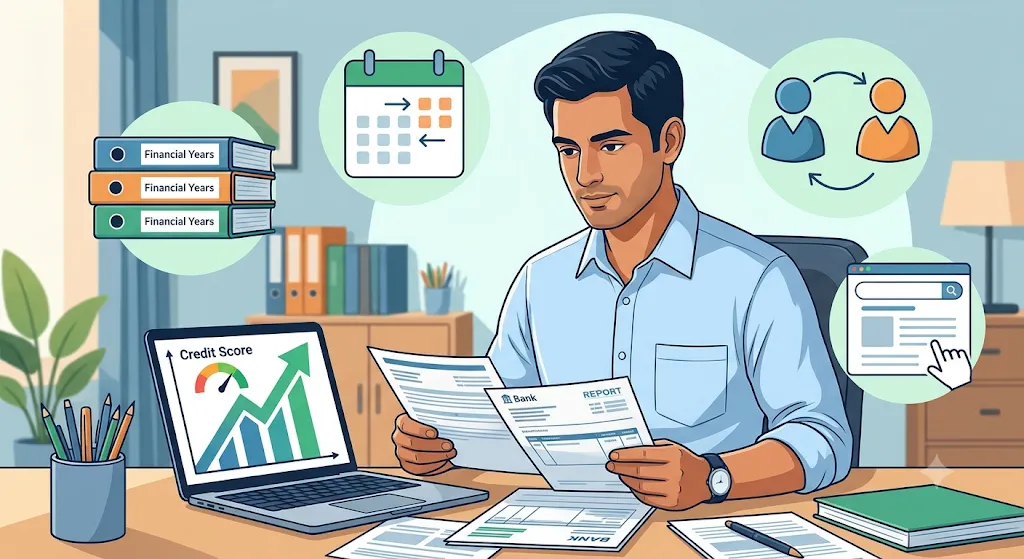
You can make up for a missing salary slip by strengthening the rest of your application. These steps help:
Not having a salary slip does not always stop you from getting a debt consolidation loan. Bank statements, ITRs, business records and tax statements can show lenders your repayment capacity instead. Gather these papers before you apply, and check your CIBIL report for errors. Then compare a few offers by APR and choose an EMI that fits your monthly income.
A salary slip isn’t always required for a debt consolidation loan. Many lenders accept other income proof, such as bank statements and ITRs, especially from self-employed borrowers.
Yes, self-employed individuals may qualify for a debt consolidation loan, subject to the lender's eligibility criteria. Instead of salary slips, they may need to submit income tax returns (ITRs), bank statements and business records to demonstrate their income and repayment capacity.
Most lenders ask for 3 to 6 months of bank statements. Self-employed borrowers may be asked for statements covering a longer period.
Bank statements show your income credits, spending pattern, and EMI outflows, which lenders use to evaluate your repayment capacity.
No, each bank or NBFC sets its own income, age and credit score rules for borrowers.
Yes, if the freelancer can show regular income. Bank statements with steady client payments and filed ITRs usually help most.
Applying to many lenders at once can affect your CIBIL score. According to TransUnion CIBIL, multiple enquiries in a short period may impact your score.
Form 26AS shows the tax deducted or collected on your income. AIS shows a wider view, including other financial transactions reported to the Income Tax Department.
No, a self-check is a soft inquiry and does not affect your score.
Yes, some lenders offer loans against shares, mutual funds, insurance policies or bonds. You could lose the pledged asset if you do not repay.
Start your journey today
Apply Now*T&C apply