By continuing, you agree to LoansJagat's Credit Report Terms of Use, Terms and Conditions, Privacy Policy, and authorize contact via Call, SMS, Email, or WhatsApp
The information published on LoansJagat is intended for general informational and educational purposes only and should not be considered financial, legal, or investment advice. Interest rates, loan terms, statistics, and other data may change over time and may vary by lender or source. Please verify the latest information and consult a qualified financial advisor or the respective Bank/NBFC before making any financial decisions.
Subscribe Now
About the author

Diwaker Sharma
Diwaker Sharma is a finance content specialist with expertise in banking, personal finance, credit cards, loans, fintech, and financial news. An MBA in Finance with prior experience in the banking sector, he combines industry knowledge with SEO and content strategy to produce insightful, research-backed articles. Passionate about making finance accessible, he transforms complex financial concepts into clear, engaging content that empowers readers to make smarter financial decisions with confidence.
Related Blog Post
Simplify All Your Loans Into One Affordable EMI

Customers Served

Debt Consolidated

1200+ Reviews

Locations in India
Club all Loans & Credit Card Bills into Single EMI

Quick Apply Loan
Consolidate your debts into one easy EMI.

Takes less than 2 minutes. No paperwork.

10 Lakhs+
Trusted Customers

2000 Cr+
Loans Disbursed

4.7/5
Google Reviews

50+
Banks & NBFCs Offers
Yes, you can, through a debt consolidation loan. One new loan clears both your existing personal loan and credit card balance at once. HDFC Bank and ICICI Bank both offer personal loans starting at 9.99% p.a., a fraction of the 30% to 40% annual interest most credit cards charge when you're carrying a balance.
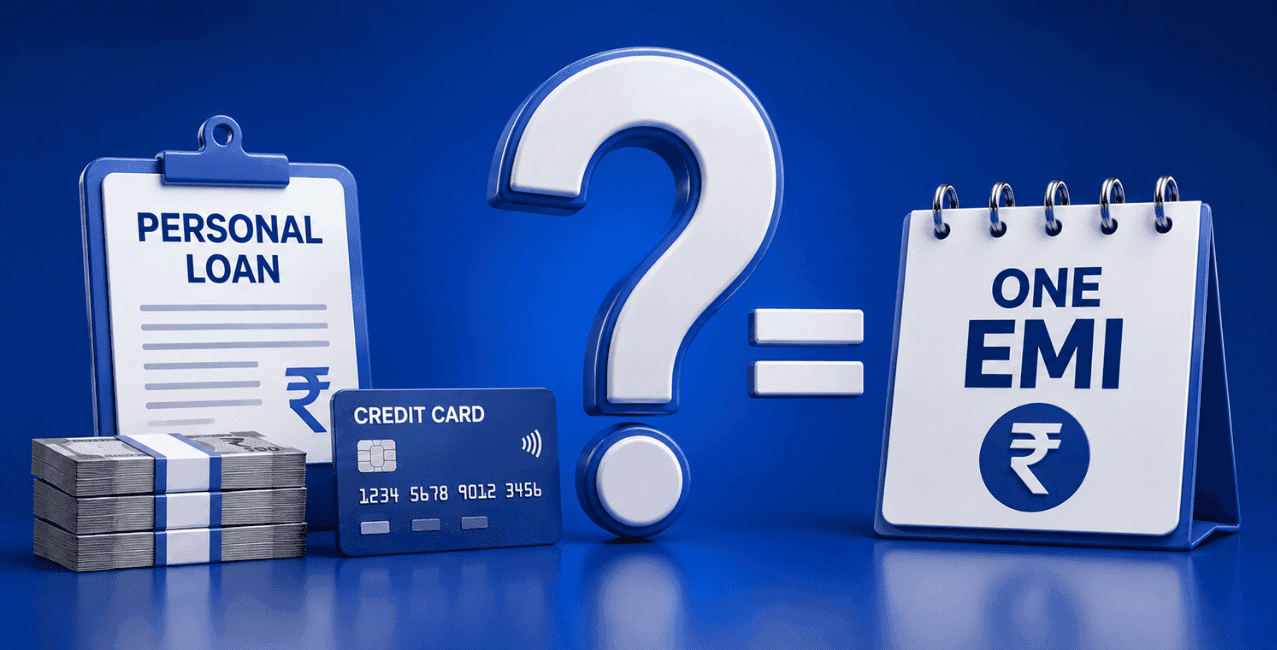
Juggling a personal loan EMI alongside a credit card bill, and eventually the question hits, can I combine personal loans and credit card debt into one EMI, especially once keeping track of two separate due dates starts wearing thin. This is for borrowers across India carrying both kinds of debt who want a straight answer, does consolidation actually work, how's it done, and what does it really cost compared to just paying both separately. We'll get into the mechanics, eligibility across a few banks, and a real cost comparison to help you figure out if this is worth doing.
Yes. A debt consolidation loan pays off both existing debts and replaces them with just 1 new loan.
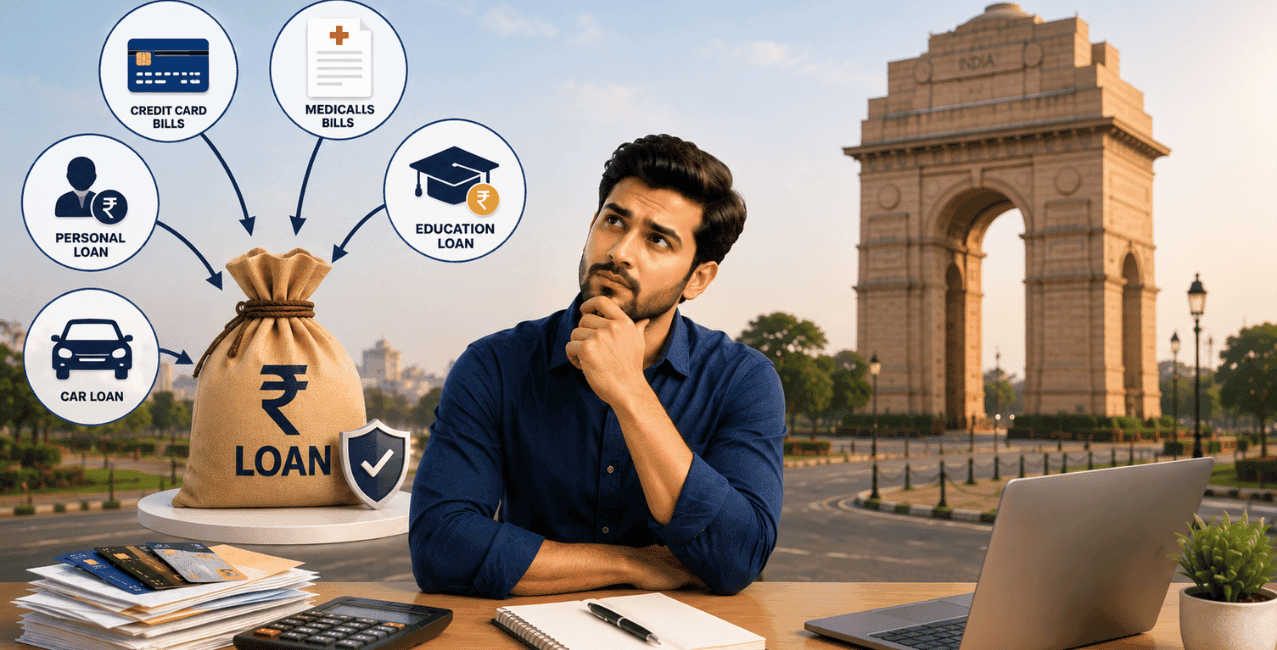
Here's the thing, a debt consolidation loan is really just a personal loan with a specific job, clearing off other debts instead of funding something new. The bank hands over the sanctioned amount, but that money doesn't land in your account to spend freely, it goes straight toward closing out your personal loan and paying off your credit card balance. What's left after that is 1 loan, 1 EMI, 1 due date, replacing whatever mess of payments you were juggling before.
Read Also : Existing EMIs Affect New Loan Eligibility: How to Improve It
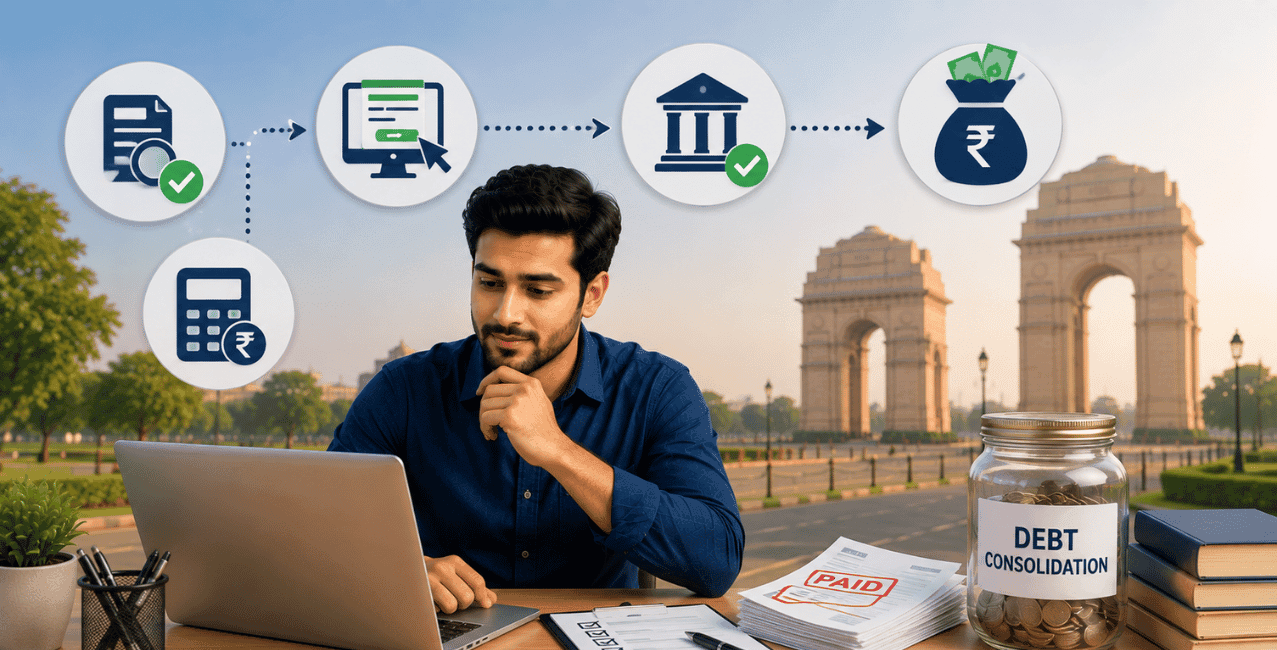
Can I Combine Personal Loans and Credit Card Debt Into One EMI? Or apply for a new loan to cover both your personal loan balance and credit card dues, and let the bank use that money to close both accounts.
Roughly how this goes:
HDFC Bank's own personal loan terms and ICICI Bank's eligibility page both confirm approval really just comes down to your income and credit profile, same as any standard personal loan. Nothing unusual about the process itself.
Pretty much the same criteria banks use for any personal loan, income, job stability, credit score.
Here's how a few major banks stack up:
Since you're asking the bank to pay off an existing personal loan and credit card balance at the same time, they'll likely look a bit closer at your debt to income ratio too, given they're handing you a bigger sanctioned amount than a typical single purpose loan.
Read Also : Employer Category and Personal Loan Eligibility: What Lenders Check
Usually less than paying both separately, since credit card interest sits well above what a consolidated personal loan charges.
Credit cards typically run 30% to 40% annually on whatever you haven't paid off. Compare that to HDFC Bank and ICICI Bank both starting at 9.99% p.a. for well qualified borrowers, or SBI at 10.00%. That gap right there is where the actual savings come from, shift your expensive card balance onto a much cheaper rate, and your total interest cost drops, even factoring in whatever rate your original personal loan already carried.
Paying both separately means juggling 2 different rates and 2 different due dates. Consolidating merges everything into 1 payment at 1 rate.
*T&C Apply
Consolidated EMI
Sanjay's 34, works in sales in Pune, and he's been juggling a personal loan EMI of ₹9,000 alongside a credit card balance of ₹1,50,000, on which he's only managing the minimum due of ₹6,500 a month. His personal loan still has ₹1,80,000 outstanding, and his credit card is charging him 36% a year on whatever's unpaid.
He goes to ICICI Bank for a debt consolidation loan of ₹3,30,000, enough to cover both, and gets approved at 11% p.a. over 4 years. His new EMI works out to around ₹8,530 a month, down from the ₹15,500 he was paying across both before. And beyond the lower monthly number, he's also stopped bleeding that 36% annual interest that kept growing his card balance every month it sat unpaid.
Now compare Meera, 30, a teacher in Chennai carrying similar debt, who goes to SBI instead. Since SBI's starting rate sits at 10.00% p.a., a touch higher than what Sanjay got at ICICI Bank, her final EMI lands slightly different, which just goes to show, comparing rates across a couple of lenders before committing genuinely changes what you actually save.
Combining personal loans and credit card debt into 1 EMI is real, and doable, through a debt consolidation loan, and it often cuts your total interest cost by a meaningful margin, since credit cards run 30% to 40% while consolidated loans through HDFC Bank, ICICI Bank, or SBI can start under 11% for qualified borrowers.
Works best when your credit card balance is really what's driving your monthly outflow, since that's where shifting to a cheaper rate saves you the most. Before you apply anywhere, run the numbers on total interest across a few lenders against just sticking with both debts separately.