By continuing, you agree to LoansJagat's Credit Report Terms of Use, Terms and Conditions, Privacy Policy, and authorize contact via Call, SMS, Email, or WhatsApp
Disclaimer: The information published on LoansJagat is intended for general informational and educational purposes only and should not be considered financial, legal, or investment advice. Interest rates, loan terms, statistics, and other data may change over time and may vary by lender or source. Please verify the latest information and consult a qualified financial advisor or the respective Bank/NBFC before making any financial decisions.
Subscribe Now
About the author

Vaishnavi kale
Vaishnavi is a Financial Content Writer at LoansJagat. She holds a B.Sc. and an M.Sc. She has experience in writing SEO-focused content across finance, digital marketing, education, and Ayurveda. Before joining LoansJagat, she worked with digital marketing agencies serving fintech clients and quick-commerce brands like Zepto and blinkit. At LoansJagat, Vaishnavi writes on banking, loans, personal finance, and insurance. Her work involves researching financial topics, understanding user search intent, and creating content that is clear and accurate. She has experience in SEO content writing, keyword research, content optimisation, and AEO. She enjoys simplifying complex topics into practical information that readers can easily understand and use. She believes that well-researched and reliable content plays an important role in helping people make informed financial decisions.
Related Blog Post
Simplify All Your Loans Into One Affordable EMI

Customers Served

Debt Consolidated

1200+ Reviews

Locations in India
Club all Loans & Credit Card Bills into Single EMI

Quick Apply Loan
Consolidate your debts into one easy EMI.

Takes less than 2 minutes. No paperwork.

10 Lakhs+
Trusted Customers

2000 Cr+
Loans Disbursed

4.7/5
Google Reviews

50+
Banks & NBFCs Offers
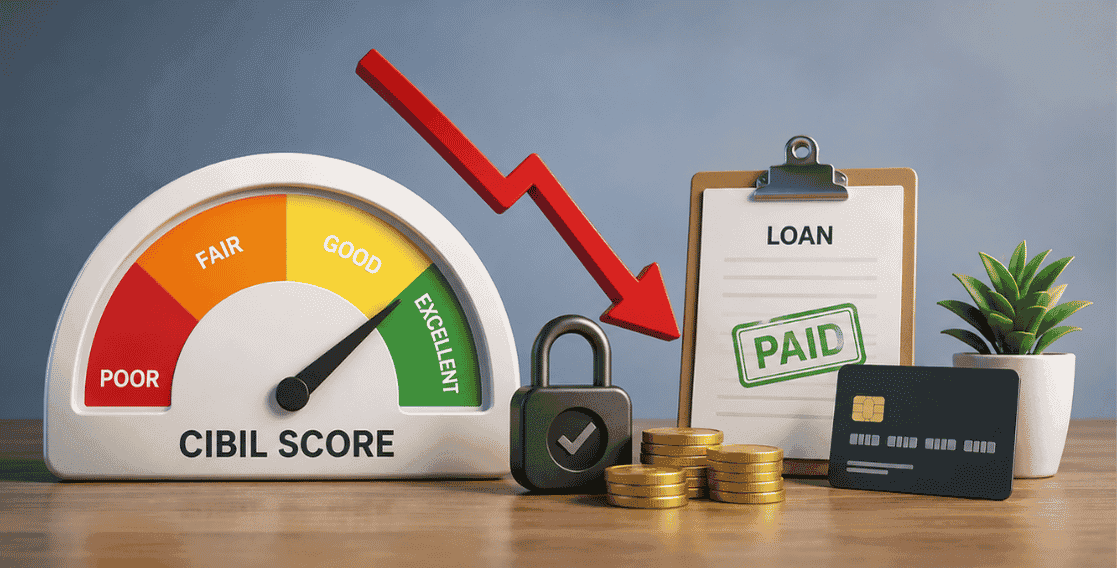
After repaying the whole loan amount, it's natural to expect an increase in CIBIL score. But in reality, this doesn't happen. When you repay your debt, a drop in CIBIL score is very common. There are many reasons behind this. It can happen due to factors such as credit history, payment history, past repayment behavior, and credit mix. Hence, it is crucial to exercise caution in this regard. To know more about this topic, stay connected with Loansjagat.
TransUnion CIBIL is a credit information company; it issues your CIBIL report. This report shows your CIBIL score, which is based on your credit history and repayment behaviour. When you go for a new loan, banks or lenders use this CIBIL score to assess your creditworthiness. Here are some factors that affect your CIBIL report.
Credit utilisation is the percentage of your available usage of the credit card that you are currently using. It has a high impact on your CIBIL score. Normally, you can use up to 30% of your credit card limit. How it affects your CIBIL score:
Example:
You should use less than 30% of the credit card amount. It is considered a healthy score.
If you have paid the loan, your CIBIL can still drop because of a change in credit utilisation ratio.
Suppose you repay your personal loan and close it. Now your only remaining loan is a heavily used credit card. So it will calculate your CIBIL score based on that. If your credit card balance is high compared to its credit limit, your credit utilisation ratio remains high, which can negatively affect your CIBIL score.
If you close a credit card after repaying its outstanding balance, your total available credit limit decreases. If your spending on the remaining credit card stays the same, your credit utilisation ratio increases. This can lower your CIBIL score.
1. Before loan closure
2. After loan closure (You closed a ₹1,00,000 credit card)
Now you have paid the loan, but your credit utilisation ratio has increased. This can negatively affect your CIBIL score.
Credit mix refers to the variety of loan types, including credit cards, personal loans, home loans, car loans, and education loans. Getting a lot of loans and credit cards within a short period of time also affects your CIBIL score. Your score can be decreased. It has a positive side too. If you have a lot of loans, it shows your lender that you can handle multiple loans.
Types of credit:
Applying for multiple loans can negatively affect your CIBIL report because every new loan can result in a new enquiry. A healthy credit mix is important, but not handling these loans can lead to lower CIBIL scores.
Also Read: Who is eligible for a debt consolidation loan?
When you close your account, your credit mix changes. And it affects your CIBIL score. But why does it happen?
Your payment history also affects your CIBIL score. When you go for a loan, lenders can check your payment history. If you miss it and delay payment it negatively affects your CIBIL score.
Your payment history and status as "Settled" instead of "Closed” is also a big reason why your CIBIL score drops even after repaying a Loan. Settling means you have paid less than the borrowed amount. And closed means you have completed the loan by paying fully.
So, if you want to avoid this situation, you need to check your CIBIL report after paying the loan. Ensure that your account is “closed”, not “settled”.
When Lenders see your CIBIL report, they check whether your repayment behaviour was disciplined or not. Even if you have paid the full loan, late payments and missing EMIs continue to appear in your CIBIL report. That's why your CIBIL score drops.
If you have a longer credit history, it shows your lender that you have used credit responsibly for a long time. They can understand your repayment habits and financial discipline.
How it helps:
Your closed loan accounts remain on the CIBIL report. That's why closing a loan does not erase your credit history.
Credit history is also a big reason why CIBIL Score drops even after paying debt. Why does it happen? Let me tell you.
Suppose you have paid one of the oldest debt credit accounts. It will reduce the average credit history. This will affect your CIBIL score. When you have few active credit accounts, lenders have less credit history to assess. That's why your CIBIL score gets affected.
Loan repayment lessens your stress, but it doesn't mean that your CIBIL score is improved instantly. Your repayment details are not updated instantly. Lenders take 30 to 60 days to update your repayment details with the credit bureaus. In some cases, CIBIL scores start dropping before increasing. Actually, increasing your CIBIL score is a gradual process. So it takes time to change the score.
If you are also going through this situation, you can follow these things to increase your CIBIL score.
High credit score debt management is important for maintaining financial health. Improving your CIBIL score isn't an instant process; it takes time. You should be patient with this process.
You may feel my stress has gone by repaying the full amount of debt, which is valid. But it is not always positive. Sometimes it can result in a drop in CIBIL score. Behind this, there are a lot of reasons like your credit utilisation ratio, credit mix, payment history, and the length of your credit history. Actually, this change isn't permanent. It is a temporary drop. It can improve over time.
If you want to maintain your CIBIL score even after paying off debt, you should pay your EMIs and credit card bills on time and keep your credit utilisation low. Also, regularly check your credit report for errors and avoid unnecessary loan or credit card applications.
There are many reasons behind this. When you pay off your loan, there is less credit history, and if you have missed the EMIs or delayed them, these things affect your CIBIL report. As a result, your CIBIL score drops even after repaying the loan.
In many cases, this happens, so it is normal for your CIBIL score to decrease after repaying debt. But this problem isn't permanent. Your CIBIL score increases with time if you are financially disciplined.
Your CIBIL score increases after some time of repayment. But the drop lasts for 30 to 60 days.
Yes, it is possible but for a short period of time. When you pay with a credit card, there is a short credit history that can affect your CIBIL score.
Yes, a drop in CIBIL score after paying off debt is normal. But if you stay financially disciplined, do not take a new loan or credit card, and pay EMIs and bills on time, your CIBIL score can improve over time.
Yes, it definitely affects your credit history. When you pay off the oldest loan and close it. Now you have a short credit history that affects your CIBIL score.
Yes, when you repay a loan, it can affect your CIBIL score temporarily. But over time it improves.
You should take care of some important things after repaying a debt. You should pay EMIs on time, do not take a new loan or credit card, do not close your credit card, and try to keep your loan status as “closed” instead of “settled”
Yes, it remains on your CIBIL report for some time.
No, paying off your loan is a good thing. This is better for the long term. It can decrease your CIBIL score, but this is temporary.