By continuing, you agree to LoansJagat's Credit Report Terms of Use, Terms and Conditions, Privacy Policy, and authorize contact via Call, SMS, Email, or WhatsApp
The information published on LoansJagat is intended for general informational and educational purposes only and should not be considered financial, legal, or investment advice. Interest rates, loan terms, statistics, and other data may change over time and may vary by lender or source. Please verify the latest information and consult a qualified financial advisor or the respective Bank/NBFC before making any financial decisions.
Subscribe Now
About the author

Anishka Bhadly
Anishka Bhadly is a content writer with a finance and business background. She has completed her bachelor's degree with a specialisation in finance and is currently pursuing an MBA in the finance field too. The knowledge she has gained from her studies and experience working with EdTech companies helped her combine theoretical knowledge with practical industry insight. Her expertise lies in creating well-researched, informative, and reader-friendly content in various banking, personal finance, loans, insurance, and investment-related topics.
Related Blog Post
Simplify All Your Loans Into One Affordable EMI

Customers Served

Debt Consolidated

1200+ Reviews

Locations in India
Club all Loans & Credit Card Bills into Single EMI

Quick Apply Loan
Consolidate your debts into one easy EMI.

Takes less than 2 minutes. No paperwork.

10 Lakhs+
Trusted Customers

2000 Cr+
Loans Disbursed

4.7/5
Google Reviews

50+
Banks & NBFCs Offers
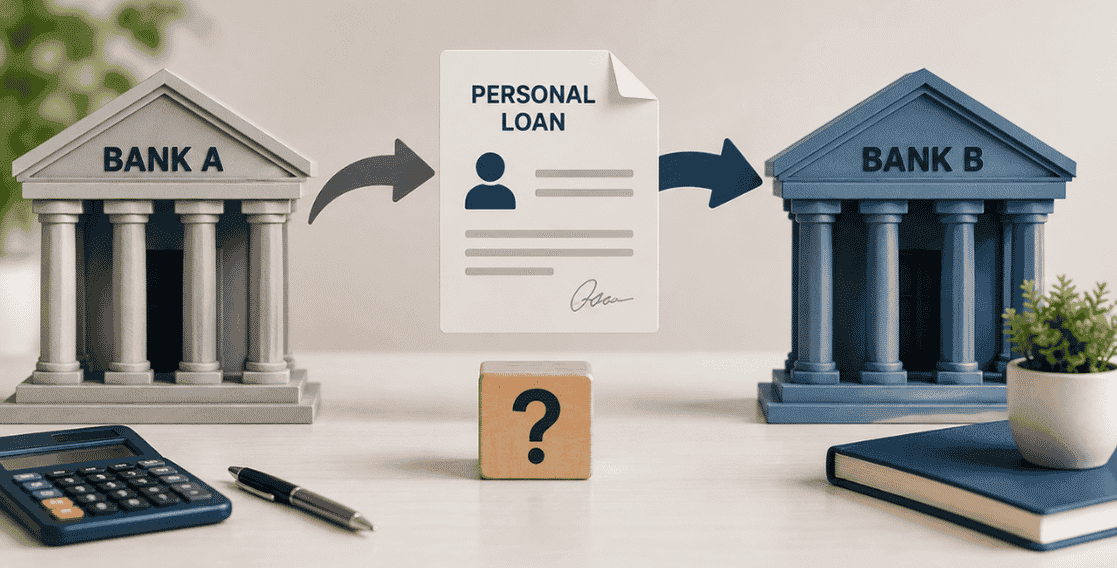
Yes, you can transfer your personal loan to another bank. The process of personal loan transfer can be easily done through “Personal Loan Balance Transfer”. The balance transfer option allows borrowers to shift their remaining loan amount from the current lender to a new bank that offers better terms. Some lenders provide lower interest rates, smaller EMIs, or a longer repayment period, which can be a plus point for most borrowers. Before the process is completed, the new bank checks your credit score, income, repayment history, outstanding amount, etc., to provide a better opportunity. Very important advice for borrowers is to always compare processing fees, foreclosure charges, and other costs to ensure the transfer actually helps you save money on the overall borrowing cost.
Key Takeaways:
In simple words, a personal loan balance transfer is a financial facility that allows borrowers to shift their existing personal loan from one bank to a different financial institution. Most borrowers choose this option, as lenders offer a lower interest rate, better repayment terms, and other such benefits. Basically, instead of paying your current lender, the new lender will pay off your outstanding loan amount, and then you need to repay the new lender as per their agreement.
For example, you have a personal loan with “Bank A” at 16% per year, and another bank is offering you the same amount at 13% per year. If the borrower meets the eligibility criteria, the new bank will clear their existing loan, and all future EMIs will be paid to the new lender. The main purpose of this tool is to reduce the overall cost and make repayment easier for you. This is where official platforms like LoansJagat help you check which option will be the best suit for you.
The process of balance transfer is very simple and can be done by following a few steps:
The process is very straightforward; however, comparing fees, foreclosure charges, and other expenses can make the switch much smoother.
Here are some major benefits that borrowers receive from using the loan balance transfer process:
This is one of the biggest reasons for getting a loan balance transfer. Even a small reduction can change the whole agreement and lead to significant savings over the remaining loan period.
A lower interest rate automatically changes the monthly EMI into a much smaller amount. This can reduce the financial burden and improve monthly cash flow.
Most lenders in the financial market allow borrowers to increase or decrease the repayment period. This is because:
Major banks provide some additional benefits to borrowers, like:
Many lenders offer to apply for an additional amount during the balance transfer process, known as a top-up loan, and it can be useful for emergencies, medical expenses, education, or home renovation.
Hence, these are the benefits of a loan balance transfer.
Most people transfer their loan because it helps them manage their finances better through lower interest and a longer tenure. Some lenders in the market also offer flexible repayment options, top-up loans, and lower EMIs to help the borrower. Here are some common reasons why people consider transferring a personal loan:
Many people, especially borrowers, always look forward to getting relief from their monthly EMIs, even if it's just a 1% or 2% cut in their interest rates, and this is where transferring a loan can be a good option.
Most people get confused between both of these terms. There is a slight difference between them.
These are the differences between personal loan balance transfer and loan refinancing:
*T&C Apply
Move your existing loan to another lender.
Both of them aim to reduce the borrowing costs; however, the better choice still depends on the interest offered, fees, and the borrower's financial goals.
A balance transfer is often found more beneficial during the early years of loan approval because a larger portion of the EMI goes towards the interest during that period. You can also consider transferring the loan if:
The above-mentioned pointers might have given you some hope if you are also stuck in the debt loop and want to get out of it. Loan transfer may feel very confusing at first, but in the long run, it can provide a lot of benefits to the borrowers.
Here are some pointers that will help you make the right decision if you want to choose a balance transfer or not:
Before making a solid decision, borrowers must keep these things in mind and follow them. Getting out of the financial trap may not be a one-night magic, but these small steps can make the process faster and more efficient.
A balance transfer process is suitable in situations like:
Many borrowers face issues with interest rates and monthly EMI amounts; this is why they might consider applying for a personal loan transfer.
One of the smartest ways of reducing your loan burden is a personal loan balance transfer. Through the balance transfer loan, borrowers can easily reduce their loan burden via lower interest rates, lower monthly EMI, and longer tenures. Lower interest can be the main attraction here, but you should always check the processing charges, foreclosure costs, repayment flexibility, and the remaining loan tenure before making a solid decision. Check offers on different banks with the help of LoansJagat instead of choosing the first available option. And, if the total savings are meaningful and the new loan term is a better fit, you can transfer your personal loan to help you manage repayments more efficiently.
One of the smartest ways of reducing your loan burden is Personal Loan Balance Transfer. Through the balance transfer loan borrowers can easily reduce their loan burden via lower interest rates, lower monthly EMI, and longer tenures. Lower interest can be the main attraction here, but you should always check the processing charges, foreclosure costs, repayment flexibility and the remaining loan tenure before making a solid decision. Check offers on different banks with the help of LoansJagat instead of choosing the first available option. And, if the total savings are meaningful and the new loan term is a better suit, you can transfer your personal loan can help you manage repayments more efficiently.
Is it good to transfer a personal loan to another bank?
Yes, but only if the new lender is offering a lower interest rate, reduced EMI< and better repayments terms to ensure the savings are higher.
Can I transfer a personal loan to a different bank?
Yes, most NBFCs and banks offer a personal loan balance transfer facility, but the approval depends on your credit score, income, and repayment history.
Can I transfer my existing loan to another bank?
Yes, you can transfer an existing personal loan after meeting the new lender’s eligibility criteria.
Does balance transfer affect CIBIL?
A balance transfer can cause a temporary drop because of the hard inquiry process, however, timely EMI payments after the transfer can improve the credit score over time.
Is my loan RBI approved?
RBI never approves the individual loans, it is a body that regulates banks and NBFCs that provide loans under applicable banking guidelines.
Can a balance transfer get rejected?
Your application can get rejected because of a low credit score, unstable income, high debt, or poor repayment history.
What are the negatives of a balance transfer?
It involves processing fees, foreclosure charges, and documentation costs, but if savings are minimal, the transfer may not be worthwhile.
How to know if balance transfer is approved?
The new lender will send a direct notification through SMS, email, phone call, or via online portal along with the revised loan agreement.
Why has my balance transfer failed?
The most common reason for failed balance transfer can be low eligibility, incomplete documents, poor credit history, or failure to meet the lender's internal policies.
How to check balance transfer eligibility?
You can check eligibility by visiting the lender’s website or using the eligibility calculator available online. Lenders often assess your credit score, income, employment, and existing loan details for eligibility.