By continuing, you agree to LoansJagat's Credit Report Terms of Use, Terms and Conditions, Privacy Policy, and authorize contact via Call, SMS, Email, or WhatsApp
Disclaimer: The information published on LoansJagat is intended for general informational and educational purposes only and should not be considered financial, legal, or investment advice. Interest rates, loan terms, statistics, and other data may change over time and may vary by lender or source. Please verify the latest information and consult a qualified financial advisor or the respective Bank/NBFC before making any financial decisions.
Subscribe Now
About the author

Darshana Patel
Darshana Patel is a finance and tech writer with a strong background in journalism, financial economics, and political science, working with Loans Jagat. She has immense experience writing content through her previous work in fintech and edtech companies. Her contribution at Loans Jagat is to simplify finance-backed content and academically powered content for the readers.
Related Blog Post
Simplify All Your Loans Into One Affordable EMI

Customers Served

Debt Consolidated

1200+ Reviews

Locations in India
Club all Loans & Credit Card Bills into Single EMI

Quick Apply Loan
Consolidate your debts into one easy EMI.

Takes less than 2 minutes. No paperwork.

10 Lakhs+
Trusted Customers

2000 Cr+
Loans Disbursed

4.7/5
Google Reviews

50+
Banks & NBFCs Offers
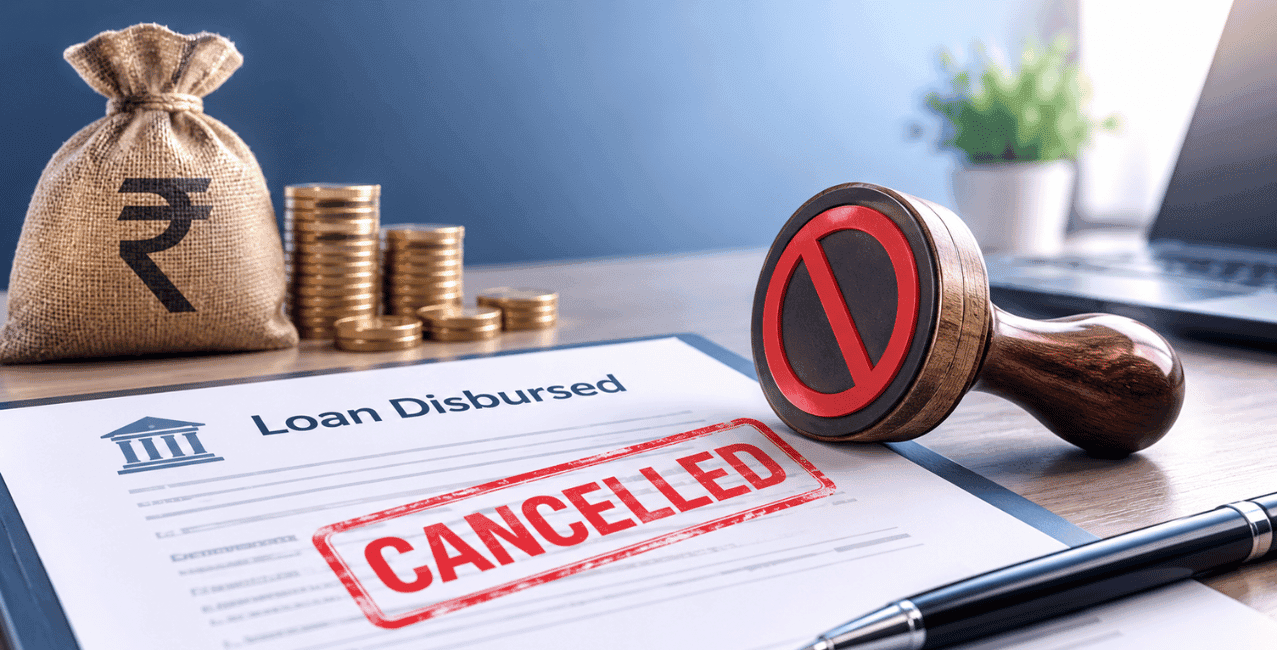
Yes, you can cancel a loan after disbursement. But every lender follows their own policy for cancelling the loan after disbursement. In short, every lender or bank offers certain terms and conditions for cancelling a loan after disbursement. Several lenders give a cooling-off period to people after the loan disbursement to cancel the loan. The whole process can be very complex and varies from bank to bank. The process of cancelling the loan after disbursement is known as loan termination. Cancelling the loan after disbursement can cause you more than you think.
There can be multiple common reasons for cancelling the loan after disbursement from the borrower’s side.
Hence, these are the reasons why people cancel the loans after the disbursement in many cases.
The cooling-off period is a small opportunity provided by several lenders after the loan is sanctioned. This gives the borrower a chance to call off the loan as soon as they can within the cooling-off timeframe without penalty. This is important because any time due to financial stress, people apply for the loan impulsively. The cooling-off period is meant to safeguard consumers, especially those who might have made a decision to borrow a loan on impulse or when compelled under duress.
Hence, this is why a cooling-off period is necessary for the borrower after the loan disbursement.
One needs to follow a few critical steps to cancel the loan after the disbursement. The process varies from lender to lender.
Hence, this is how you can cancel the loan after the loan is disbursed.
If you cancel the loan within the cooling-off period right after disbursement, then it will not majorly impact your credit score. But after the cooling-off period, if you cancel your loan on any terms, then that could heavily impact your credit score.
*T&C Apply
Hence, this is how your loan cancellation will impact your credit score.
Borrowers often cancel the loan once it gets disbursed due to several reasons, like other financial sources, etc. The lender often provides a cooling-off period to the borrower in case they change their mind and call off the loan after disbursement. If one closes the loan within the cooling-off time frame, no penalties are applied to the borrower, but if they do so after the cooling-off period passes, they might be subject to heavy penalties. Hence, cancelling the loan has a different impact on the credit score, which is not very harsh if done within the cooling-off period.
Loan disbursement refers to the action of the bank releasing the loan amount into your bank account.
No, not every bank provides the same cooling-off period for the borrower; this timeframe may vary from one bank to another.
No, loan cancellation within the cooling-off period does not create an impact on the credit score.
Yes, one can cancel the loan after the cooling-off period, but it will not be called a loan cancellation; instead, it is called loan foreclosure or prepayment.
No, typically one does not need to pay a penalty if one cancels the loan within the cooling-off period.
Yes, one can usually apply for another loan after cancelling the previous loan.
Yes, the lender provides certain terms and conditions for the loan cancellation to the borrower, even if it is within the cooling-off period.
People cancel the loan after disbursement because they get a better offer from another bank, they get better financial sources, or the terms and conditions become unacceptable to the borrower after the loan is sanctioned.
The first step one needs to take is to go through the loan agreement to see the cooling-off period timeframe or any terms and conditions provided by the lender for loan cancellation.
No, loan cancellation does not increase the risk of loan settlement, as they are completely different concepts in banking.