By continuing, you agree to LoansJagat's Credit Report Terms of Use, Terms and Conditions, Privacy Policy, and authorize contact via Call, SMS, Email, or WhatsApp
Disclaimer: The information published on LoansJagat is intended for general informational and educational purposes only and should not be considered financial, legal, or investment advice. Interest rates, loan terms, statistics, and other data may change over time and may vary by lender or source. Please verify the latest information and consult a qualified financial advisor or the respective Bank/NBFC before making any financial decisions.
Subscribe Now
About the author

Diwaker Sharma is a finance content specialist with expertise in banking, personal finance, credit cards, loans, fintech, and financial news. An MBA in Finance with prior experience in the banking sector, he combines industry knowledge with SEO and content strategy to produce insightful, research-backed articles. Passionate about making finance accessible, he transforms complex financial concepts into clear, engaging content that empowers readers to make smarter financial decisions with confidence.
Related Blog Post
Simplify All Your Loans Into One Affordable EMI

Customers Served

Debt Consolidated

1200+ Reviews

Locations in India
Club all Loans & Credit Card Bills into Single EMI

Quick Apply Loan
Consolidate your debts into one easy EMI.

Takes less than 2 minutes. No paperwork.

10 Lakhs+
Trusted Customers

2000 Cr+
Loans Disbursed

4.7/5
Google Reviews

50+
Banks & NBFCs Offers
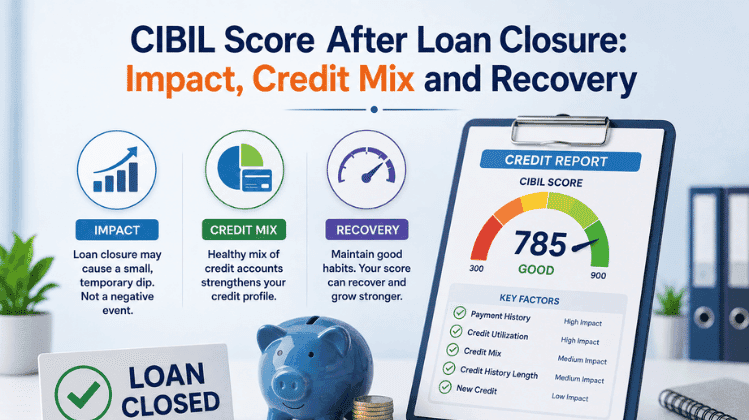
Closing a loan can cause a small, temporary dip in your CIBIL score, since it affects your credit mix and slightly changes your account activity, but the impact is usually minor if your other accounts stay in good standing. According to CIBIL's own official page, your score is calculated mainly using Payment History, Credit utilisation, Age of Credit, and Enquiries, and closing a loan touches several of these factors at once.
Closing a loan should feel like a win, and financially it genuinely is, but plenty of borrowers notice their CIBIL score shift slightly right after. This piece breaks down exactly why that happens, which specific score factors get affected, and whether it's actually something worth worrying about.
Your CIBIL score can dip slightly after closing a loan because it changes your credit mix, reduces your number of active accounts, and shifts the overall picture lenders see of your ongoing credit activity.
According to CIBIL's own official page, your score is calculated mainly using Payment History, Credit utilisation, Age of Credit, and Enquiries. Closing a loan directly touches at least 2 of these, your credit mix, since 1 fewer active account now sits on your report, and potentially your credit utilisation picture, if that closed loan was a large chunk of your overall credit exposure. This isn't a sign anything went wrong, it's simply how the scoring model reacts to a genuine change in your credit profile.
Payment history continues benefiting your score even after closure, since a fully repaid loan with no missed payments remains a positive entry on your credit record.
According to CIBIL's own understanding document, payment history shows how consistently you've made payments on time and in full, and late or missed payments negatively impact your score. A closed loan with a clean repayment record doesn't disappear from your history, it stays reflected on your report as a positive account, continuing to support your score even though the loan itself is no longer active. This is precisely why a properly closed loan, especially 1 repaid entirely on schedule, shouldn't be viewed as something that hurts your long-term credit standing.
Credit mix changes once you close a loan because you now hold 1 fewer active account, potentially shifting the balance between your secured and unsecured credit exposure.
According to CIBIL's own blog on credit mix, credit mix refers to the combination of different types of credit you've used over time, split between secured credit, like home loans, automobile loans, or loans against fixed deposits, and unsecured credit, like personal loans and credit cards. If the loan you just closed was your only secured credit account, your remaining active accounts might now lean entirely unsecured, which the same CIBIL source notes is generally viewed less favourably than a balanced mix. Here's what to keep in mind:
A balanced mix, per CIBIL's own guidance, generally supports a stronger score than relying heavily on 1 credit type.
Closing a loan doesn't erase its contribution to your credit history's age, since the account remains on your report as closed, continuing to count toward your overall credit age even after settlement.
Your length of credit history reflects how long you've actively managed credit accounts, and this factor rewards stability and a longer track record. A closed account, provided it was managed responsibly, still contributes to this history rather than vanishing entirely from your record the moment it's settled. The genuine impact here is more subtle, if the closed loan was your oldest active account, your average account age across remaining active accounts might shift slightly, but the historical record of that account itself continues to matter.
Credit enquiries don't directly result from closing a loan, but any subsequent loan applications you make shortly after closure can add fresh enquiries that interact with your score independently of the closure itself.
According to CIBIL's own blog, multiple enquiries may have a negative impact on your score, since they indicate your loan burden may go up in the future. If you're closing 1 loan and simultaneously applying for another, it's worth understanding these are 2 separate factors interacting with your score at once, the closure affecting your credit mix and account count, and the new application triggering a fresh enquiry, rather than assuming any score movement is caused by the closure alone.
You generally shouldn't worry about a temporary dip after loan closure, since this movement tends to be minor and typically recovers as your remaining accounts continue showing consistent, on-time payment behaviour.
Since your score reflects an ongoing pattern rather than a single snapshot, a small shift immediately after closure usually corrects itself within a few reporting cycles, provided you continue managing your remaining credit responsibly. According to CIBIL's own guidance for maintaining a healthy score, consistently paying bills on time and keeping credit utilisation low remain the strongest levers for maintaining or rebuilding your score, regardless of any short-term fluctuation triggered by a loan closure.
You should check that your closed loan actually shows as "Closed" rather than "Active" on your report, and confirm the account reflects zero outstanding balance, since reporting errors here can genuinely affect your score longer than the closure itself would.
Here's what to verify:
Overall score trend: Track your score across a few months post-closure to confirm any dip is genuinely temporary rather than tied to an unrelated error.
Understanding how each factor shifts helps you separate a normal, expected change from a genuine error worth disputing.
Take a borrower who closes their only car loan, their sole secured credit account, while still holding 2 personal loans and a credit card. A month later, checking their score, they notice a small dip and initially assume something went wrong. Reviewing their report against CIBIL's own explanation of credit mix, they realise their remaining active accounts are now entirely unsecured, explaining the shift without indicating any actual error.
They confirm the car loan correctly shows as "Closed" with zero outstanding balance, and over the following months, as their remaining accounts continue showing consistent on-time payments, their score gradually recovers. Anyone managing multiple loans and wanting a clearer picture of how each one contributes to their credit profile can also check a resource like LoansJagat to stay organised across their active and closed accounts.
Closing a loan can cause a small, temporary shift in your CIBIL score, mainly through changes to your credit mix and account activity, but a properly closed loan with a clean repayment record remains a genuine positive on your credit history overall. Since factors like payment history and age of credit continue reflecting your closed account rather than erasing it, this dip typically recovers on its own as your remaining accounts keep showing responsible, on-time behaviour. Checking that your closed loan reports correctly, showing "Closed" status with zero outstanding balance, remains the most important step to take right after any closure.
It can dip slightly, since closing a loan changes your credit mix and reduces your number of active accounts, but the impact is usually minor and temporary.
Yes, a fully repaid loan with no missed payments remains a positive entry on your credit report, continuing to support your score.
Because a balanced mix of secured and unsecured credit is generally viewed favourably, and closing your only secured loan can temporarily shift this balance.
No, the closed account remains on your report and continues contributing to your overall credit history, even though it's no longer active.
Generally not, since this movement tends to be minor and usually recovers as your remaining accounts continue showing consistent, on-time payments.
Confirm the account shows "Closed" status, zero outstanding balance, and accurate Days Past Due history.
Yes, since a fresh application triggers a new credit enquiry, which is a separate factor from the closure itself and can add its own impact.
A balanced combination of secured credit, like home or auto loans, and unsecured credit, like personal loans and credit cards.
It varies, but consistent on-time payments on your remaining accounts generally help your score stabilise over a few reporting cycles.
Directly through CIBIL's own official website, which lists Payment History, Credit utilisation, Age of Credit, and Enquiries as the main factors.