By continuing, you agree to LoansJagat's Credit Report Terms of Use, Terms and Conditions, Privacy Policy, and authorize contact via Call, SMS, Email, or WhatsApp
Disclaimer: The information published on LoansJagat is intended for general informational and educational purposes only and should not be considered financial, legal, or investment advice. Interest rates, loan terms, statistics, and other data may change over time and may vary by lender or source. Please verify the latest information and consult a qualified financial advisor or the respective Bank/NBFC before making any financial decisions.
Subscribe Now
About the author

Darshana Patel is a finance and tech writer with a strong background in journalism, financial economics, and political science, working with Loans Jagat. She has immense experience writing content through her previous work in fintech and edtech companies. Her contribution at Loans Jagat is to simplify finance-backed content and academically powered content for the readers.
Related Blog Post
Simplify All Your Loans Into One Affordable EMI

Customers Served

Debt Consolidated

1200+ Reviews

Locations in India
Club all Loans & Credit Card Bills into Single EMI

Quick Apply Loan
Consolidate your debts into one easy EMI.

Takes less than 2 minutes. No paperwork.

10 Lakhs+
Trusted Customers

2000 Cr+
Loans Disbursed

4.7/5
Google Reviews

50+
Banks & NBFCs Offers
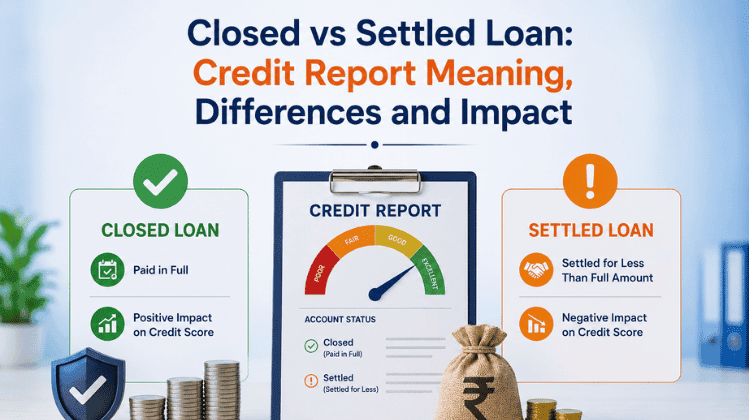
Closed loan' and 'loan settlement' have different meanings in banking terms. A closed loan simply means the loan has been fully repaid according to the agreed terms and conditions. Whereas loan settlement means the borrower has done the partial payment of the loan with the lender’s permission due to financial instability. In the banking field, both loan closure and loan settlement are different and opposite to each other. Each of these acts upon the situation of the borrower. A closed loan means paying the complete outstanding loan amount to the lender legally, and loan settlement is not able to meet the loan repayment margin and paying a lower amount of the loan to the lender with mutual agreement.
Loan closure is the action by the borrower to pay the complete loan amount to the lender, including the interest and all applicable charges, and nothing to owe in the future. This is also marked as a loan closed in the borrower's credit report, which positively impacts a person's credit score.
After the loan is successfully closed by the borrower, the lender issues a ‘no objection certificate’ to the borrower mentioning the same. Loan closure takes place either by paying the last EMI to the lender or by paying the complete amount before the loan tenure ends. This complete payment before the loan tenure is known as foreclosure of the loan, which will again be marked as 'loan closed’ in the credit report of the borrower.
A closed loan mark usually helps to build the credit score and impacts it positively for the bank to give further loans.
Hence, this is what a loan closure is and the advantages one can get after closing the loan successfully.
Loan settlement is the action of the borrower paying a partial or lesser loan amount to the lender with the lender's permission due to financial hardship. Loan settlement is mainly practised when the borrower faces immense financial stress, and he/she is not able to pay the next instalment at all.
Moreover, loan settlement has a negative impact on the borrower’s credit score, making it a barrier for them to obtain the next loan. Borrowers need to take a pause and focus on rebuilding their credit score after loan settlement because it heavily damages the credit score. The credit report of the borrower will also mark the loan as a settled loan.
Hence, this is how loan settlement impacts the borrower.
The difference between loan closure and loan settlement is very broad, like two opposite directions. It is necessary that one should know the difference between them to take essential steps according to their financial situations.
*T&C Apply
Hence, these are the key differences between loan settlement and loan closure.
Loan settlement and loan closure are two opposite concepts in banking in the banking field. It’s important to understand that loan closure is when the borrower pays the complete amount to the lender, including all other charges and interest. Whereas loan settlement is when the borrower pays less than the actual loan amount to the lender with their permission due to financial hardship. Hence, a closed loan positively impacts the borrower’s credit report, opening the gates for future loans, whereas loan settlement is seen as negative on the borrower’s credit report.
Loan settlement is done when the borrower faces immense financial hardship to pay the complete loan amount and instead pays only a partial loan amount to the lender with their permission.
No, loan settlement never helps rebuild a credit score, in fact it crashes the credit score more than an average credit range.
This is totally dependent on the lender’s will. If the lender is providing the loan, then the interest rate can be very high, and terms can be very strict due to a low credit score.
Yes, loan closure is seen as a positive mark on the credit report by the bank when providing a future loan to the borrower.
Foreclosure refers to the complete payment of the loan before the tenure ends. This is not seen as negative because the borrower pays the complete outstanding loan amount to the lender, including all charges and interest, before the tenure completes.
Yes, loan closure positively impacts the credit report because it shows future lenders that you are a highly responsible and financially disciplined borrower.
The primary advantage of a loan settlement is that it provides immediate financial relief by legally wiping out your debt for a fraction of the total amount owed.
Loan closure positively impacts a credit report by updating the account status to "Closed" or "Paid in Full" and preserving your flawless payment track record.
The similarity between loan settlement and loan closure is that both actions permanently stop your monthly EMI obligations and legally terminate your relationship with the lender for that specific debt.
No, loan settlement cannot be practised without the lender’s permission. It strictly requires the lender’s approval to settle the loan during financial hardship faced by the borrower.