By continuing, you agree to LoansJagat's Credit Report Terms of Use, Terms and Conditions, Privacy Policy, and authorize contact via Call, SMS, Email, or WhatsApp
The information published on LoansJagat is intended for general informational and educational purposes only and should not be considered financial, legal, or investment advice. Interest rates, loan terms, statistics, and other data may change over time and may vary by lender or source. Please verify the latest information and consult a qualified financial advisor or the respective Bank/NBFC before making any financial decisions.
Subscribe Now
About the author

Diwaker Sharma is a finance content specialist with expertise in banking, personal finance, credit cards, loans, fintech, and financial news. An MBA in Finance with prior experience in the banking sector, he combines industry knowledge with SEO and content strategy to produce insightful, research-backed articles. Passionate about making finance accessible, he transforms complex financial concepts into clear, engaging content that empowers readers to make smarter financial decisions with confidence.
Related Blog Post
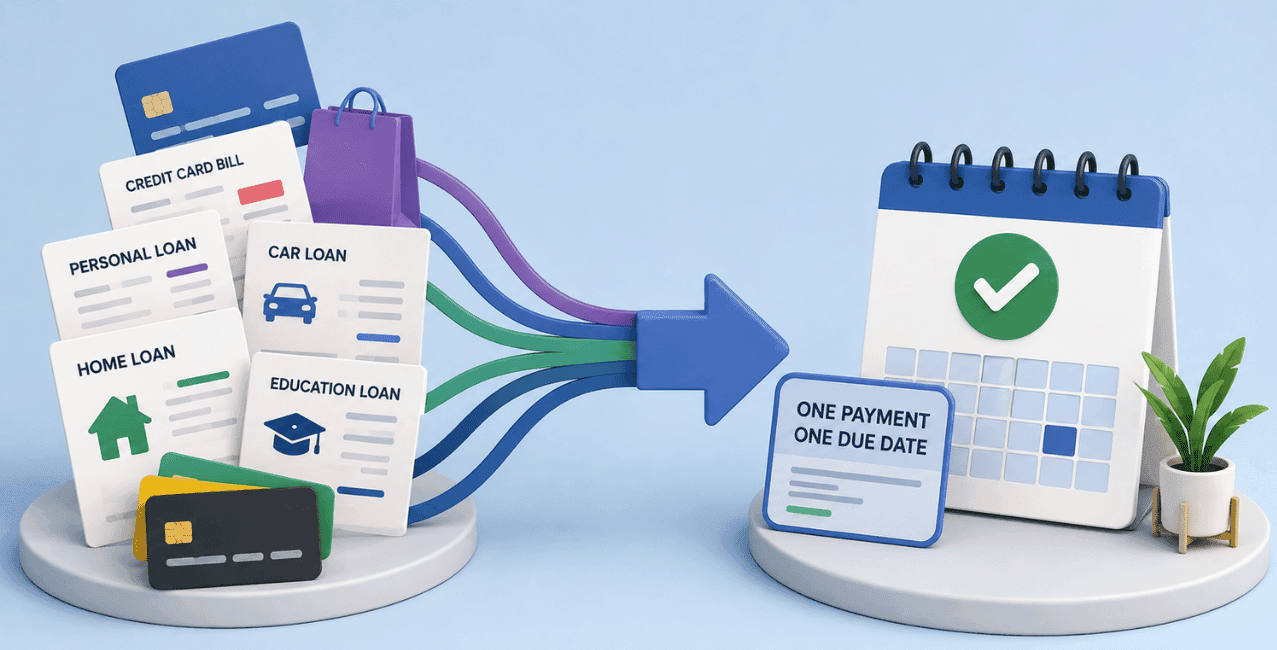
Simplify All Your Loans Into One Affordable EMI

Customers Served

Debt Consolidated

1200+ Reviews

Locations in India
Club all Loans & Credit Card Bills into Single EMI

Quick Apply Loan
Consolidate your debts into one easy EMI.

Takes less than 2 minutes. No paperwork.

10 Lakhs+
Trusted Customers

2000 Cr+
Loans Disbursed

4.7/5
Google Reviews

50+
Banks & NBFCs Offers
The effective cost of a loan, the Annual Percentage Rate or APR, folds your interest rate together with every other mandatory charge, processing fees, insurance, and penalties, into 1 yearly percentage. The RBI has required every lender to disclose this figure through a standardised Key Fact Statement on all new retail and MSME loans.
Compare a few loan offers, and it doesn't take long to realise the advertised rate isn't really telling you the whole story. This is for borrowers across India who want a real, accurate way to work out a loan's effective cost, using actual disclosures and formulas rather than just going by the headline rate.
The true annual cost of borrowing, your interest rate plus every other mandatory charge, rolled into 1 number known as the Annual Percentage Rate, or APR.
Reporting on RBI's April 2024 notification describes APR as the annual cost of credit to the borrower, interest rate and every other charge tied to that credit facility, all combined. Here's why that matters, 2 loans quoting an identical interest rate can end up costing very different amounts once you factor in processing fees, documentation charges, and whatever else gets added on. The rate you see advertised is really just a starting point, not the number that actually decides your final bill.
Interest rate, processing fee, documentation charges, any insurance tied to the loan, and prepayment or foreclosure penalties, that's roughly the full list.
Here's what typically piles on top of your interest rate:
Per industry guidance on Key Fact Statements, lenders now have to spell out contingent charges, penalties, foreclosure, and switching separately inside this document. No more digging through a full loan agreement just to find them.
Add up your total interest and total fees, then divide that number by your loan principal. This gives you a simplified, single-year approximation of APR, not the precise formula used for multi-year loans, since a proper APR calculation needs to account for how your fees and interest spread across your actual tenure.
Here's the simplified formula, valid specifically for a 1-year loan:
APR (1 year loan) = [(Total Interest + Total Fees) / Loan Principal] × 100
Say you take a loan of ₹1,00,000 at a nominal 10% annual rate for exactly 1 year, with a ₹2,000 processing fee attached. Your interest alone comes to ₹10,000. Add the ₹2,000 fee, and you're at ₹12,000 total. Divide that by your ₹1,00,000 principal, multiply by 100, and you land at 12%, quite a bit higher than the 10% you were originally quoted. Since this example runs for exactly 1 year, that 12% figure directly represents the APR for this specific loan, but the same shortcut doesn't hold once your tenure stretches beyond a year.
For loans running multiple years, the fee portion needs to be annualised, spread proportionally across your tenure, rather than added to a single year's interest as a lump sum. A ₹2,000 fee on a 1-year loan hits your APR harder than the same ₹2,000 fee on a 5-year loan, since it's effectively a smaller addition once averaged across more years. This is exactly why lenders use a more detailed, tenure-adjusted calculation, reflected in the Key Fact Statement's own APR figure, rather than the simplified version shown here. Treat this formula as a quick, directional estimate for a 1-year loan specifically, and rely on your lender's disclosed APR in the KFS for anything longer.
The Key Fact Statement, or KFS, already has your loan's calculated APR sitting right in it, so you usually don't even need to run the formula yourself.
Per RBI's own notification, this covers every new retail and MSME term loan sanctioned from October 1, 2024 onward, including existing customers taking fresh loans. The same source confirms the KFS has to stay valid for at least 3 working days on loans running 7 days or longer, giving you actual time to look it over before signing anything. Since the document already carries a computation sheet showing exactly how APR and the amortisation schedule got worked out, checking the lender's own numbers against a quick calculation of your own is a smart way to catch anything that doesn't add up.
Quite a lot, actually, since a longer tenure spreads interest across more months, and your total interest paid climbs even if the EMI itself feels lighter.
Go shorter on tenure, and you're looking at higher EMIs but less total interest overall. Stretch it out, and your monthly burden eases while your total cost across the loan's life climbs. Pull up an official EMI calculator, HDFC Bank's or ICICI Bank's own work fine, enter your loan amount and rate, then just adjust the tenure. You'll see immediately how much your total interest and effective cost, along with it, shift with each extra year you tack on.
Because it only reflects the interest piece, ignoring processing fees, insurance costs, and everything else that adds to what you actually end up paying.
Here's how the two stack up side by side:
Since 2 lenders can quote you the exact same nominal rate while charging wildly different fees on the side, comparing APR figures, not nominal rates, is really the only reliable way to know which loan actually costs less.
Picture a borrower comparing 2 personal loan offers of ₹3,00,000 each, both quoted at 11% nominal interest over a 2 year tenure. Lender A charges a ₹6,000 processing fee. Lender B charges just ₹2,000, but tacks on a mandatory ₹4,500 insurance premium tied to the loan. On paper, both look identical, same rate, after all.
*T&C Apply
Loan amount
Once the borrower checks both Key Fact Statements, required under RBI's 2024 mandate, the actual effective cost gap turns out to be roughly 0.2 percentage points, not the ₹500 difference in fees alone. Lender A still comes out marginally cheaper once APR is properly calculated, but the margin is a lot slimmer than just comparing add-on costs would suggest, which is exactly why running the full calculation matters more than eyeballing the fee line items. Want to run this kind of comparison across several lenders at once instead of doing it one by one? LoansJagat pulls together offers from 50-plus banks and NBFCs, making it a lot easier to spot these effective cost gaps without checking each lender separately.
Calculating the effective cost of a loan really just means looking past the nominal rate and tallying up every fee, insurance charge, and penalty that actually touches what you pay. Since RBI's 2024 mandate now forces every lender to disclose APR through a standardised Key Fact Statement, you've got direct access to this number without needing to work it out entirely by hand. Compare APR, not just the rate on the ad, across every offer you're weighing, and that's genuinely the most accurate way to know your real borrowing cost before you sign anything.