By continuing, you agree to LoansJagat's Credit Report Terms of Use, Terms and Conditions, Privacy Policy, and authorize contact via Call, SMS, Email, or WhatsApp
Disclaimer: The information published on LoansJagat is intended for general informational and educational purposes only and should not be considered financial, legal, or investment advice. Interest rates, loan terms, statistics, and other data may change over time and may vary by lender or source. Please verify the latest information and consult a qualified financial advisor or the respective Bank/NBFC before making any financial decisions.
Subscribe Now
About the author

Vidhi Chauhan
Vidhi Chauhan is a copywriter and content writer with extensive experience creating high-quality, SEO-driven content across multiple industries, with a strong focus on fintech. She has written extensively on GST, banking, personal loans, business loans, credit cards, income tax, insurance, and other financial topics, helping Indian readers understand complex concepts through clear, accurate, and engaging content.
Related Blog Post
Simplify All Your Loans Into One Affordable EMI

Customers Served

Debt Consolidated

1200+ Reviews

Locations in India
Club all Loans & Credit Card Bills into Single EMI

Quick Apply Loan
Consolidate your debts into one easy EMI.

Takes less than 2 minutes. No paperwork.

10 Lakhs+
Trusted Customers

2000 Cr+
Loans Disbursed

4.7/5
Google Reviews

50+
Banks & NBFCs Offers
Borrowers are responsible for repaying the loan to lenders. Banks want to know whether a borrower can comfortably repay a loan. So they use FOIR (Fixed Obligation to Income Ratio) to know that borrowers can really repay the loan. When you apply for a new loan, lenders check your existing EMIs and other liabilities. FOIR helps them understand how much money is left after paying your existing obligations. FOIR helps you know your loan eligibility and reduces the chances of loan application rejection. Through this guide, we will understand what FOIR means, how banks calculate it, and how it can affect your loan eligibility.
Banks used a FOIR ratio to check the capacity of Borrower to repay the loan. It shows the percentage of your monthly income that is already committed to fixed financial obligations.
Here are the key points to understand regarding FOIR:
Banks calculate FOIR by comparing your total monthly fixed obligations with your monthly income.
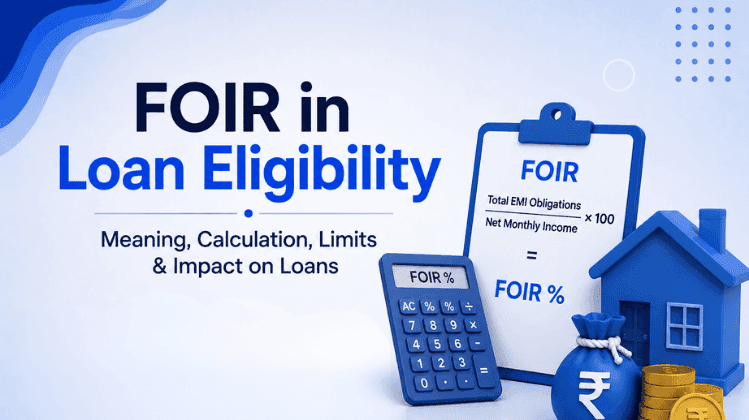
FOIR (%) = Total monthly fixed obligation/ gross monthly income.
Here is the step-by-step process banks may follow to calculate FOIR:
Suppose your monthly income and loan obligations are:
So, your FOIR is:
FOIR = (30,000/ 60,000) * 100
= 50%
This means 50% of your monthly income would go towards fixed loan obligations, while the remaining 50% would be available for other expenses.
Banks do not always consider every expense you make while calculating FOIR. The exact calculation can vary between lenders. Usually, they focus on regular debt obligations and other fixed commitments that their policy considers.
The EMI of the proposed new loan.
Calculate the percentage: The result is multiplied by 100 to get your FOIR.
*T&C Apply
Daily living expenses, utility bills, and insurance premiums are not counted as separate debt obligations. But lenders can consider them indirectly by keeping your FOIR around 40%–50%. The remaining 50%–60% of your income is generally left for your regular living and household expenses.
There is no single FOIR limit fixed by the RBI for every loan. Banks and NBFCs set their own FOIR limits based on their internal credit policies, the loan product, income level, and borrower profile.
Some commonly used ranges are:
FOIR is an important factor that banks and NBFCs may use when checking your loan eligibility. A lower FOIR means that you have more income left after paying your existing obligations, which can improve your chances of getting a new loan. However, FOIR is not the only factor lenders consider. Your income, credit score, employment or business stability, existing debts, and other eligibility conditions can also affect the final decision.
You can manage your FOIR by keeping it under control, paying credit card dues on time, and avoiding unnecessary debt. You should clear small loans first, it reduces your monthly obligations. The exact way a lender calculates FOIR can differ, so a lower FOIR does not guarantee loan approval.
FOIR stands for Fixed Obligation to Income Ratio. It shows how much of your monthly income is used for fixed financial obligations.
Many lenders generally consider 40% to 50% a comfortable FOIR range. However, there is no single limit for all banks, and each lender may have its own policy.
A high FOIR means your income’s large portion goes towards EMI. It shows that your income is already committed to debt payments. But the final decision depends on the lender’s assessment.
Adding an earning co-applicant can increase the total income considered by the lender and may improve the overall repayment capacity. However, lenders also check the co-applicant's credit score, income, and existing debts.
Usually, voluntary investments such as SIPs and mutual funds are not treated as fixed debt obligations. However, lenders may have their own assessment methods.
Indian lenders commonly use FOIR to assess a borrower's debt burden, much like the DTI (Debt-to-Income) ratio used in other markets. Both compare debt-related monthly obligations with income to check repayment capacity.
Yes. Credit card EMIs or eligible minimum monthly dues may be considered as fixed obligations while calculating FOIR.
Yes, you can reduce your FOIR by paying off smaller loans. Also reduce outstanding credit card balances, or choose a longer loan tenure. But a longer tenure can increase the total interest you pay over the loan period.
Yes. Banks and NBFCs may use FOIR or similar affordability measures for different types of loans, including home loans, personal loans, car loans, and other retail credit products.