By continuing, you agree to LoansJagat's Credit Report Terms of Use, Terms and Conditions, Privacy Policy, and authorize contact via Call, SMS, Email, or WhatsApp
The information published on LoansJagat is intended for general informational and educational purposes only and should not be considered financial, legal, or investment advice. Interest rates, loan terms, statistics, and other data may change over time and may vary by lender or source. Please verify the latest information and consult a qualified financial advisor or the respective Bank/NBFC before making any financial decisions.
Subscribe Now
About the author

Ananya Shrivastava
Ananya Shrivastava is a Content Writer specialising in finance-focused news, blogs, and long-form articles on Indian markets, RBI policy, personal finance, and lending. She has authored over 450 blogs and 250 news pieces, combining technical knowledge with rigorous research to simplify complex financial concepts into clear, engaging content. With a marketing-driven lens and sharp editorial judgment, she consistently achieves top Google rankings while ensuring every claim is backed by verified data.
Related Blog Post
Simplify All Your Loans Into One Affordable EMI

Customers Served

Debt Consolidated

1200+ Reviews

Locations in India
Club all Loans & Credit Card Bills into Single EMI

Quick Apply Loan
Consolidate your debts into one easy EMI.

Takes less than 2 minutes. No paperwork.

10 Lakhs+
Trusted Customers

2000 Cr+
Loans Disbursed

4.7/5
Google Reviews

50+
Banks & NBFCs Offers
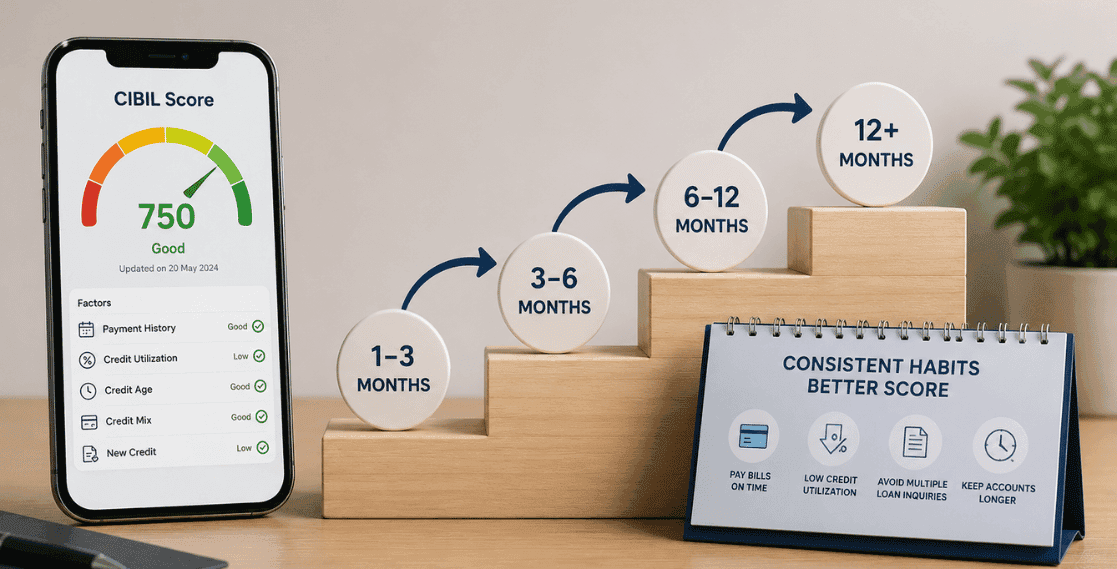
A score in the 650 to 700 range can reach 750 within 4 to 12 months. This applies to borrowers who pay on time and keep card balances low. A score below 650, or one affected by a settlement, generally needs 12 to 18 months. An RBI direction effective January 1, 2025, now requires reporting every 15 days instead of monthly.
Key Takeaways
Lenders across India turn down loan applications every day over credit scores that fall short of expectations. Applicants are then left asking how long a fix will realistically take. Salaried employees ask this question while applying for personal loans. Freelancers ask it before their first credit card application. Small business owners ask it while pursuing a home loan. The question carries more weight since January 2025, when the RBI shortened the credit bureau reporting cycle from roughly a month down to 15 days.
TransUnion CIBIL processes most of these updates, since Indian lenders check this bureau first. The speed at which it processes new data sets the pace for how quickly recovery becomes visible. This process does not happen quickly. Months of repayment behaviour build a credit score, and a single on-time payment cannot offset several months of missed ones.
The CIBIL score acts as a continuous account of how a person has managed his/her borrowed money. It ranges from 300 to 900. TransUnion CIBIL calculates this number from four inputs. These are repayment history, current outstanding debt, the mix of credit types held, and how many loans or cards the individual has applied for recently.
No single number of months applies to every borrower. Two factors determine the answer. The first is the score a borrower is starting from. The second is why the score fell in the first place.
Yes, considerably. One missed payment leaves a very different mark on a credit report than a settled loan does. The recovery paths reflect that difference clearly.
The credit score reflects past behavior and not the transaction itself. Lenders want to see that behaviour repeated before offering better terms. Several factors keep this process from moving faster.
Most importantly, nothing updates until a lender actually submits the data, and this happens on the lender's own reporting schedule rather than the borrower's.
Updates occur only when a bank or NBFC transmits new data to the bureau. Nothing updates on a schedule tied to the individual borrower. Before 2025, monthly reporting was standard practice across most lenders. A cleared dues amount could sit unrecorded for up to 45 days under that system.
The RBI Master Direction on Credit Information Reporting changed this. From January 1, 2025, it requires lenders to submit records on the 15th and last day of every month. Furthermore, the RBI has recommended a further move towards weekly reporting. According to Business Standard, the revised deadline is expected to be July 1, 2026.
The scoring model does not weigh every input equally. Axis Bank has published a breakdown of the approximate weighting behind each factor.
Payment history and utilisation together account for 65% of the score. Correcting these two factors first explains why some borrowers see faster movement than others addressing the same underlying problem.
*T&C Apply
Where credit card debt is the core problem, consolidating it into a personal loan carrying a lower interest rate is worth considering.
Yes, and this costs nothing. CIBIL's own free score page confirms that every individual can obtain one free score and full credit report each calendar year directly from the bureau. CIBIL itself recommends monthly checks, primarily to catch errors or fraud before they compound. A borrower's own check is logged as a soft inquiry, which carries no penalty and does not affect the score in either direction.
Not by 100 points, and not for most borrowers. A borrower can see a smaller, genuine improvement within 30 days after clearing a high card balance or correcting a reporting error. Moving from a poor score to a good one still requires several reporting cycles rather than a single payment.
Yes. Lenders apply different minimum expectations depending on the type of credit being sought.
A borrower targeting a home or car loan rather than a premium credit card may find the effective wait shorter, since the required score itself is lower.
Rohit Malhotra, 34, a marketing manager from Gurgaon, checked his CIBIL score in January 2025 and realised that his CIBIL score stood at 612. He had defaulted on three payments on his credit card due to a change in jobs and owed a sum of ₹1,80,000 on a total limit of ₹2,20,000 on his credit card.
In order to resolve this, he has taken a loan of ₹1,50,000 at a 13% interest rate and used the funds to pay off the credit card debt. This brought his utilisation down to 14%. He also set up auto-pay on every EMI and stopped applying for new credit.
With the start of January 2026, he will be able to obtain a mortgage top-up at an interest rate of 8.9%, whereas the interest rate on such loans provided by the same lender was 11.5% a year ago. It is equivalent to savings of around ₹4,80,000 on a loan of ₹40,00,000 over 20 years.
Rohit's numbers align with what lenders describe more generally for this kind of recovery. Borrowers typically see noticeable improvement by month six and a genuinely strong score by month twelve, provided the underlying repayment habits hold.
Repairing a CIBIL score realistically takes several months rather than several days. The exact duration depends heavily on the extent of the earlier damage. Borrowers in the 650 to 700 range can reach 750 within 4 to 12 months of disciplined repayment. A lower starting score, particularly one carrying a default, generally takes over a year. A change in the rate of progress has come because of the rule of 2025, although there is no change in the essential element of time.
FAQs
It will take around 12 to 18 months. A score at that level usually involves missed payments that require sustained correction.
Partial improvement is possible within a month, particularly after clearing high card balances. Full recovery takes considerably longer.
Every 15 days as of January 2025, following the reporting schedule set out in the RBI Master Direction on Credit Information Reporting.
No, it tends to work against recovery instead. Closing an old account shortens the overall length of credit history.
The update appears in the next 15-day reporting cycle rather than instantly, since this depends on when the lender submits the data.
No. This is logged as a soft inquiry, and CIBIL’s official website confirms it has no bearing on the score.
A great deal, since it accounts for roughly 30% of the score under Axis Bank’s published breakdown. It is usually the quickest factor to correct.
It stays on record for years and continues to weigh on the score until enough positive repayment history builds up around it.
Yes, provided the borrower uses it to clear high-interest credit card debt and repays it on time. This combination lowers utilisation and adds positive history at once.
Most of the banks and financial institutions look for 750 or more. However, loans such as home loans and car loans sometimes accept 650 as well.