By continuing, you agree to LoansJagat's Credit Report Terms of Use, Terms and Conditions, Privacy Policy, and authorize contact via Call, SMS, Email, or WhatsApp
The information published on LoansJagat is intended for general informational and educational purposes only and should not be considered financial, legal, or investment advice. Interest rates, loan terms, statistics, and other data may change over time and may vary by lender or source. Please verify the latest information and consult a qualified financial advisor or the respective Bank/NBFC before making any financial decisions.
Subscribe Now
About the author

Darshana Patel is a finance and tech writer with a strong background in journalism, financial economics, and political science, working with Loans Jagat. She has immense experience writing content through her previous work in fintech and edtech companies. Her contribution at Loans Jagat is to simplify finance-backed content and academically powered content for the readers.
Related Blog Post
Simplify All Your Loans Into One Affordable EMI

Customers Served

Debt Consolidated

1200+ Reviews

Locations in India
Club all Loans & Credit Card Bills into Single EMI

Quick Apply Loan
Consolidate your debts into one easy EMI.

Takes less than 2 minutes. No paperwork.

10 Lakhs+
Trusted Customers

2000 Cr+
Loans Disbursed

4.7/5
Google Reviews

50+
Banks & NBFCs Offers
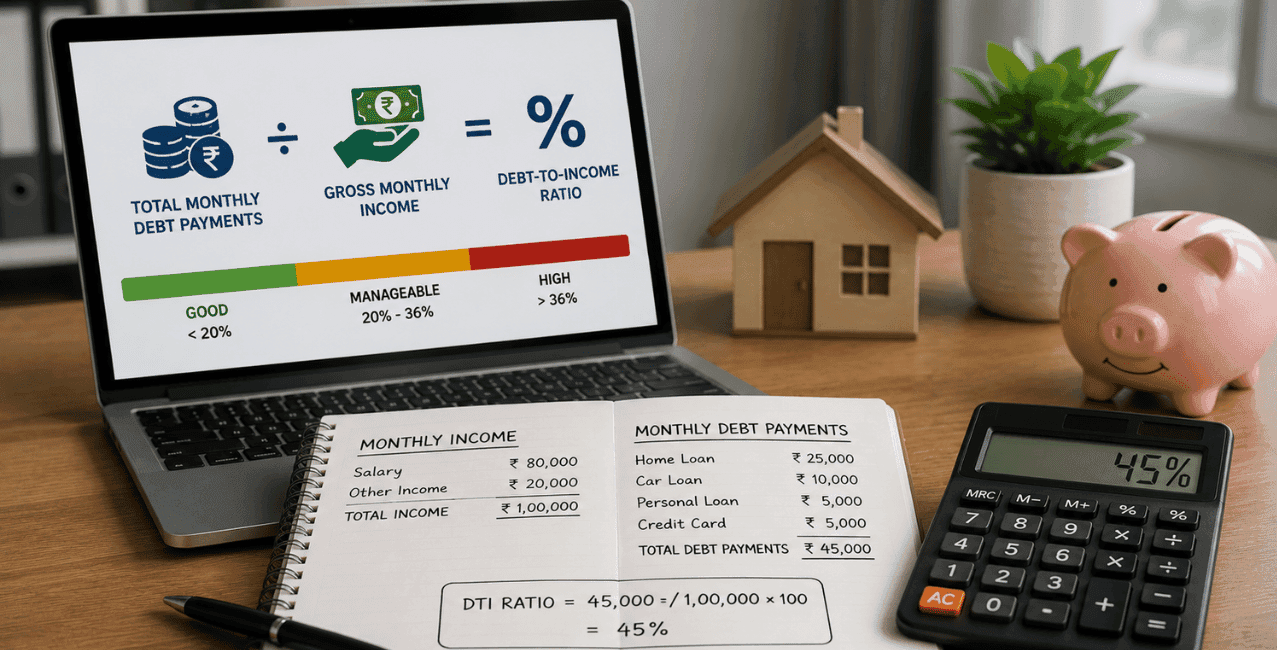
It is essential for all to calculate their monthly debt burden to understand their financial standing. People traditionally calculated their debts in relation to their income by simply subtracting them from the total income. In current times, this method has evolved into the name 'debt-to-income ratio’. It adds up all your recurring monthly debt payments and divides that sum by your gross monthly income before taxes. In simple terms, it estimates your debt burden within the margin of your monthly income. Many banks or finance companies, like LoansJagat, estimate your debt-to-income ratio as one of the parameters before providing you with any financial services.
The debt-to-income ratio (DTI) is a parameter that gives a final understanding of your debts within the ecosystem of your income.
The debt-to-income ratio is usually calculated using a formula, and if the final estimation is higher, then your debt burden is higher, and several banks or financial institutions can reject your loan request. On the other hand, if the final estimation is lower, then your debt burden is less, and you can benefit from several financial institutions.
Disclaimer: The DTI ratio may vary from one bank to another. Each bank has its own policies and parameters, including DTI, to decide whether to provide services or not. There is no standard range; this can vary from bank to bank.
These are the DTI ranges according to the banks in India:
Here, we will be taking the example of Axis Bank to understand the concept of categorisation of DTI ratios.
Hence, these are the ranges for DTI according to which people understand their financial position, and banks understand whether to provide financial services or not.
The debt-to-income ratio calculates your monthly debt burden against your monthly earnings.
Formula of Debt-to-Income Ratio = (total debt payments / gross monthly income) x 100
For example, your monthly income is ₹30,000, and the total payments you make are a home loan EMI of ₹10,000, a phone EMI of ₹2,000, credit bills of ₹4,000, and a car loan EMI of ₹3,500.
This means your total monthly payments make up to = ₹2,000 + ₹4,000 + ₹3,500 + ₹10,000 = ₹19,500 from your total income of ₹30,000.
So, according to the DTI formula = (₹19,500 / ₹30,000) x 100
= (₹0.65) x 100
= 65%
This means your monthly debt burden is 65%, which is very high according to several banks' DTI margins.
There are several DTI advantages in terms of loan approvals, debt management, and better financing.
Here is the detailed explanation of the advantages of the debt-to-income ratio:
Hence, these are the advantages of the debt-to-income ratio.
There are several ways to manage the high debt-to-income ratio. One needs the proper planning and understanding of the expenses to lower the DTI ratio.
Here are the ways to manage the high DTI ratio:
• A healthy DTI can support eligibility for higher loan amounts or credit limits.
• Borrowers with suitable DTI levels may receive reduced fees or more flexible loan terms.
*T&C Apply
Focus on paying off your smallest debt first before moving to the next. Another method is to tackle debt with the highest interest rate first.
Hence, this is how you can easily manage your high DTI ratio to turn it into a low DTI ratio.
People need to understand the concept of expenses when it comes to maintaining a low DTI ratio for major benefits.
Here are the mistakes to avoid:
Hence, these are the common mistakes people make and do not raise that their DTI ratio will go high.
The debt-to-income ratio acts as an important tool to determine your monthly debt burden. It acts as an important parameter for loan approvals in several banks or financial institutions. Top fintech companies like LoansJagat, which connect people with perfect financial lenders, also check the DTI ratio of people to make this perfect match.
DTI is important to determine your financial standing and capacity to hold new debt. Moreover, it helps banks and people to understand the monthly debt burden.
Yes, if any mistake occurs in the credit report, it gets affected indirectly because errors such as unclosed loans can artificially inflate monthly debt obligations and negatively impact a borrower's DTI ratio.
Banks or other financial institutions examine parameters like your credit score, credit history, age, employment status, income, etc., for loan approvals.
Yes, the DTI ratio gives the final estimation in percentage.
No, the debt-to-income ratio varies from bank to bank. There is no standard margin followed by all the banks.
More than 40% of DTI ratios fall under the high-risk category, according to Axis Bank’s policy.
Yes, debt management will definitely lower your high debt-to-income ratio.
One should not take too many EMIs at once. Also, one needs to cover the pending debts, like credit dues, as soon as possible. These are the two major mistakes one should avoid to avoid falling into a high DTI ratio.
The low DTI ratio means you have less debt burden on you, and banks can easily give you loan approvals.
Yes, a DTI ratio below 20% is one of the factors that indicates that you hold strong financial standing.