By continuing, you agree to LoansJagat's Credit Report Terms of Use, Terms and Conditions, Privacy Policy, and authorize contact via Call, SMS, Email, or WhatsApp
Disclaimer: The information published on LoansJagat is intended for general informational and educational purposes only and should not be considered financial, legal, or investment advice. Interest rates, loan terms, statistics, and other data may change over time and may vary by lender or source. Please verify the latest information and consult a qualified financial advisor or the respective Bank/NBFC before making any financial decisions.
Subscribe Now
About the author

Anishka Bhadly is a content writer with a finance and business background. She has completed her bachelor's degree with a specialisation in finance and is currently pursuing an MBA in the finance field too. The knowledge she has gained from her studies and experience working with EdTech companies helped her combine theoretical knowledge with practical industry insight. Her expertise lies in creating well-researched, informative, and reader-friendly content in various banking, personal finance, loans, insurance, and investment-related topics.
Related Blog Post
Simplify All Your Loans Into One Affordable EMI

Customers Served

Debt Consolidated

1200+ Reviews

Locations in India
Club all Loans & Credit Card Bills into Single EMI

Quick Apply Loan
Consolidate your debts into one easy EMI.

Takes less than 2 minutes. No paperwork.

10 Lakhs+
Trusted Customers

2000 Cr+
Loans Disbursed

4.7/5
Google Reviews

50+
Banks & NBFCs Offers
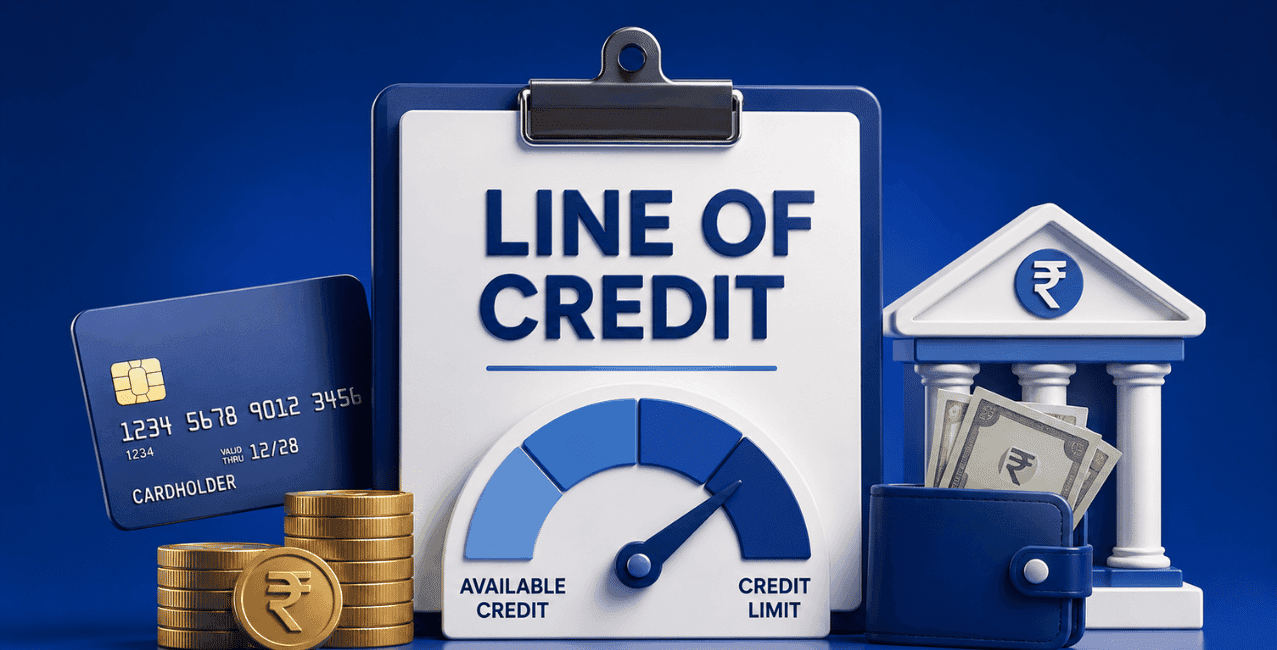
A line of credit gives you access to funds up to a certain amount to withdraw from it when you need. Contrary to a loan, with a line of credit, you are not obliged to take the whole sum at once. You can just take the amount you need and pay back the money you took, being charged only for the used funds. Depending on the credit rules, you may have an opportunity to use the whole line of credit repeatedly, being able to withdraw and pay back money as you need. Lines of credit can be either secured or unsecured and may serve different purposes like personal, business, home improvement, etc. Though having a lot of advantages, lines of credit are not free, so you should know the rates and terms of credit use.
A line of credit may be an excellent solution for any situation when you need some money. The main difference between a line of credit and a standard loan is that with a line of credit, you will not be given a lump sum of money upfront. Instead, you are allowed to withdraw cash from your credit line up to a specific limit. Moreover, you typically will only be charged interest on the amount you withdraw, not the entire credit line amount. A credit line can be useful in any situation when you need money to pay off bills or expenses you did not plan. Individual lines of credit can be opened by both individuals and organisations.
Lines of credit could be different depending upon the requirement of funds and the objective of the borrower. Few of them are mentioned below:
Depending upon need, eligibility, interest rates, and terms and conditions, one could choose the most appropriate personal credit facility.
A line of credit differs from a loan in various ways, as the former allows the borrower to take the amount in instalments as compared to availing a lump sum payment against a loan. There are several key features that differentiate a line of credit from other forms of borrowing. These have been discussed below:
In conclusion, it can be stated that a line of credit is a flexible borrowing method that allows a person to manage his/her financial requirements in a better manner.
A line of credit and a traditional loan are two popular financing options. Both of them allow the borrower to obtain funds from a financial institution. However, they differ in several aspects. The main differences are related to the cash disbursement, interest rates, flexibility, and repayment terms. Understanding the differences between a line of credit and a traditional loan can help someone in making the right choice.
Both alternatives have distinct characteristics and repayment schemes. Therefore, it is essential for borrowers to assess their borrowing purposes, requirements, additional expenses, and repayment abilities to choose the most suitable option. Additionally, each candidate should consider their financial comfort and convenience in terms of the repayment schedule.
Eligibility criteria for a line of credit can vary between different lenders and for different types of accounts. In general, though, you will be judged according to the same criteria, which usually include the following:
Even if you meet all of the above criteria, it does not necessarily mean that you will be approved for a loan. This is because different lenders have their own additional requirements that they impose on loan seekers, including total debt outstanding at the time of application, ability to repay, and other factors.
Although a line of credit is associated with some risks, it is still a popular and convenient type of financing. However, each borrower should be aware of several potential disadvantages of a line of credit before opening an account. Some of the most notable downsides of a line of credit include the following:
Thus, it is essential for a borrower to assess the risks and costs associated with a line of credit before actually taking a loan. It is also crucial to only spend amounts of money that one can afford to repay.
A line of credit can be beneficial for a borrower who requires flexibility in repayments and only pays interest on the withdrawn amount. However, it ultimately depends on the applicant’s requirements and their ability to repay, along with the cost and interest rates. LoansJagat can assist the borrower in comparing the best deals across banks and NBFCs for credit-line services like personal loan overdraft. It can also help you understand rates, eligibility, fees, and tenure for different credit lines, enabling you to make an informed decision.
A line of credit may be a great option for those who want to get access to funds when needed but without incurring a large debt at once. Its main benefit is that one has to pay back only the amount they have borrowed. Still, there are several caveats, such as the possibility that the rate might change, additional fees for borrowing, limits on the credit line, and terms of repayment. All should be taken into consideration before applying for any type of loan.
A lender approves a line of credit and decides its maximum amount. The borrower can use it at any time he needs money, paying back the withdrawn amount and being able to use the same credit for further withdrawals, depending on the conditions of the credit facility. Interest is typically paid on the outstanding balance.
The purpose of a line of credit is that the borrower does not have to use the whole sum at once and only pays for the part he uses.
The risk of a line of credit is that the interest rate on it can be variable, the lender may impose various fees, and it will be relatively easy to borrow, which may lead to overpayment.
Repayment of a line of credit can be done in instalments during the draw period and according to the contract terms, including minimum monthly payments.
Yes, it is possible during the draw period stated in the contract, as well as up to the credit limit, using the methods available to the borrower.
The main difference is that a line of credit allows one to get access to funds up to a certain limit, while a loan is given as a lump sum and paid back in instalments.
There is none, since it depends on many factors; however, when comparing two offers, you should pay attention to the APR, possibility of rate fluctuation, and additional costs.
The former is more suitable for a specific and one-time need, while the latter is more appropriate for ongoing requirements.
It depends on the offer, since a lot of factors may affect how long the draw period, that is, the time when you can withdraw money, will last.
There are several risks associated with a line of credit, including a potential increase in the interest rate, additional fees, overutilisation, and a negative impact on your credit score in case of delinquency. In case of default, the collateral, if any, may be at risk.