By continuing, you agree to LoansJagat's Credit Report Terms of Use, Terms and Conditions, Privacy Policy, and authorize contact via Call, SMS, Email, or WhatsApp
Disclaimer: The information published on LoansJagat is intended for general informational and educational purposes only and should not be considered financial, legal, or investment advice. Interest rates, loan terms, statistics, and other data may change over time and may vary by lender or source. Please verify the latest information and consult a qualified financial advisor or the respective Bank/NBFC before making any financial decisions.
Subscribe Now
About the author

Vidhi Chauhan
Vidhi Chauhan is a copywriter and content writer with extensive experience creating high-quality, SEO-driven content across multiple industries, with a strong focus on fintech. She has written extensively on GST, banking, personal loans, business loans, credit cards, income tax, insurance, and other financial topics, helping Indian readers understand complex concepts through clear, accurate, and engaging content.
Related Blog Post
Simplify All Your Loans Into One Affordable EMI

Customers Served

Debt Consolidated

1200+ Reviews

Locations in India
Club all Loans & Credit Card Bills into Single EMI

Quick Apply Loan
Consolidate your debts into one easy EMI.

Takes less than 2 minutes. No paperwork.

10 Lakhs+
Trusted Customers

2000 Cr+
Loans Disbursed

4.7/5
Google Reviews

50+
Banks & NBFCs Offers
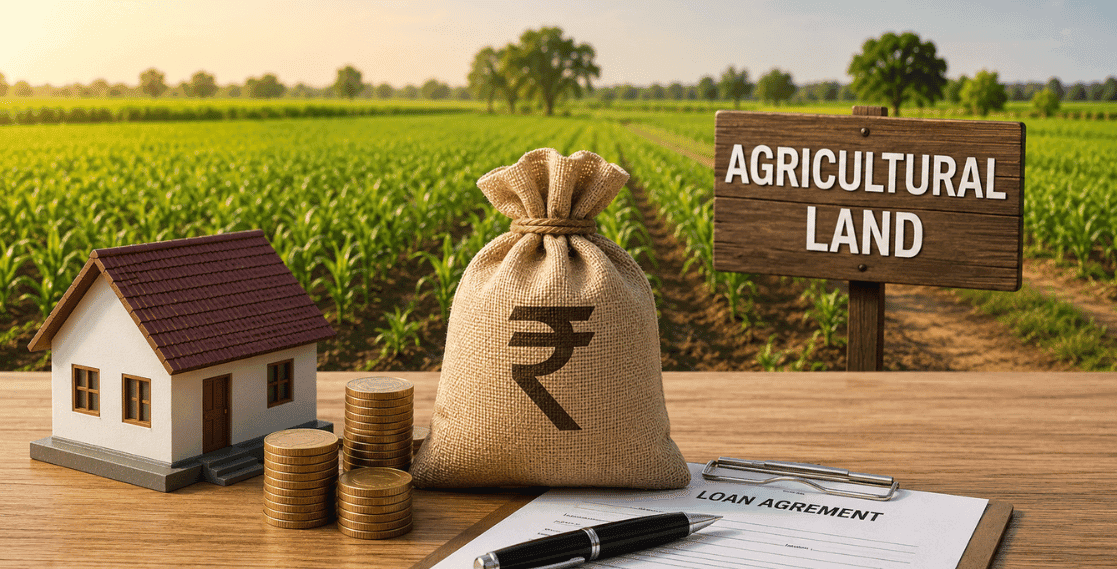
A Loan Against Agricultural Land is one of the kinds of loans where qualified individuals obtain money through a mortgage on their agricultural land. While other loans such as residential or commercial loans do not have extra requirements, loans against agricultural land may have some special conditions, which include the following: ownership of the land, its location, use, legal issues and state laws that apply. The income of the individual, credit score, capacity of the person to repay the loan, and worthiness of his/her property are considered during the issuance of the loan. It is necessary to know all these details since different lending institutions and states might have different eligibility conditions. Besides, interest rate, amount of the loan, and required documents will differ.
Key Takeaways
Loan Against Agricultural Land refers to a secured loan in which the borrower pledges his/her agricultural land as security for funds from the lending institutions. In this process, the lending institution levies charges on the agricultural land, and the borrower is responsible for repaying the loan through an instalment agreement. The release of the lien takes place after the completion of repayment.
The simple process behind it involves pledging the agricultural land as security for the borrowed funds. The lender then takes into consideration various aspects like valuation, location, documentation, nature of usage, and legality of the property, among others. The decision about the amount of loan, interest rates, and repayment period follows accordingly.
Some reasons for which borrowers can seek financing against the agricultural land can be:
The loan for agricultural land is different from the standard mortgage loan for residential and commercial properties. Residential and commercial properties are easier to appraise, while agricultural land faces stricter state-specific ownership and usage regulations. Lenders may approve loans only when land ownership and borrower location meet specific eligibility requirements.
The geographical location, ownership status, usage, and legality of the agricultural land thus become crucial factors in determining whether a loan can be granted or not. The borrower must have valid ownership documents and meet the lender's mortgage or collateral requirements.
Can I take a loan against agricultural land? And what are its eligibility criteria?
Can I take a loan against agricultural land? The answer to this question is Yes, certain banks and financial institutions provide loans against agricultural land, but other financial institutions do not offer loans against agricultural land due to specific state land laws. This is because the availability of funds for the loan is based on various factors, including the type of land, ownership of land, and purposes of the loan.
Before the approval of a Loan Against Agricultural Land, the following eligibility criteria are usually assessed by lenders:
Creditworthiness of the borrower is also taken into consideration by the lending institution before giving the go-ahead to the loan application. This includes the credit history of the individual, debts that he/she owes at the moment, income status, etc.
Interest rate, loan amount and repayment tenure for a Loan Against Agricultural Land depend on many factors, including the lending institution, financial background of the borrower, value of the agricultural land and purpose of loan.
The key terms of the facility can be summarised as follows:
Loan terms vary according to eligibility, land value, and SBI policies.
One thing to note about these conditions is that they apply only to SBI’s Kisan Samriddhi Rin program, and therefore should not be used as standard terms for every Loan Against Agricultural Land. The interest rate, loan amount, security conditions, and repayment periods may vary greatly from one lending institution to another.
Documents needed for taking a Loan Against Agricultural Land can vary according to the lender, borrower, use of the loan, and even the location of the property. The documents usually asked by lenders include those proving the identification of the borrower, financial status and title of the agricultural land.
*T&C Apply
Based on the document requirements generally associated with agricultural financing, borrowers may need to provide the following:
Additional documents may be requested depending on the applicant's profile, loan amount, and the lender's requirements.
If the agricultural land is being put up as security by the borrower, then some land documentation might be of special interest for the lender.
This includes:
AIF applicants should have detailed information about their projects, which includes PAN, project site, legal status, and promoter details. Document requirements will differ depending on the applicant and the lending institutions.
Loan Against Agricultural Land can assist those who qualify to secure funding, using their agricultural land as collateral. Nevertheless, eligibility criteria, interest rates, loan amount, repayment terms, and documentation requirements will differ from one lending institution and state to another. Borrowers need to verify land ownership and legalities in order to be qualified.
FAQs
1. Can the agricultural land be mortgaged twice?
Generally, a property mortgaged by one lender cannot be presented as a charge to another lender without the approval of the existing lender. The borrower may have to settle the debt from the existing mortgage or get approval for a new mortgage.
2. Is there any valuation process of agricultural land before approving a loan?
The lender may arrange for a valuation of the property by a registered valuer based on factors including the value of the property and its suitability as a charge.
3. Can the agricultural land, which is co-owned, be mortgaged?
Co-owned property can only be considered as a means to acquire a loan if all owners of the land give their approval and satisfy all requirements by the lender.
4. What will happen if the borrower does not return the loan?
In the case of a default, the bank or creditor can commence proceedings to collect money in accordance with the loan contract and the relevant legislation. It can also lead to enforcement of the security interest and the sale of the mortgaged property.
5. Is it possible for the borrower to repay the loan on agricultural land earlier than expected?
The possibility of repaying a loan early depends on the requirements of the lender and the kind of loan. One should make sure whether there are foreclosure and prepayment fees when closing the loan in advance.
6. Does the location of the agricultural land play any role?
Yes, lenders have restrictions concerning the regions they operate in. Agricultural land from remote or restricted territories may need special attention before considering a loan.
7. Can inherited agricultural land be used as a mortgage?
Yes, in order to get a loan, one should prove the legality of their ownership by providing necessary documents.
8. Can agricultural land be used as collateral for getting business finance?
Agricultural land is generally accepted as collateral only for agricultural and allied activities. Most banks do not accept purely agricultural land as security for standard business loans.
9. Is it mandatory to have a guarantor for a loan against agricultural land?
It is not necessary to have a guarantor for a loan application against agricultural land if the borrower and collateral meet the bank requirements. In some cases, lenders may ask for guarantors/co-applicants.
10. How much time does it take for processing a loan against agricultural land?
The time required to process a loan application against agricultural land depends on various factors like documentation, valuation of the land, etc.