By continuing, you agree to LoansJagat's Credit Report Terms of Use, Terms and Conditions, Privacy Policy, and authorize contact via Call, SMS, Email, or WhatsApp
The information published on LoansJagat is intended for general informational and educational purposes only and should not be considered financial, legal, or investment advice. Interest rates, loan terms, statistics, and other data may change over time and may vary by lender or source. Please verify the latest information and consult a qualified financial advisor or the respective Bank/NBFC before making any financial decisions.
Subscribe Now
About the author

Vidhi Chauhan is a copywriter and content writer with extensive experience creating high-quality, SEO-driven content across multiple industries, with a strong focus on fintech. She has written extensively on GST, banking, personal loans, business loans, credit cards, income tax, insurance, and other financial topics, helping Indian readers understand complex concepts through clear, accurate, and engaging content.
Related Blog Post
Simplify All Your Loans Into One Affordable EMI

Customers Served

Debt Consolidated

1200+ Reviews

Locations in India
Club all Loans & Credit Card Bills into Single EMI

Quick Apply Loan
Consolidate your debts into one easy EMI.

Takes less than 2 minutes. No paperwork.

10 Lakhs+
Trusted Customers

2000 Cr+
Loans Disbursed

4.7/5
Google Reviews

50+
Banks & NBFCs Offers
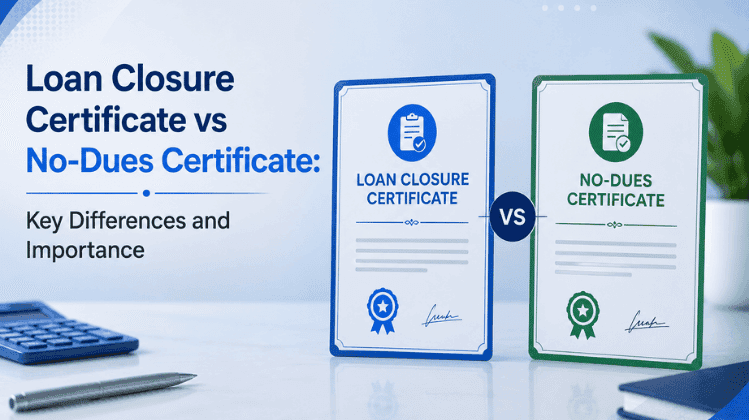
The Loan Closure Certificate and the No-Dues Certificate are two similar types of certificates that certify that your loan liabilities have been paid off. There are different names for each one according to different banks and financial organisations. The Loan Closure Certificate is usually issued by banks certifying that the loan account is closed officially, whereas the No-Dues Certificate confirms the absence of any outstanding payments on the loan account.
It is very useful to know the difference between the Loan Closure Certificate and the No-Dues Certificate as it will enable you to manage your accounts correctly, clarify any inconsistencies in your credit report, and settle matters associated with a secured loan. These documents will be helpful if there will be some doubts regarding your loan payment in the future. Read further to learn about the Loan Closure Certificate, No-Dues Certificate, and their importance in detail.
The status of loan closure could affect your credit history.
A Loan Closure Certificate is issued by a financial institution after the loan has been repaid in full and the loan account has been closed.
This means that the loan has come to an end, and there will be no further payments that will have to be made by the borrower. Such a certificate may include information such as the borrower's name, the account number of the loan, the amount of the loan, the date of closure, and the repayment of the loan.
The loan closure certificate is especially important when there is a need for documentation of the closure of the loan account.
Depending on the lending organisation, the document may consist of:
No Dues Certificate (NDC) is a document issued by the lender verifying that there are no pending dues on the part of the borrower regarding the loan.
Alternatively, this is also known as a No Objection Certificate (NOC), depending on the lender. For instance, after the settlement of a personal loan, the lender provides a document stating that there are no dues in the loan account.
In the case of a secured loan, such as a vehicle or property loan, the lender also provides the necessary documents for releasing its lien/charge on the asset.
Loan Closure Certificate and No-Dues Certificate (NDC), which may also be called a No Objection Certificate (NOC), are both similar certificates that are issued once you pay off the entire loan amount. Often, these two names may be used by banks interchangeably, though there may be variations in their format and language.
The key details commonly associated with these documents are compared below:
As such, even though there are slight differences in the terminologies used, the reason for obtaining each of the two documents is basically the same, to prove that the loan has been repaid in full and there is no liability left.
There can be various reasons for which obtaining a certificate proving the closure of a loan is important.
It provides written proof of your having discharged your obligation to repay the loan. It may be helpful in case of any future dispute on the status of your loan.
Having the loan closure documents with your financial records may help in keeping an account of your past loans and repayment.
After closing your loan, the bank reports the updated status of the account to the concerned credit bureau. The loan closure document may prove helpful in raising disputes in case the loan still shows up as outstanding in the report.
Number of the reference or certificate, if any
*T&C Apply
The certificate alone cannot update your credit report. This has to be done by the bank.
In the case of secured loans, some documents may be needed after the payment process to allow for the cancellation of the lender’s lien over the asset.
For instance, when borrowing against a car, the documents may concern removing the lender’s hypothecation from the vehicle.
Documentation by the lender may be helpful in the case of disputes regarding whether there is an outstanding amount to pay.
A No Dues Certificate may also prove very useful after the loan is paid off. It states that on the basis of the lender’s documents, there is no amount pending under that loan.
It may come in handy in cases when:
It is important to note that the closure certificate itself does not affect your credit score in any way.
It is all about how the loan account is reflected by the lender in the credit reports provided to the credit bureaus. After the loan repayment period is over, the loan account must be marked either as closed or settled, depending on the situation.
Closed loan and settled loan are two different things, as the latter implies that the lender did not receive the entire outstanding loan balance. This can affect your credit history differently.
The Loan Closure Certificate as well as the No-Dues Certificate is significant proof of fulfiling all your loan obligations. While different banks may use different terminologies, both of these certificates can serve you well in proving the repayment of the loan and avoiding future conflicts. It is crucial to preserve them for several reasons.
You may request the certificate after making the final instalment and ensuring that the payment has been processed by the bank. It is always better to receive the certificate shortly after closure rather than when you require it for any other financial activity.
It is possible in most cases for a borrower to apply for and/or download the closure certificates online via internet banking or mobile application of the bank.
You may write to the customer service of your bank requesting for the same.
These charges will vary based on the lender's policy and type of loan. You can refer to the lender's schedule of charges prior to applying for the certificate.
Yes, you may contact the lender for a duplicate of the certificate. The lender may ask you to fill out a form or even identify yourself before issuing the certificate.
It will be wise to hold on to them as long as possible until they become useful to you in one way or the other. If it is a secured loan, it is especially necessary to hold onto it till everything pertaining to ownership and lien is completed.
The loan closure certificate may become proof of the past completion of the loan payment process. However, usually, the lenders consider your present income, outstanding debts, and many other factors while evaluating you as a potential borrower separately.
If you find wrong details in the certificate, like your name, account number, or closure date, immediately inform the lender about it. Also ask for a new certificate.
A settlement letter will be concerned with an agreement where the creditor agrees to accept a particular sum of money to discharge any liability that is due on account. There is thus a difference between a loan that has been paid in full and one that has been settled.
Ensure that the closure or repayment has been correctly recorded on the correct loan account. In case of secured borrowing, ensure that the procedures pertaining to assets have been discharged properly.