By continuing, you agree to LoansJagat's Credit Report Terms of Use, Terms and Conditions, Privacy Policy, and authorize contact via Call, SMS, Email, or WhatsApp
Disclaimer: The information published on LoansJagat is intended for general informational and educational purposes only and should not be considered financial, legal, or investment advice. Interest rates, loan terms, statistics, and other data may change over time and may vary by lender or source. Please verify the latest information and consult a qualified financial advisor or the respective Bank/NBFC before making any financial decisions.
Subscribe Now
About the author

Vidhi Chauhan is a copywriter and content writer with extensive experience creating high-quality, SEO-driven content across multiple industries, with a strong focus on fintech. She has written extensively on GST, banking, personal loans, business loans, credit cards, income tax, insurance, and other financial topics, helping Indian readers understand complex concepts through clear, accurate, and engaging content.
Related Blog Post
Simplify All Your Loans Into One Affordable EMI

Customers Served

Debt Consolidated

1200+ Reviews

Locations in India
Club all Loans & Credit Card Bills into Single EMI

Quick Apply Loan
Consolidate your debts into one easy EMI.

Takes less than 2 minutes. No paperwork.

10 Lakhs+
Trusted Customers

2000 Cr+
Loans Disbursed

4.7/5
Google Reviews

50+
Banks & NBFCs Offers
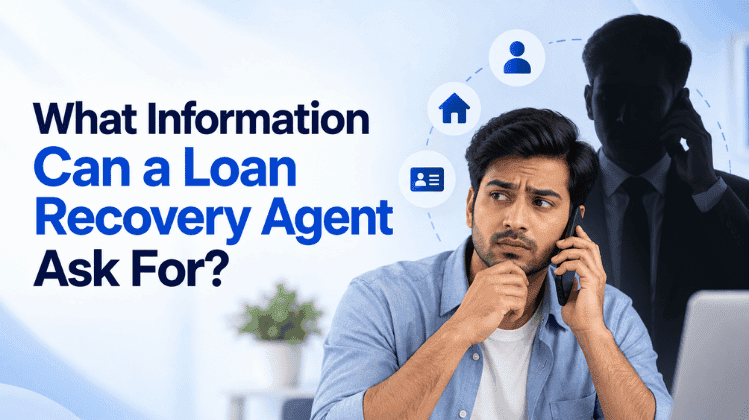
As a recovery agent, one can seek information which is reasonably necessary for verifying the identity of the borrower, understanding the debt and discussing the repayment of the debt. Being a recovery agent does not mean that anyone can access all your personal and financial information. A borrower needs to know the difference between information sought for legitimate reasons related to the debt and other sensitive information like OTPs, PINs, passwords, and banking information, which should never be revealed. Knowing the information which can be sought will help you answer confidently and, at the same time, keep your information safe. RBI also imposes certain guidelines on the way of communicating with the borrowers by recovery agents, which also include protection from harassment, intimidation, and invasion of privacy. Let us understand what information a recovery agent can ask for.
Recovery calls do not include any form of harassment or privacy violation.
The loan recovery agent is the agent appointed by the bank to help recover any unpaid dues in a loan taken from the bank. According to RBI guidelines, an agency engaged by the bank and an agent/employee of the agency fall under the category of a recovery agent.
The major role of the recovery agent is to communicate with the borrower and collect dues on behalf of the bank. It is important to note that just because the bank appoints the agent for the loan, the agent does not automatically get the same powers as that of the lender.
One should always check the identity of the agent before interacting with him/her. The RBI has directed banks to inform borrowers about the recovery agency in charge of their matter.
There isn't any list issued by the RBI which mentions that every piece of information can be demanded by the agent. Rather, the information asked must be related to the lawful purpose of loan recovery.
Usually, an agent may ask questions like:
An agent may want to confirm whether he/she is talking to the right borrower or not. The identity of the borrower may be confirmed using basic details which are already linked to the loan account.
For instance, an agent may ask you to confirm the following:
But borrowers have to be cautious while giving too much sensitive information to the agents on the grounds of their being recovery agents.
In case you have doubts regarding the caller's identity, then you may get in touch with the lender through the lender's official customer-care department to verify the recovery agency.
The most common reason for the recovery call is the default on the loan. Hence, the representative may talk about the following points of information:
The borrower can request the representative to provide the information regarding the outstanding amount in writing or directly from the bank.
This would be necessary if there is any variation between the outstanding amount as mentioned by the representative and your loan statement.
The debt collector may question you about the timeframe of your payment or whether you are going through temporary financial trouble.
Questions such as the following are some examples:
These are relevant questions for settling your overdue account.
If you are unable to make the repayment immediately, you can explain your position without disclosing unnecessary personal details.
The broker might want to determine whether the borrower has provided the right contact details to the lender for communications regarding the loan.
The contact details might include the right mobile phone number, email address, or correspondence address.
It is important for borrowers to be able to differentiate between verifying existing contact details and disclosing more information than what is necessary.
If the agent asks for any information that seems irrelevant to the loan, make sure to clarify the reason behind the same with the lender.
In case the bank is making a proposal regarding repayment, the borrower might be questioned as to his capability for making such a payment.
For example, the representative could inquire as to your ability to clear the defaulted EMI either immediately or within a certain period of time.
The ultimate aim is to arrive at a legitimate solution to the problem rather than pressurise the borrower into divulging personal details.
It doesn’t automatically mean you have to disclose any and all information if you have been contacted regarding your loan.
Some of the things you should be wary of disclosing include the following:
*T&C Apply
A legitimate recovery process doesn’t give anyone the right to ask you for your banking credentials.
If anyone contacts you asking you to disclose your OTP/PIN to ‘verify’ your account or process your payment, hang up the phone.
A recovery agent might require the verification of the address of the borrower, especially when there is communication related to the loan involved.
But if you have already provided your address to the lender, then try to find out why more information is needed from you.
Most importantly, even if you provide your address, it does not give the recovery agent unrestricted power to enter your home or take possession of anything.
As per the guidelines issued by RBI in 2008, loans are to be recovered or vehicles to be seized through legal process only.
It is equally important to know what the agent shouldn't be doing as what he can ask.
As per RBI, the banks and their agents cannot indulge in any kind of intimidating and harassing behaviour while recovering dues. The guidelines stress the issue of privacy and don't permit any intimidating calls/anonymous calls/any misrepresentation or misleading.
Further, RBI instructions also clarify that regulated firms and recovery agents cannot harass debtors, invade the privacy of family members, send inappropriate messages through mobiles or social media, make threatening or anonymous calls or make frequent recovery calls. Moreover, regulated firms and recovery agents should not make calls before 8 am or after 7 pm to recover overdue loans.
Thus, payment-related queries shouldn't result in threats/humiliation/private information.
Borrowers should have an idea about the questions that a loan recovery agent can ask to ensure that they can safeguard their personal privacy while clearing their outstanding bills. These agents are permitted to ask for relevant information regarding the loans and repayment, but are not allowed to ask for banking login details or harass you.
It is all right for the recovery agent to contact or meet the borrower for recovery purposes, but the procedure must preserve the dignity and privacy of the borrower. The unnecessary divulgence of the loan details to other individuals or colleagues is not advisable.
Yes, one can seek written correspondence through email or other mediums in order to keep the matter clear and well documented.
Inform the person calling that you are not the borrower and your number should be blacklisted. If this is not done, then document the correspondence and report the matter to the bank through its grievance redressal mechanism.
This can be possible if the recovery agent has been authorised by the lender to communicate settlement or repayment offers. Ensure that you put everything in writing before paying and check the terms of the offer from the lender.
It is not recommended for borrowers to give cash unless they have authorisation from the lender. It would be best to make payments in an authorised way, which will provide a transaction record of your payment.
Yes, you can ask for documentation proving the authority of the agent to work for the lender. This would be helpful, especially if the contact seems unfamiliar and doubtful.
Make sure to cross-check the details from the lender's statement before accepting any verbal information. In case there seems to be some error, you can contact the lender via their support mechanism.
It should never happen that a family member is used to shame, threaten or harass the borrower in any way. In case another person is being contacted regarding the matter, you can inquire with the lender as to why that happened.
You should keep evidence of recovery contacts in case the issue becomes a source of conflict in the future. You will need to preserve all the communication, including messages, e-mails, payment records and anything else that might be relevant to the recovery process.
Never pay or provide any confidential information just because the person on the line claims to represent a bank or another lending agency. Contact the lending agency yourself using its official numbers.