By continuing, you agree to LoansJagat's Credit Report Terms of Use, Terms and Conditions, Privacy Policy, and authorize contact via Call, SMS, Email, or WhatsApp
Disclaimer: The information published on LoansJagat is intended for general informational and educational purposes only and should not be considered financial, legal, or investment advice. Interest rates, loan terms, statistics, and other data may change over time and may vary by lender or source. Please verify the latest information and consult a qualified financial advisor or the respective Bank/NBFC before making any financial decisions.
Subscribe Now
About the author

Vidhi Chauhan is a copywriter and content writer with extensive experience creating high-quality, SEO-driven content across multiple industries, with a strong focus on fintech. She has written extensively on GST, banking, personal loans, business loans, credit cards, income tax, insurance, and other financial topics, helping Indian readers understand complex concepts through clear, accurate, and engaging content.
Related Blog Post
Simplify All Your Loans Into One Affordable EMI

Customers Served

Debt Consolidated

1200+ Reviews

Locations in India
Club all Loans & Credit Card Bills into Single EMI

Quick Apply Loan
Consolidate your debts into one easy EMI.

Takes less than 2 minutes. No paperwork.

10 Lakhs+
Trusted Customers

2000 Cr+
Loans Disbursed

4.7/5
Google Reviews

50+
Banks & NBFCs Offers
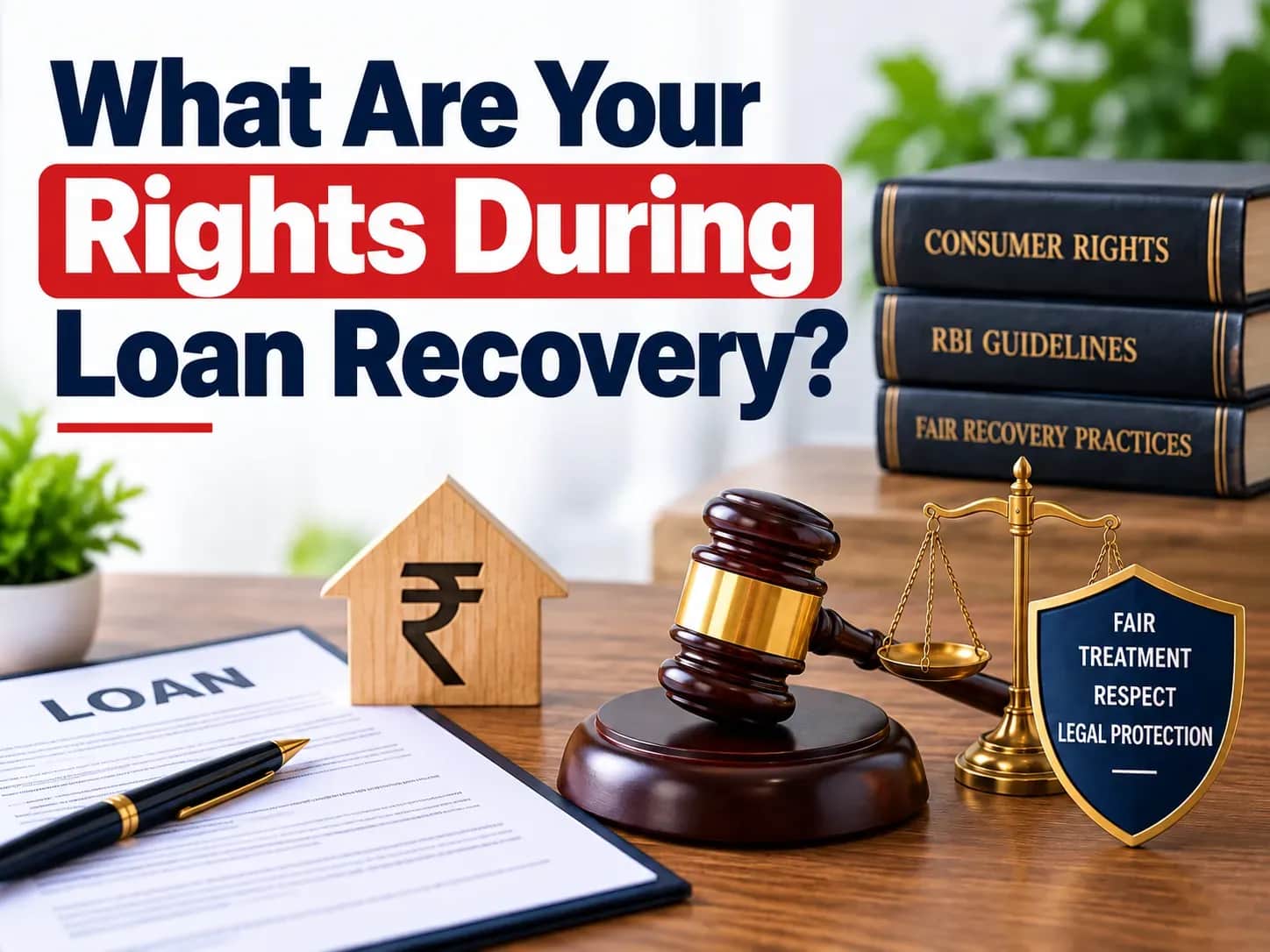
When recovering loans, you should be treated with dignity, respect and fairness, despite having missed loan repayments one or more times. The lender has the legal authority to recover due amounts that are genuine, but he or she cannot use harassing, threatening, intimidating and other unethical means of forcing the debtor to pay back the debt.
Understanding your rights when recovering a loan can assist you in differentiating between legitimate actions and unethical actions of the lender or any recovery agent. Such rights include protection from harassment, identification of a recovery agent, privacy, communication and grievance redressal mechanism.
Being aware of such rights can make it easier for you to cope with loan repayments while still trying to sort out the overdue loan. It is now time to learn about some of the rights of every borrower during the loan recovery process.
Loan recovery refers to the process through which the lender tries to recover the outstanding loan amount from the borrower who has not been able to make repayments on time as per the agreed repayment plan.
The loan recovery process includes the following:
It is the responsibility of the borrower to pay back a genuine loan. Nonetheless, the loan recovery process needs to be in accordance with the relevant laws and the terms and conditions of the loan agreement.
Significantly, according to the RBI's Fair Practice guidelines, the lenders should not harass the borrowers in order to recover loans.
Another key right during loan recovery is your right to dignity and respect.
The act of defaulting on a loan does not grant the lending institution or any recovery agents carte blanche to harass, threaten, or intimidate the debtor. Communication during the process of recovery must be professional in its intent to settle the loan.
Some of the behaviours a borrower should not be subject to include:
According to the RBI's guidelines, banks should ensure fair treatment of debtors in their dealings, and thus harassment must not form part of the recovery process.
When a bank transfers your loan to a recovery agency, you have the right to know that it is being done by an authorised agency or person for the recovery process.
According to RBI guidelines, the borrower must be made aware of the details of the recovery agency or company to which the cases of default are transferred. This is done in order to give notice and authorisation.
In case the recovery agent comes to meet you, the identification becomes important.
For example, the recovery agent will be supposed to bring along documents like:
In case the lender changes the recovery agency while conducting the recovery process, the borrower must be informed about it.
While a borrower may be facing problems repaying loans, he or she is entitled to his or her right to privacy.
There could be instances where recovery agents need to approach borrowers to recover outstanding debts, but this does not necessarily give them an unlimited right to disclose the financial position of the borrower to irrelevant individuals.
It must be noted that your financial issues cannot be made public just like that.
This is why the guidelines issued by the RBI recognise the significance of providing proper training to the recovery agents regarding customer information, including customer privacy.
There is one more point which borrowers must keep in mind. A genuine recovery agent does not need your:
UPI PIN
Communication in loan recovery must be reasonable and professional.
According to the RBI's Fair Practices Code, the act of consistently harassing borrowers at inappropriate times is expressly mentioned as a form of undue harassment.
Recovery agents must be adequately trained to fulfil their duties in a responsible manner. This has been explicitly stated in the guidelines in respect of issues such as calling timings and customer information privacy.
This clearly implies that borrowers can reasonably expect the communication in relation to recovery to be linked only to the act of recovery of legitimate dues and not become harassment.
In case of any abuse or harassment through calls, it would be appropriate to keep a record of:
Type of communication
Borrowers have the right to raise grievances against recovery practices.
*T&C Apply
Under the RBI guidelines, it is necessary that the banks have a system through which the grievances raised by the borrowers concerning the recovery process can be sorted out. Also, details of the grievance redressal mechanism are required to be shared with the borrower in case the bank provides information about the recovery agency.
This is important because recovery agencies work in the interest of the lenders. It is not possible for the bank to avoid taking responsibility for the actions performed by the agency that is appointed for the recovery process.
It is the responsibility of the lender to ensure that its recovery process complies with the guidelines issued.
In case you feel that the recovery agency has indulged in misconduct, you may consider:
Following up on the lender's grievance redressal system.
RBI Guidelines have one very important provision regarding borrowers' complaints.
In case there is a grievance or complaint by the borrower, then the bank shall not send that complaint to the recovery agency until and unless the complaint is settled. However, there is a provision under which, in certain cases where the lender has proper evidence that complaints are vexatious, the lender can go for recovery proceedings.
This makes it clear to the borrowers that they need to make sure that their complaint is genuine and that they have proper documentation that they have made the complaint.
If you feel that:
Then, raise your grievance in written form and save a copy of your complaint.
It is the right of the lender to recover the outstanding money. However, the method to achieve this has to be legal and just.
The guidelines by RBI caution the banks that their arrangement with the recovery agents must not in any way motivate the use of uncivilised, unscrupulous and unlawful recovery methods. This is because of the fact that high incentives coupled with a tough recovery target can create undue pressure, resulting in the use of illegal recovery methods.
You,as the borrower, have no obligation to succumb to any kind of illegal pressure solely because you have an outstanding loan.
However, what you also need to understand is the fact that not working out at all can actually make your situation worse.
The best way is normally to talk to the lender regarding your inability to repay the loan amount.
This will help you in negotiating some other options that include:
Settlement or resolution of eligible options
Being aware of your rights during debt recovery is sure to make your handling of repayment problems easier and more responsible. As much as the lenders have the legal right to recover their money, it is imperative that the borrowers do not face any form of harassment or intimidation.
A recovery agent cannot automatically enter your house and remove your assets without following the process set by law. If there is an enforcement proceeding involved, then the lender should follow the law.
The action that a lender can take is based upon the loan type and loan agreement, whether it is a secured loan or not and the process set by law. In case of defaulting on an EMI payment, the lender cannot seize your property or assets at once.
Yes, a written statement can be demanded by you from your lender regarding your loan amount. It will help you in knowing the principal, interest and the outstanding amount, among others.
Maintain all documentation relating to the payments made, including bank statements, confirmation of transactions and let the lender know about the discrepancy. Ask the lender to revise its records and get a written acknowledgement after the payment has been received.
One should take care while making the payment in cash to any person representing the lending company. It is better to make the payment in the authorised channel and always get an official receipt for the payment.
It is not right to assume that an employer can be contacted just to apply pressure over the unpaid loan. You may approach the lending company to complain about the disclosure of your personal information.
The consequence of disregarding recovery notices could be an imposition of more interest/charges, as well as any possible damage to your credit reputation in case of taking recovery actions. Discussing the situation with the lender could create better chances to arrange for repayment.
You can try talking to the lender about restructuring repayments according to your financial situation. Whether the lender is willing to make such an agreement depends upon the policy of the lender.
Delayed payments or defaults may lead to a bad credit history, but it does not have to stay the same forever. Good repayment habits and debt clearance may help you build good credit in the future.
Borrowing more money can lead to a bigger financial load if your borrowing does not help to change your repayment position. Before you borrow any more money, you need to compare total costs, interest rate, EMI and repayment term.