By continuing, you agree to LoansJagat's Credit Report Terms of Use, Terms and Conditions, Privacy Policy, and authorize contact via Call, SMS, Email, or WhatsApp
Disclaimer: The information published on LoansJagat is intended for general informational and educational purposes only and should not be considered financial, legal, or investment advice. Interest rates, loan terms, statistics, and other data may change over time and may vary by lender or source. Please verify the latest information and consult a qualified financial advisor or the respective Bank/NBFC before making any financial decisions.
Subscribe Now
About the author

Vaishnavi is a Financial Content Writer at LoansJagat. She holds a B.Sc. and an M.Sc. She has experience in writing SEO-focused content across finance, digital marketing, education, and Ayurveda. Before joining LoansJagat, she worked with digital marketing agencies serving fintech clients and quick-commerce brands like Zepto and blinkit. At LoansJagat, Vaishnavi writes on banking, loans, personal finance, and insurance. Her work involves researching financial topics, understanding user search intent, and creating content that is clear and accurate. She has experience in SEO content writing, keyword research, content optimisation, and AEO. She enjoys simplifying complex topics into practical information that readers can easily understand and use. She believes that well-researched and reliable content plays an important role in helping people make informed financial decisions.
Related Blog Post
Simplify All Your Loans Into One Affordable EMI

Customers Served

Debt Consolidated

1200+ Reviews

Locations in India
Club all Loans & Credit Card Bills into Single EMI

Quick Apply Loan
Consolidate your debts into one easy EMI.

Takes less than 2 minutes. No paperwork.

10 Lakhs+
Trusted Customers

2000 Cr+
Loans Disbursed

4.7/5
Google Reviews

50+
Banks & NBFCs Offers
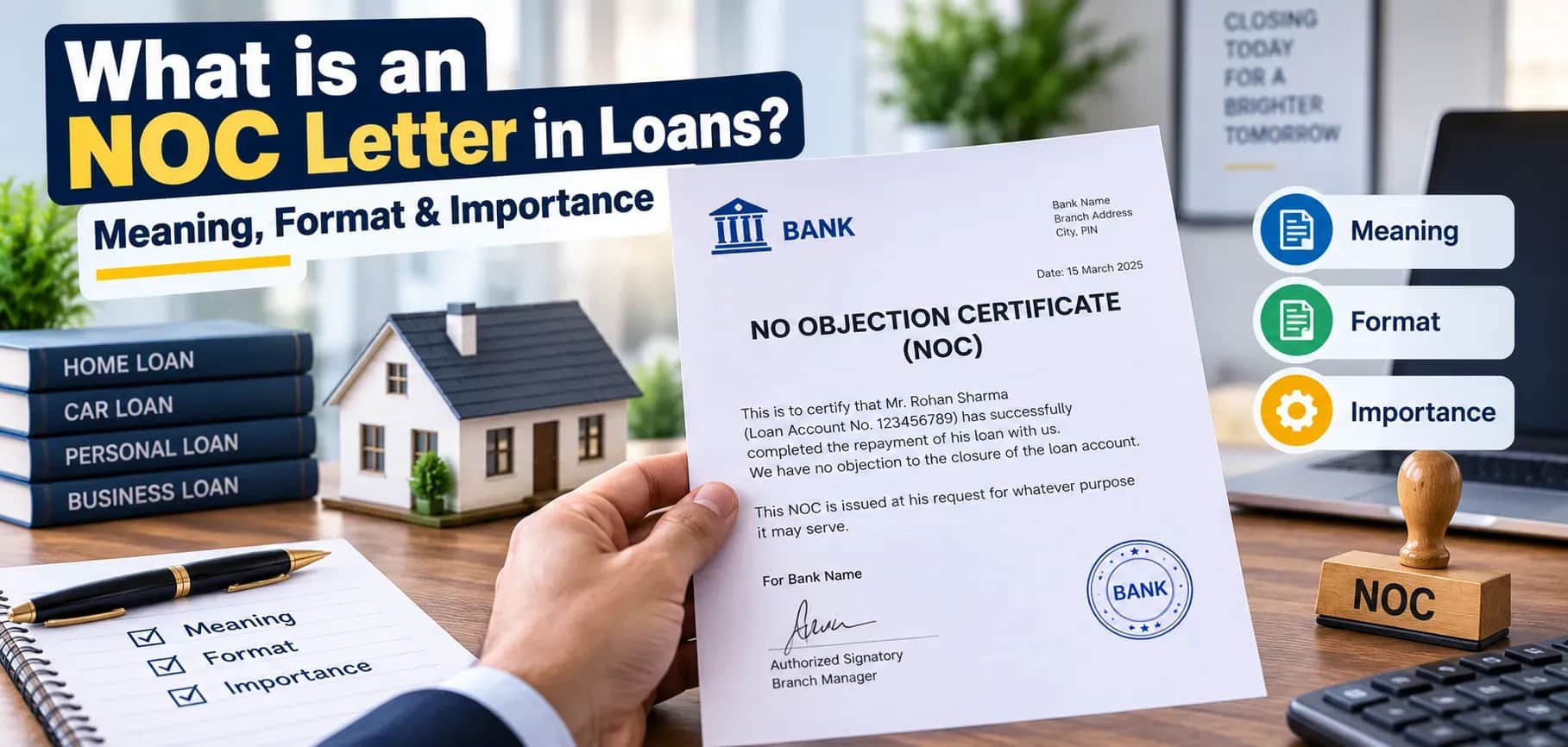
After loan disbursement, EMI payment becomes your priority. No matter if you have a home loan, vehicle loan, or personal loan, you have to repay it within a given time. Just paying EMI on time and completing the loan isn't the last stage. After final payment you should make sure that your lender also has closed this loan. You need an official document or statement that ensures you have paid all the loan successfully. Banks provide this type of certificate which is called No Dues Certificate (NDC) or No Objection Certificate (NOC). According to the RBI, lenders should release original property documents and remove registered charges within 30 days after full repayment or settlement.
A Loan Closure Certificate is an official document which is issued by a bank or NBFC after you fully repay your loan. This closer certificate confirms that you have paid all your principal, interest, late fees, processing fees, and other applicable charges. It also confirms that you have no pending dues with the lender.
Leander uses No Due Certificate (NDC), No Objection Certificate (NOC), and Loan Closure Certificate interchangeably but there is a small difference between them.
No Due Certificate (NDC): This is an official document that confirms you have paid all dues for the loan and nothing is pending.
No Objection Certificate (NOC): This is a document that confirms the lender has no objection to a specific action, like removing its claim from an asset
Loan Closure Certificate: This is an official confirmation that the loan account has been closed in the lender’s records.
Loan Closure Certificate is an important document so you should keep it safely even after the loan ends. It has all your loan details because it contains information about:
This certificate is necessary in future. It is proof that you have all your debt.
If you fail to obtain this document, it can lead to severe operational and financial bottlenecks down the line.
Banks regularly send your loan payment details to credit bureaus. From January 1, 2025, credit institutions are required to update credit information on a fortnightly basis, generally as of the 15th and the last day of each month. The lender reports the closed account to credit bureaus, which then update the credit report and the credit report shows the status “closed”. If the lender does not complete the closure process, your loan may continue to show as “Active” or may incorrectly show a small overdue amount. This can affect your credit score.
It also help to remove Liens and get Your Property Documents
For secured loans like home loans, the lender holds your original property documents as security. After you close the loan, the bank should return these documents and complete the required process to remove its charge from the property records.
The Registration Certificate (RC) usually mentions the lender's hypothecation. After repaying the loan, you can use the lender's NOC and Form 35 to request removal of the hypothecation through the applicable RTO/Parivahan process. The NOC does not itself remove hypothecation; the borrower must complete the applicable RTO/Parivahan process.
A small unpaid amount can sometimes remain because of an accounting or calculation error. Your NDC/NOC provides written proof that you have cleared the loan and helps you resolve any future dispute about pending dues.
Your responsibility isn't ended after paying all the loan. Here are some steps you should follow:
After the final payment is processed you should request the Loan Closure Certificate through your lender’s net banking portal, such as e-Services, Certificates, or submit a written request at your home branch. Keep your final payment receipt ready.
You should collect all original property deeds and title documents from the lender within 30 days of full loan closure, as mandated by the RBI to avoid penalties. Simultaneously, check these returned assets against the original List of Documents (LOD) you received at loan inception. For payment mechanisms, you should ensure that applicable NACH or e-Mandates are officially cancelled with your bank, and request your lender to securely destroy or return any remaining unused post-dated or security cheques.
Next, verify that the lender officially completes the required charge satisfaction process with CERSAI, where applicable (this applies strictly to secured collateral like a home or property loan). If you are closing a vehicle loan, you must take the lead on the transport registry side: manually submit the lender’s NOC and Form 35 to your local Regional Transport Office (RTO) to formally strip the hypothecation status from your vehicle’s Registration Certificate (RC).
Download your updated credit report from CIBIL, Experian, or CRIF High Mark. Check that your loan status shows “Closed” and not “Settled,” “Written Off,” or “Active.”
A Loan Closure Certificate is an important proof that you have fully repaid your loan and have no outstanding dues with the lender. After making the final payment, don't consider the process complete until you confirm that the loan account is properly closed. Request the NDC/NOC or Loan Closure Certificate, collect your original documents, ensure applicable liens or hypothecation are removed, and check your credit report to confirm that the account is marked “Closed” rather than “Settled” or “Active.” For secured loans, also verify that the lender has completed the required charge-release process. Keeping these documents safely can protect you from future disputes and make it easier to prove that your loan obligations have been fully completed.
They serve a similar purpose but may be issued under different names by lenders. Both can confirm that the borrower's outstanding dues have been cleared. The exact document provided depends on the lender and loan type.
No. The lender must report the updated account status to the relevant credit information companies, and the change may take time to appear on your credit report. You should check the report after the lender's reporting cycle.
A loan is generally marked closed when the borrower repays the dues in full according to the loan terms. A settled status generally means the lender has accepted an amount lower than the total outstanding dues. These statuses can have different implications for your credit profile.
Usually, the lender will issue the closure document only after all amounts payable under the loan have been cleared. Check with the lender for any remaining interest, fees or other charges before assuming the account is fully closed.
The RBI's September 2023 directions require regulated entities to release original movable or immovable property documents and remove charges registered with any registry within 30 days of full repayment or settlement of a personal loan account. The rule is specifically about release of documents and removal of charges, rather than prescribing a universal 30-day deadline for issuing a document called a loan closure certificate.
If the lender delays releasing the original movable or immovable property documents or filing charge satisfaction beyond the applicable 30-day period, and the delay is attributable to the lender, the RBI directions provide for compensation of ₹5,000 per day of delay. The ₹5,000/day compensation for delayed document release applies when the delay is attributable to the lender.
The lender must assist the borrower in obtaining duplicate or certified copies of the documents and bear the associated costs. The RBI directions also provide for compensation in such cases, subject to the additional period specified in the directions.
It is still advisable to obtain written confirmation that the loan account has been fully closed. It can serve as a record that there are no outstanding dues and may be useful if the loan status is later reported incorrectly.
Ask the lender in writing to confirm the loan's closure status and provide the applicable closure or no-dues document. Keep proof of the final payment and previous correspondence. If the issue is not resolved, you can use the lender's grievance-redressal mechanism and, where applicable, escalate the complaint under the RBI's complaint framework.
Yes. Confirm that the loan account is reported as closed, the outstanding balance is shown as zero and there are no incorrect overdue amounts. If the information is inaccurate, raise a correction request with the lender and the relevant credit information company.