By continuing, you agree to LoansJagat's Credit Report Terms of Use, Terms and Conditions, Privacy Policy, and authorize contact via Call, SMS, Email, or WhatsApp
The information published on LoansJagat is intended for general informational and educational purposes only and should not be considered financial, legal, or investment advice. Interest rates, loan terms, statistics, and other data may change over time and may vary by lender or source. Please verify the latest information and consult a qualified financial advisor or the respective Bank/NBFC before making any financial decisions.
Subscribe Now
About the author

Diwaker Sharma
Diwaker Sharma is a finance content specialist with expertise in banking, personal finance, credit cards, loans, fintech, and financial news. An MBA in Finance with prior experience in the banking sector, he combines industry knowledge with SEO and content strategy to produce insightful, research-backed articles. Passionate about making finance accessible, he transforms complex financial concepts into clear, engaging content that empowers readers to make smarter financial decisions with confidence.
Related Blog Post
Simplify All Your Loans Into One Affordable EMI

Customers Served

Debt Consolidated

1200+ Reviews

Locations in India
Club all Loans & Credit Card Bills into Single EMI

Quick Apply Loan
Consolidate your debts into one easy EMI.

Takes less than 2 minutes. No paperwork.

10 Lakhs+
Trusted Customers

2000 Cr+
Loans Disbursed

4.7/5
Google Reviews

50+
Banks & NBFCs Offers
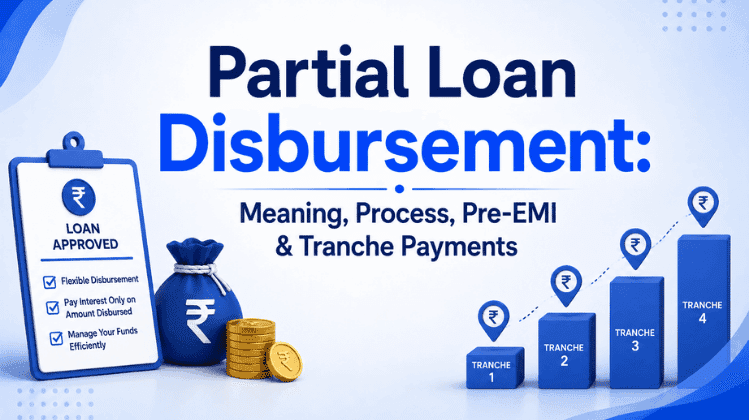
Partial loan disbursement means your lender releases the sanctioned loan amount in stages, rather than as a single lump sum, typically for under-construction properties. According to PNB Housing Finance's own official page, the loan amount for houses or flats under construction gets disbursed in stages based on the progress of construction, with the customer investing their proportionate share of the cost before each disbursement.
Anyone taking a home loan for a property that's still being built eventually encounters the term partial loan disbursement and wonders exactly how it works. This guide is for borrowers across India who want a clear, accurate explanation of what partial disbursement actually means, why lenders structure loans this way, and what it means for your interest payments during the construction period.
Partial loan disbursement, also called tranche or stage-wise disbursement, means your lender releases your sanctioned loan amount in parts, rather than crediting the full amount to you at once.
According to PNB Housing Finance's own official page:
This structure applies specifically because the property itself isn't complete yet, so releasing the full loan amount upfront would mean paying for construction that hasn't actually happened.
Lenders use partial disbursement to match the release of funds with actual verified construction progress. Protecting both the borrower and the lender from releasing money faster than a project genuinely needs it.
According to Axis Bank's own official article:
This approach genuinely reduces risk for the lender, since funds only move once there's verified progress to justify releasing them. The borrower avoids paying interest on money that hasn't actually reached the builder yet.
Pre-EMI is the interest you pay only on the portion of the loan actually disbursed so far, rather than on the entire sanctioned amount, while your loan is still being released in tranches.
According to Tata Capital's own official blog:
Interest during this period accrues from the date of each specific disbursement, meaning your Pre-EMI amount actually grows in steps as each new tranche gets released, rather than staying fixed throughout construction.
Yes, partial disbursement also applies to education loans, where funds get released progressively to match tuition and living expenses as they actually become due across a course.
According to Credila's own official website, formerly HDFC Credila:
Since education costs are typically billed by universities on a semester or yearly basis, this staged approach means the lender releases funds as fees actually become due, mirroring the same underlying logic as construction-linked home loan tranches.
Before agreeing to partial disbursement, check your Pre-EMI obligations, the specific milestones triggering each tranche, and who the funds actually get paid to.
Here's what genuinely matters:
Understanding the difference between these 2 disbursement methods helps you know what to expect based on your specific property or loan type.
*T&C Apply
Suppose a homebuyer is sanctioned a home loan of ₹40,00,000 for an under-construction apartment. Instead of receiving the full amount at once, the lender releases the first tranche once the foundation is verified as complete, then further tranches as the plinth level and flooring stages get confirmed, following the milestone-based structure PNB Housing Finance's own page describes.
During this period, the borrower pays Pre-EMI only on whatever's actually been disbursed so far, keeping their monthly outgo considerably lower than full EMI would require. Once the final tranche is released upon construction completion, their regular EMI, covering both principal and interest, begins as confirmed under the structure Tata Capital's own blog outlines. Anyone planning their finances around a partial disbursement loan can also check a resource like LoansJagat to understand how staggered disbursement affects their overall repayment planning.
Partial loan disbursement is a well-established, standard practice for home loans on under-construction properties and for education loans covering ongoing course costs, with funds released in tranches tied to verified progress rather than as a single lump sum. Since you typically pay Pre-EMI only on the amount actually disbursed during this period, this structure genuinely reduces your interest burden compared to receiving the full loan upfront. Understanding your specific lender's milestone definitions, Pre-EMI terms, and payment destination before agreeing to this structure helps you plan your finances accurately from application through to full repayment.