By continuing, you agree to LoansJagat's Credit Report Terms of Use, Terms and Conditions, Privacy Policy, and authorize contact via Call, SMS, Email, or WhatsApp
Disclaimer: The information published on LoansJagat is intended for general informational and educational purposes only and should not be considered financial, legal, or investment advice. Interest rates, loan terms, statistics, and other data may change over time and may vary by lender or source. Please verify the latest information and consult a qualified financial advisor or the respective Bank/NBFC before making any financial decisions.
Subscribe Now
About the author

Vidhi Chauhan is a copywriter and content writer with extensive experience creating high-quality, SEO-driven content across multiple industries, with a strong focus on fintech. She has written extensively on GST, banking, personal loans, business loans, credit cards, income tax, insurance, and other financial topics, helping Indian readers understand complex concepts through clear, accurate, and engaging content.
Related Blog Post
Simplify All Your Loans Into One Affordable EMI

Customers Served

Debt Consolidated

1200+ Reviews

Locations in India
Club all Loans & Credit Card Bills into Single EMI

Quick Apply Loan
Consolidate your debts into one easy EMI.

Takes less than 2 minutes. No paperwork.

10 Lakhs+
Trusted Customers

2000 Cr+
Loans Disbursed

4.7/5
Google Reviews

50+
Banks & NBFCs Offers
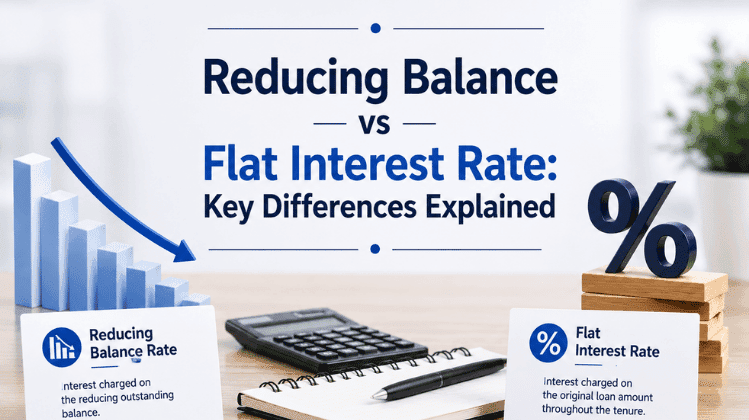
Flat interest rate and reducing balance interest rate are different primarily in terms of interest calculation. While the flat interest rate is calculated based on the initial principal, the reducing balance interest rate is computed based on the remaining principal at the time of repayment. Thus, even two loans bearing the same interest rate could incur varying interest amounts depending on how interest was computed. It is for this reason that understanding the difference between flat and reducing balance interest rates is important when comparing loans, estimating actual repayment capacity, and choosing an appropriate loan that fits one's financial situation. When choosing an interest rate, it would thus be wise to understand how interest rate computation is made, how interest and EMI vary accordingly, and other loan charges that need to be considered.
Consider EMI, loan tenure, fees, and total repayment when selecting loans.
When we talk about a flat interest rate, it is calculated based on the principal amount for the duration of the loan. Irrespective of the amount of outstanding principal balance, the interest amount will remain unchanged despite the fact that you pay EMIs.
Consider that you take a loan of ₹1 lakh for three years at a flat interest rate of 10%. Interest will be charged in such a case as follows:
Flat Interest = Principal × Rate × Tenure ÷ 100
= ₹1,00,000 × 10% × 3
= ₹30,000
Therefore, your total payment will be ₹1,30,000, exclusive of any other fees. Then, the EMI will be decided on the basis of the total payment over the agreed repayment period.
As you may see from above, the basic characteristic of a flat rate of interest is the fact that interest will keep being calculated not on the outstanding principal balance, but on the initial amount of the loan. It helps to make the calculations easier.
On the other hand, a flat interest rate can make the loan seem more profitable in comparison with the reducing balance interest rate. Of course, the rates will be equal in percentage terms. However, the flat rate calculation method ignores the repaid principal balance.
In the case of reducing balance interest, the interest is charged on the outstanding principal amount and not on the total amount of the loan taken. There are two components in each installment: interest and principal. Once you pay off the principal amount, the outstanding balance reduces, and the interest charged will be on that balance.
If you borrow ₹1 lakh and repay ₹5,000 of the principal amount within the first few months, then the outstanding balance becomes ₹95,000. This balance becomes the basis for calculating further interest amounts.
The common formula for EMI calculation in the case of a reducing balance loan is:
EMI =
[P × R × (1+R)^N] / [(1+R)^N – 1]Where,
Even though the EMI amount remains constant in the case of the reducing balance interest rate loan, the EMI structure varies. At the start of the tenure, more of the EMI amount is utilised for interest repayment.
The primary difference lies in the principal amount used for calculating interest.
The difference becomes particularly relevant for larger loans and longer repayment periods. A reducing balance structure can result in lower overall interest because the amount on which interest is charged keeps declining.
Take two imaginary loans of ₹1,00,000 over three years; the first follows the flat rate formula while the second follows the reducing balance rate formula. Even if both have a 10% interest rate, the computation of the interest will definitely differ from each other.
In the flat rate formula, 10% will still be charged against the initial ₹1,00,000 for the whole three years. In the reducing balance rate, interest will be charged according to the remaining balance after each installment payment.
This is the reason why customers cannot compare loan offers solely based on the given interest rate. A 10% flat rate and a 10% reducing balance rate do not carry the same meaning when it comes to the cost of the loan.
EMI, processing fees, pre-payment charges, and other costs also need to be considered.
*T&C Apply
For many people, reducing balance rate can prove more beneficial than the flat interest rate, especially in cases where the loan amount is large or the repayment period is long. Since interest is paid on the remaining principal amount, the interest becomes lesser as the principal amount is paid off.
The flat interest rate could still suit some people due to its simplicity of calculation and repayment period. This can be so easy to calculate since the interest is calculated based on the initial principal throughout the entire repayment period.
It is all about the choice of the right method according to the loan being taken. Short-term and small loans might not have much difference while longer-term and larger loans will have a noticeable difference.
To determine whether a flat or reducing interest rate is better for you, go beyond simply verifying the stated interest rate. These points must be considered:
Calculate how much interest will accrue over the entire period instead of only making a comparison of the stated percentage.
Ensure that the monthly payment falls within the limits of your salary as well as your financial liabilities.
Longer periods could lower EMIs but might raise interest outgoings.
Charges related to processing, penalties for delays in payments, foreclosures, and others may increase the cost of borrowing. The loan documents must indicate the interest calculation process to be used in repayments.
In case the two lending institutions use varied interest calculation processes, compare total repayments instead of the percentages stated by each.
The online loan EMI calculator would help you calculate the amount of monthly payments.
It is important that you know the difference between a reducing balance and flat interest rates when taking up any loan. The flat interest rate computes the interest on the initial principal throughout the period of the loan, while the reducing balance interest rate computes the interest on the outstanding principal after repayment.
While a flat interest rate seems simpler and easier, a reducing balance will most probably save you money through lower interest. You thus do not need to simply go for the lower rate in terms of percentage, but rather check the interest computation system, amount of interest payable, EMI, loan term, and other fees.
Yes, because the amount of savings depends on how much of the principal is left at the time of payment. Always verify whether the lender allows partial prepayment or there are any restrictions and/or fees involved.
No, some loans have variable or floating interest rates. Verify the terms of the sanction letter/loan agreement to see whether your rate of interest is fixed or not.
The annual interest rate does not provide a complete picture of all the expenses involved in borrowing. Comparing the total amount payable, taking into account all relevant fees and charges, helps.
Yes, because the percentage allocated to the repayment of the principal and interest will be different based on the loan and repayment structure. It is always good to look at the amortisation schedule to get insight into how the payment is made.
An amortisation schedule offers a detailed view of how much of the principal, interest, and remaining balance are included in each installment. People who borrow money need to have a look at this.
Yes, but sometimes a longer period means that you will be paying interest for a long time. People should consider both factors carefully.
Yes, a lender might take into consideration the credit history and other relevant aspects during the process of defining the terms for an applicant. A better credit score is likely to increase the odds of obtaining more attractive terms.
Reading the loan agreement allows the borrower to find out what terms will be attached to his obligations to repay the money he borrows.
Yes, the upfront costs raise the cost of borrowing despite the fact that they are not accounted for in the interest rate. This will enable a borrower to compare the total cost of each loan offer.
One needs to consider other issues such as the possibility of flexible repayment and prepayment options.