By continuing, you agree to LoansJagat's Credit Report Terms of Use, Terms and Conditions, Privacy Policy, and authorize contact via Call, SMS, Email, or WhatsApp
Disclaimer: The information published on LoansJagat is intended for general informational and educational purposes only and should not be considered financial, legal, or investment advice. Interest rates, loan terms, statistics, and other data may change over time and may vary by lender or source. Please verify the latest information and consult a qualified financial advisor or the respective Bank/NBFC before making any financial decisions.
Subscribe Now
In case there is a loan account having an overdue amount for a certain number of days, the same could be placed under the relevant category of Special Mention Account (SMA). SMA stands for Special Mention Account and is an indicator of the stress on the account. An SMA is a preliminary categorisation of the account before it gets classified as an NPA as per the relevant guidelines. It does not always mean that the borrower has become an NPA; however, the non-payment of the due amount could make the account graduate through SMA stages and ultimately get categorised as an NPA after crossing the relevant due date period. The significance of knowing the procedure in case of an SMA loan account is to know the possible consequences and take remedial measures.
Here, SMA stands for 'Special Mention Account'. An SMA loan account is a loan account wherein the payment of principal, interest, or other amount becomes overdue for a certain period of time.
This is not an NPA because the account has not passed the threshold limit to be considered an NPA. The reason behind this is that it is not just to classify the borrower as a defaulter, but also to take early corrective measures.
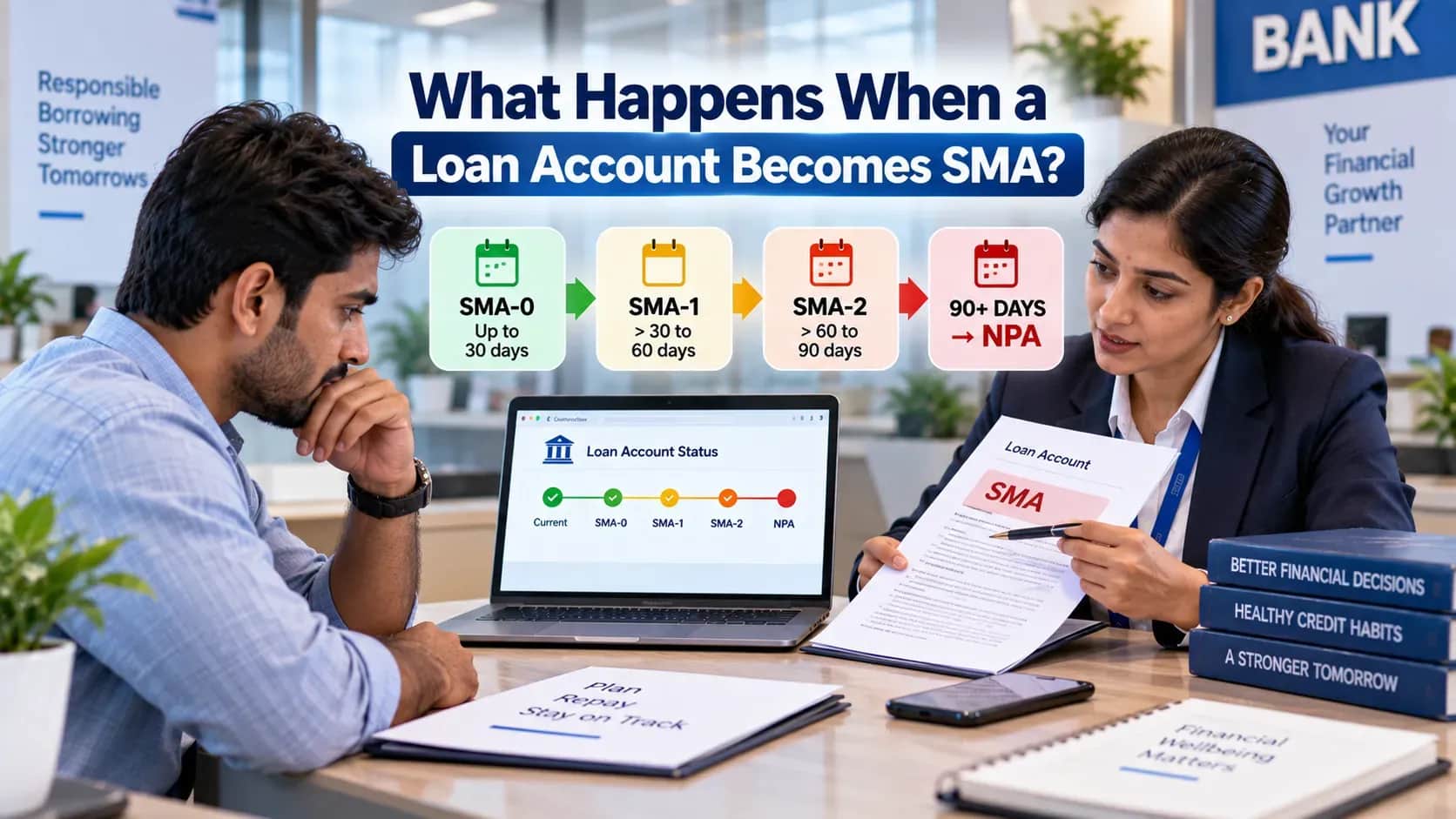
For the regular loans, RBI categorisation depends upon the number of days overdue for an amount. Thus, SMA-0 refers to the case where an amount is overdue within 30 days; SMA-1 refers to an amount being overdue from 30 days to 60 days, while SMA-2 refers to an amount overdue from 60 days to 90 days. When the amount is overdue for more than 90 days, the account may be categorised as NPA, subject to the relevant regulatory guidelines.
As for example, if your EMI is due on the 5th of every month and you fail to pay it, then the category for SMA would depend upon the number of days the amount remains overdue, rather than simply due to missing the EMI.
A number of steps can be taken by the lender once an account is tagged as SMA. There are variations in the procedure followed by various lenders and different loan products, but the following steps may be involved.
Once the payments fall behind schedule, the system can recognise the account as under pressure.
An account might be monitored more frequently, especially the longer it goes without payment.
There could be a review of issues such as:
And that is why it is important to pay attention to reminders about overdue EMIs.
You might be contacted by the creditor via SMS, email, telephone calls, through the app, or any other means of communication to remind you of the outstanding amount.
Such communications are essential as they allow for the resolution of the outstanding amount without having your account go beyond this stage.
Even if you cannot make payments for some time, it is always wise to contact the creditor rather than ignore such communications.
SMA categorisation is not always an absolute process.
Where the amount of money due has not been paid by the borrower, the loan can progress from one SMA category to another over time.
As follows:
Non-payment, followed by SMA-0, SMA-1, SMA-2, and finally NPA.
This shows that time plays a role here.
The person who clears the amount of money due earlier will be able to prevent further categorization.
As the loan progresses towards the 90-day period, there might be more follow-ups required.
This will involve the lender asking the debtor to settle outstanding payments or explain why there has been a difficulty in settling the payment.
Where there is a need for business cases, there might be additional follow-ups on cash flow, financial reports, or accounts management.
This will help establish whether it is a temporary situation or a permanent issue of repayment difficulties.
There are instances where a prompt approach can prove to be very significant.
It would be wise not to depend only on your recollection of the EMI that is due.
The information to be determined would include:
Total amount needed to regularise the account.
In case the payment was not made due to cash flow challenges, paying the overdue amount in full could save your account from additional problems.
Check the amount owed before paying.
If you cannot make the payments due at once, reach out to your lender.
Depending on the situation and the lender’s policy, the following options can be considered:
These are not guaranteed rights and will vary depending on lenders, types of loans, and borrowers’ situations.
Another mistake that people usually make is taking another loan from somewhere else just to settle their EMI.
It may help solve the problem of a month's liquidity, but at the same time, it may put them into bigger debt.
Before making a new loan, check the interest rate, processing fee, duration, and overall repayment of that loan.
Making payments is not always the end of the story.
Make sure that the outstanding amount has been settled properly in your loan account.
SMA classification acts as a warning signal that indicates that there are some issues with the repayment of the loan account. One should understand that despite the fact that at this point in time the loan is not an NPA, the continuation of defaulting on payments will result in the transition of the account from SMA-0 to SMA-1 and further to SMA-2 depending on the number of days it is overdue, until it becomes an NPA.
Yes, the classification of any loan as an SMA could be altered if the loan gets regularised; however, that would depend on certain RBI rules and regulations, as well as the type of loan account and procedure followed by the lender. Just because the loan amount gets cleared doesn’t necessarily imply that the classification will get reversed.
SMA classification may make the banks cautious while evaluating the repayment capacity of the borrower. The loan eligibility also depends on various other aspects such as the income, obligations, and credit history of the borrower, and the discretion of the lender.
The borrower may approach the lender in case he feels that the classification of the loan as an SMA is wrong and prove this fact by presenting relevant documents.
It would be best if you kept receipts of payments, transaction numbers, updated statements of the loan, and written proof of the status of your account. This document will be helpful in case there is any dispute about the loan account or your credit report.
No, because regularising an account depends on various conditions set forth by the relevant authorities and the judgment of the lenders about your account. It would be best if you consult with the lender regarding the outstanding balance of your account.
Yes, this is possible since repayment stress might recur after regularising the loan account if payments are missed.
The classification as an SMA borrower does not necessarily imply that all other properties related to the borrower will cease to exist. Nevertheless, the bank may review and change credit facilities based on its own policy and loan agreements.
The SMA classification will be controlled by RBI regulations, which apply to the loan concerned. The following categories of SMA apply to normal loans depending on the period the amount is overdue. SMA-0 applies if the amount is overdue for 0-30 days; SMA-1 for 31-60 days and SMA-2 for 61-90 days. There are some cases where the applicable norms vary.
Review the payment dates, overdue amount, interest calculation, charges, and the status of the account, as reflected in the documents provided by the lending institution. Matching the above information with your bank statements can help detect any issues at an early stage.
10. How can the borrowers prevent themselves from being classified as SMA customers on multiple occasions?
Automating the process of EMI payments, having enough balance prior to the due date, and planning for future obligations are ways of preventing oneself from missing one's loan repayment schedule. Having an emergency fund can be helpful too.
About the author

Vidhi Chauhan
Vidhi Chauhan is a copywriter and content writer with extensive experience creating high-quality, SEO-driven content across multiple industries, with a strong focus on fintech. She has written extensively on GST, banking, personal loans, business loans, credit cards, income tax, insurance, and other financial topics, helping Indian readers understand complex concepts through clear, accurate, and engaging content.
Related Blog Post
Simplify All Your Loans Into One Affordable EMI

Customers Served

Debt Consolidated

1200+ Reviews

Locations in India
Club all Loans & Credit Card Bills into Single EMI

Quick Apply Loan
Consolidate your debts into one easy EMI.

Takes less than 2 minutes. No paperwork.

10 Lakhs+
Trusted Customers

2000 Cr+
Loans Disbursed

4.7/5
Google Reviews

50+
Banks & NBFCs Offers
Other services mentioned in this article