By continuing, you agree to LoansJagat's Credit Report Terms of Use, Terms and Conditions, Privacy Policy, and authorize contact via Call, SMS, Email, or WhatsApp
The information published on LoansJagat is intended for general informational and educational purposes only and should not be considered financial, legal, or investment advice. Interest rates, loan terms, statistics, and other data may change over time and may vary by lender or source. Please verify the latest information and consult a qualified financial advisor or the respective Bank/NBFC before making any financial decisions.
Subscribe Now
About the author

Ananya Shrivastava
Ananya Shrivastava is a Content Writer specialising in finance-focused news, blogs, and long-form articles on Indian markets, RBI policy, personal finance, and lending. She has authored over 450 blogs and 250 news pieces, combining technical knowledge with rigorous research to simplify complex financial concepts into clear, engaging content. With a marketing-driven lens and sharp editorial judgment, she consistently achieves top Google rankings while ensuring every claim is backed by verified data.
Related Blog Post
Simplify All Your Loans Into One Affordable EMI

Customers Served

Debt Consolidated

1200+ Reviews

Locations in India
Club all Loans & Credit Card Bills into Single EMI

Quick Apply Loan
Consolidate your debts into one easy EMI.

Takes less than 2 minutes. No paperwork.

10 Lakhs+
Trusted Customers

2000 Cr+
Loans Disbursed

4.7/5
Google Reviews

50+
Banks & NBFCs Offers
When EMIs eat up most of your salary, you have several ways to bring things under control: a balance transfer to a lower rate, a debt consolidation loan combining multiple debts into 1 EMI, loan restructuring, or, in serious cases, a One-Time Settlement. You can merge several loans into a single account with a lower blended rate, which can meaningfully cut your monthly outflow. A platform like LoansJagat helps you compare consolidation offers before you commit to one.
Anyone watching most of their paycheck disappear into EMIs before it even reaches their bank account eventually asks what to do when their EMIs take up most of their salary. This guide is for borrowers across India juggling multiple loans, whether personal or credit card, or who want practical, realistic options to bring their monthly outflow back under control. It covers how to check if your EMIs have crossed a risky threshold, how balance transfer and debt consolidation actually work, and what happens if repayment genuinely becomes impossible.
It means your Fixed Obligation to Income Ratio, or FOIR, has climbed well above what banks consider a safe, manageable range, which signals financial strain rather than just tight budgeting.
FOIR is the ratio between your fixed monthly obligations and your gross income, and it states that a credible borrower's FOIR typically sits within 40% to 55%. When your EMIs push past this range and start consuming the bulk of your salary, you're left with little room for essential expenses, savings, or unexpected costs. This isn't just a lender's abstract concern either. It directly affects your own ability to handle a medical emergency, a job change, or any disruption to your regular income.
You calculate this by adding up every EMI you're currently paying, dividing that total by your gross monthly income, and multiplying by 100 to get your actual FOIR.
Here's the formula for calculating your EMIs:
FOIR = (Total Monthly EMI Obligations ÷ Gross Monthly Income) × 100
Follow these steps to work out your own number:
A FOIR above 50% suggests significant debt obligations and signals higher risk, which is where most borrowers start feeling their EMIs take up most of their salary rather than just a manageable chunk of it.
A few structured paths exist depending on how serious your situation actually is, ranging from simply moving to a better rate to settling a defaulted account.
Debt consolidation tends to offer the biggest relief, since it doesn't just lower 1 loan's rate for most borrowers whose EMIs have simply grown unmanageable across several debts. It folds everything, including expensive credit card debt, into a single lower cost payment.
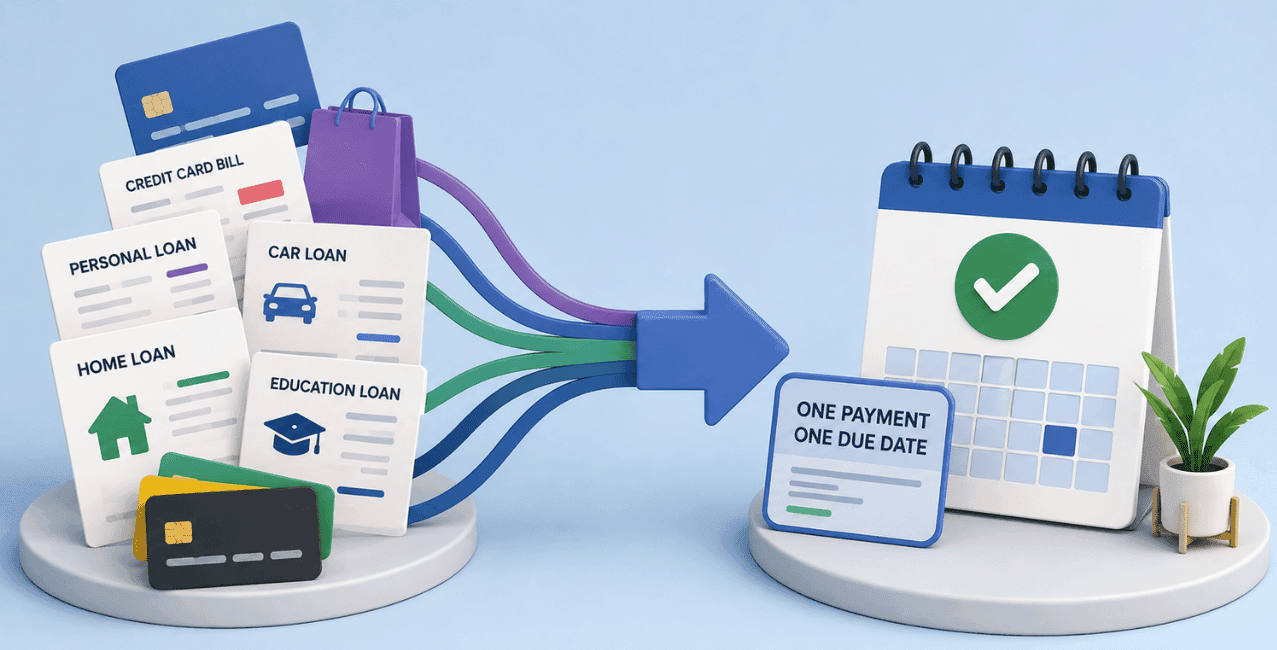
Debt consolidation means combining multiple existing debts, personal loans, credit card dues, and other EMIs, into 1 new loan with a single, often lower, monthly payment.
This matters most when credit card debt is part of the mix, since card interest typically runs 30% to 40% annually, far higher than a consolidated personal loan rate, meaning consolidation often cuts your total interest cost significantly, not just your monthly payment.
You consolidate your debts by applying for a new loan to cover your combined outstanding balances, then letting the lender use those funds to close your existing accounts.
Here is how the process of debt consolidation works:
Nominal charges like foreclosure fees and processing fees typically apply during this process, though the interest savings from consolidating expensive debt onto a lower rate usually outweigh these costs over time. Since comparing this across lenders manually takes time, this is where LoansJagat simplifies debt consolidation for borrowers.
LoansJagat's debt consolidation loan is built to turn several EMIs into 1, comparing real offers from banks and NBFCs so you're not doing this legwork on your own.
LoansJagat compares offers from 50+ partnered banks and NBFCs together, covering loans up to ₹50 lakhs across both unsecured and secured consolidation routes, so you're not checking each lender's site individually.
Submit your basic details, and LoansJagat returns instant loan offers within 2 minutes, giving you a real sense of what rate and amount you'd actually qualify for before you commit to anything.
A dedicated loan manager handles your case end-to-end, and applications get routed to lenders in a controlled manner rather than sent out indiscriminately, protecting your credit score from unnecessary multiple inquiries.
LoansJagat coordinates foreclosure letters, NOCs, and the rest of the paperwork on your behalf, and where the lender permits it, also supports lender-to-lender payout so your old debts get closed directly.
The entire process runs 100% paperless, with no upfront fee for sanction or disbursal, so there's no cost barrier to simply checking what you'd qualify for.
Interest rates start at 9.99% per annum, going up to 17% depending on your credit profile, and many users cut their combined EMI by up to 50%, spread over a repayment tenure of 2 to 7 years.
Final approval always rests with the lender, but once your debt consolidation loan is sanctioned, multiple EMIs become just 1.
If repayment genuinely becomes impossible even after consolidating, options include requesting your bank to restructure the loan or, in more serious cases, applying for a One-Time Settlement once the account has turned into a Non-Performing Asset.
Reaching out to your lender before you actually miss a payment, rather than after, generally gives you more options and better terms to work with.
A One-Time Settlement is a negotiated arrangement where a lender accepts a reduced lump sum from a defaulting borrower to fully close a loan account, reserved for situations of genuine financial hardship rather than a first resort.
According to RBI's own Framework for Compromise Settlements and Technical Write-offs, dated June 8, 2023, this framework applies once an account has already turned into a Non-Performing Asset, typically after 90 days of missed payments. The same framework confirms a minimum 12 month cooling period applies for non-farm credit before that lender can extend fresh credit to you again. Since a settled account gets reported differently on your credit report than a fully closed one, this option is best considered only after balance transfer, debt consolidation, or restructuring have genuinely been ruled out.
Each option suits a different stage of financial difficulty, from simply wanting a better rate to genuinely being unable to repay at all.
*T&C Apply
Take a salaried employee earning ₹80,000 a month, currently paying EMIs across a personal loan and credit card dues that together consume ₹42,000 monthly. Here's how the numbers actually break down.
By consolidating both debts into a single new loan at a lower blended rate, the combined EMI drops from ₹42,000 to ₹31,500, bringing the FOIR down from 52.5% to a comfortable 39.4%, well within the range banks consider acceptable.
When your EMIs take up most of your salary, debt consolidation is usually the most effective first step, since combining your existing debts, especially expensive credit card dues, into 1 lower rate loan can meaningfully cut both your monthly outflow and total interest cost. A balance transfer works well too if it's really just 1 loan carrying a higher rate than what's available elsewhere. If you're genuinely struggling even after taking these steps, approaching your lender for restructuring before missing a payment keeps more options open. A One-Time Settlement should stay a last resort, since the RBI's own framework makes clear this path carries real, lasting consequences for your credit profile.
Calculate your exact FOIR to confirm how serious the situation is, then explore debt consolidation to combine your existing debts into 1 lower EMI.
If your total monthly EMI obligations divided by your gross income and multiplied by 100 exceeds 50%, your EMI burden is generally considered high by most lenders.
A balance transfer moves 1 existing loan to a new lender for a better rate, while debt consolidation combines several debts, loans, and credit cards into 1 new loan.
Yes, especially if credit card debt is part of the mix, since moving that balance off its 30% to 40% interest rate onto a lower consolidated rate reduces what you pay overall.
Loan restructuring modifies your existing loan's terms with your current lender, while debt consolidation combines multiple debts into 1 entirely new loan.
Only after your account has genuinely become unmanageable and other options like debt consolidation, balance transfer, or restructuring have already been ruled out.
RBI's own framework confirms a minimum 12 month cooling period applies for non-farm credit before that specific lender can extend fresh credit to you again.
No, since your consolidated loan stays active and in good standing, unlike a settlement which gets reported differently on your credit report.
Nominal charges apply, including foreclosure fees on your existing loans and processing fees for the new consolidated loan, though interest savings usually offset these over time.
LoansJagat lets you compare debt consolidation offers across several lenders, check your FOIR, see eligibility criteria, and view your EMI outflow before and after consolidation, all in 1 place.