By continuing, you agree to LoansJagat's Credit Report Terms of Use, Terms and Conditions, Privacy Policy, and authorize contact via Call, SMS, Email, or WhatsApp
Disclaimer: The information published on LoansJagat is intended for general informational and educational purposes only and should not be considered financial, legal, or investment advice. Interest rates, loan terms, statistics, and other data may change over time and may vary by lender or source. Please verify the latest information and consult a qualified financial advisor or the respective Bank/NBFC before making any financial decisions.
Subscribe Now
About the author

Ananya Shrivastava
Ananya Shrivastava is a Content Writer specialising in finance-focused news, blogs, and long-form articles on Indian markets, RBI policy, personal finance, and lending. She has authored over 450 blogs and 250 news pieces, combining technical knowledge with rigorous research to simplify complex financial concepts into clear, engaging content. With a marketing-driven lens and sharp editorial judgment, she consistently achieves top Google rankings while ensuring every claim is backed by verified data.
Related Blog Post
Simplify All Your Loans Into One Affordable EMI

Customers Served

Debt Consolidated

1200+ Reviews

Locations in India
Club all Loans & Credit Card Bills into Single EMI

Quick Apply Loan
Consolidate your debts into one easy EMI.

Takes less than 2 minutes. No paperwork.

10 Lakhs+
Trusted Customers

2000 Cr+
Loans Disbursed

4.7/5
Google Reviews

50+
Banks & NBFCs Offers
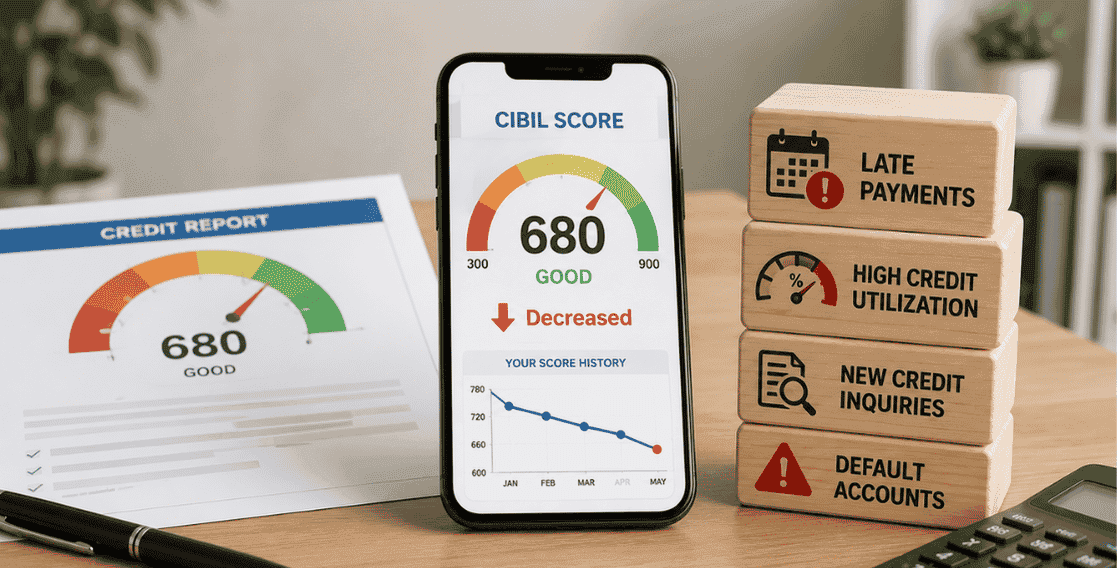
Late payments, high credit utilisation, a settled or written-off loan, closure of an old credit card, and multiple loan applications within a short span are common causes of most CIBIL score declines. CIBIL identifies payment history, credit utilisation, credit age, and recent enquiries as the core inputs used to calculate the score, so any change in these factors is reflected in the score.
Key Takeaways
TransUnion CIBIL is one of the four credit information agencies operating in India, subject to the Credit Information Companies (Regulation) Act, 2005. The repayments provided by the banks and NBFCs to TransUnion CIBIL are compiled and formulated into a three-digit number between 300 and 900. A downgrade typically means that the change has been witnessed within the latest reporting cycle.
For example, these changes could be missing payments on time, an increase in the balance owed, closing of an account, or applying for new credit. Under the current fortnightly reporting cycle, such changes are reflected within approximately 15 days, compared with the earlier 30 to 40 day cycle.
Late payments, high credit utilisation, loan settlements, account closures, and multiple credit enquiries account for most score declines. Each is reported separately to CIBIL and carries a different degree of impact.
According to CIBIL's description of the scoring process, payment history, credit utilisation, credit age, and enquiries are the core inputs used to calculate the score. A decline in performance is not generally caused by a technical problem on its own. In fact, more often than not, the cause can be traced back to one of these four variables.
| Cause | Typical Point Impact | How Long It Stays on Record |
| Missed EMI or late payment | 50 to 100 points | Several years |
| High credit utilisation | 20 to 75 points | Reverses once utilisation falls |
| Loan settlement or write-off | 75 to 150 points | Several years |
| Closure of an old credit account | 10 to 40 points | Permanent reduction in credit age |
| Multiple credit enquiries | 5 to 20 points per cluster | 12 months on the report |
CIBIL does not publish exact point deductions for individual events. The ranges above are commonly observed industry estimates, not official figures, and the actual impact on any individual score depends on the borrower's overall credit profile.
Determining the variable that is causing the decline enables you to fix the problem at the root.
A missed EMI or credit card due date is one of the most significant causes of a score decline. One late payment can cause a decrease in score between 50 and 100 points depending on the credit status of the borrower.
Anil Verma, aged 36 years, is a sales manager residing in Jaipur, and had a CIBIL score of 776 in April 2025. He was 12 days late for his credit card payments during the period of city change, with the total amount of ₹42,000 due on his card. In the following reporting cycle, his score fell to 704, a decline of 72 points.
A missed payment affects a credit profile in the following ways:
Credit utilisation, the proportion of available credit being used, ranks second only to payment history in its influence on the score. A ratio above 30 to 40 percent is generally regarded by lenders as an indicator of financial strain.
The utilisation ratio is obtained by dividing the outstanding balance by the total credit limit. With the credit limit being ₹1,00,000, the outstanding balance of ₹70,000 is enough to make the utilisation ratio 70% of the total limit, which is high-risk. The relationship holds in both directions, so an increase in utilisation from a low level to a high one can reduce the score by a similar margin.
| Credit Limit | Outstanding Balance | Utilisation Ratio | Effect on Score |
| ₹1,00,000 | ₹25,000 | 25% | Supports score stability |
| ₹1,00,000 | ₹45,000 | 45% | Marginal negative effect |
| ₹1,00,000 | ₹70,000 | 70% | Considered high risk |
| ₹1,00,000 | ₹90,000 | 90% | Associated with a sharp decline |
Closing an old credit card can reduce a score, as it shortens the average length of credit history and lowers the total available credit limit.
Credit age, the length of time accounts have been held, is one of the four core factors used in CIBIL's calculation. Closing an old account affects a credit profile in the following ways:
An older card with no annual fee is often retained for this reason, even when used only occasionally.
A loan marked "settled" rather than "closed" has a considerable and lasting negative effect on the score, since it indicates the borrower repaid less than the amount originally owed.
When a lender agrees to a reduced payoff on a loan or credit card, the account status is reported as settled rather than closed.
| Account Status | What It Means | Effect on Future Applications |
| Closed | Full amount repaid as originally agreed | Generally viewed favourably |
| Settled | Lender accepted a reduced amount | Viewed as a repayment risk for several years |
| Written off | Lender has stopped pursuing recovery | Viewed as the most severe negative status |
Both statuses affect a credit profile more severely than a limited number of late payments, so full repayment is generally preferable to a settlement wherever it is financially feasible.
Applying for several loans or credit cards within a short period can reduce a score, since each formal application generates a hard enquiry that is recorded and reviewed by future lenders.
The two types of enquiries differ as follows:
A limited number of hard enquiries spread across a year has minimal effect on the score.
Five or six formal applications within two or three months can be interpreted by lenders as an indication of financial stress, even if every application is eventually approved.
Comparing loan offers through pre-qualification checks, which register only as soft enquiries, is a more common approach while evaluating credit options.
A reporting error, such as a loan incorrectly marked as overdue or a closed account shown as active, can cause a score to decline without any actual change in repayment behaviour.
Lenders occasionally submit incorrect data to CIBIL, and in some cases a payment made on time is recorded late due to a processing delay. Under the RBI's directive of October 2023, credit information companies are required to notify borrowers when their report is accessed, and to state the reason if a correction request is rejected.
When a score declines with no corresponding change in repayment behaviour, the following steps are generally taken:
How Frequently Is a CIBIL Score Updated Now?
The CIBIL score has been updated every 15 days since January 1, 2025, against the monthly cycle prior to that date. This means both favourable and unfavourable changes in repayment behaviour are reflected in roughly half the time.
*T&C Apply
| Aspect | Before January 1, 2025 | After January 1, 2025 |
| Reporting frequency | Monthly | Fortnightly, on the 15th and last day of each month |
| Lender submission window to bureaus | Not fixed at 7 days | Within 7 calendar days of the fortnight |
| Bureau data ingestion window | 7 calendar days | Reduced to 5 calendar days |
| Time for a missed payment to appear on record | Up to about 40 days | About 15 days |
The RBI notification, RBI/2024-25/60, dated August 8, 2024, was issued to provide lenders with more current data for underwriting decisions. It also allows an improvement in repayment behaviour to be reflected sooner than under the previous monthly cycle.
Restoring your lost score would entail clearing off any outstanding dues, ensuring the credit usage is less than 30%, restricting applications for any new credit, and checking the report for inaccuracies.
Following these processes consistently will always lead to positive results within two to three reporting cycles.
Conclusion
There is always a reason for a fall in the CIBIL score, which may be either non-payment of an amount, high utilisation ratio, any kind of settlement, account closure, or a bunch of inquiries. Reviewing the latest credit report is the appropriate starting point, followed by addressing the specific factor responsible for the decline. With fortnightly reporting now in place, consistent repayment behaviour and controlled credit usage are reflected in the score more quickly than under the earlier monthly cycle.
A single missed EMI can reduce a score by 50 to 100 points, depending on the existing credit profile.
No, checking one's own score is recorded as a soft enquiry and does not affect the CIBIL score.
A missed payment or default typically remains on record for several years.
It is a widely followed guideline rather than a fixed rule, and staying below this level generally supports score stability.
Repaying a loan on schedule or ahead of time does not reduce the score and can support a longer, positive credit history.
This is possible only if full repayment is renegotiated and the lender updates the status with the bureau.
A single hard enquiry usually results in a small, temporary reduction of a few points.
Under the fortnightly reporting cycle, improvements can appear within about 15 days, compared with up to a month previously.
Yes, a default on a jointly held loan affects the CIBIL score of both the applicant and the co-applicant.
Credit information companies are required to provide one free full credit report each year, accessible on their official websites.