By continuing, you agree to LoansJagat's Credit Report Terms of Use, Terms and Conditions, Privacy Policy, and authorize contact via Call, SMS, Email, or WhatsApp
Disclaimer: The information published on LoansJagat is intended for general informational and educational purposes only and should not be considered financial, legal, or investment advice. Interest rates, loan terms, statistics, and other data may change over time and may vary by lender or source. Please verify the latest information and consult a qualified financial advisor or the respective Bank/NBFC before making any financial decisions.
Subscribe Now
About the author

LoansJagat Team
‘Simplify Finance for Everyone.’ This is the common goal of our team, as we try to explain any topic with relatable examples. From personal to business finance, managing EMIs to becoming debt-free, we do extensive research on each and every parameter, so you don’t have to. Scroll up and have a look at what 15+ years of experience in the BFSI sector looks like.
Related News
Simplify All Your Loans Into One Affordable EMI

Customers Served

Debt Consolidated

1200+ Reviews

Locations in India
Club all Loans & Credit Card Bills into Single EMI

Quick Apply Loan
Consolidate your debts into one easy EMI.

Takes less than 2 minutes. No paperwork.

10 Lakhs+
Trusted Customers

2000 Cr+
Loans Disbursed

4.7/5
Google Reviews

50+
Banks & NBFCs Offers
Other services mentioned in this article
Key Takeaways
The Indian rupee is no longer merely reacting to global uncertainty. It is beginning to reflect a deeper economic stress that policymakers can no longer ignore.
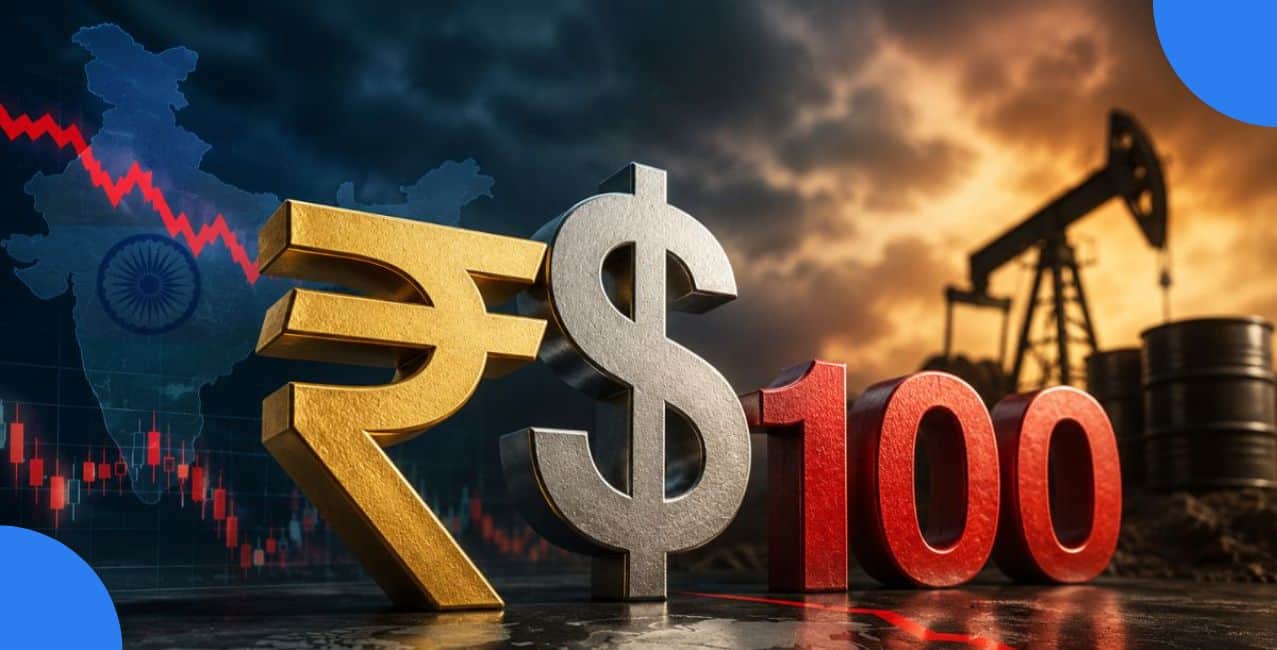
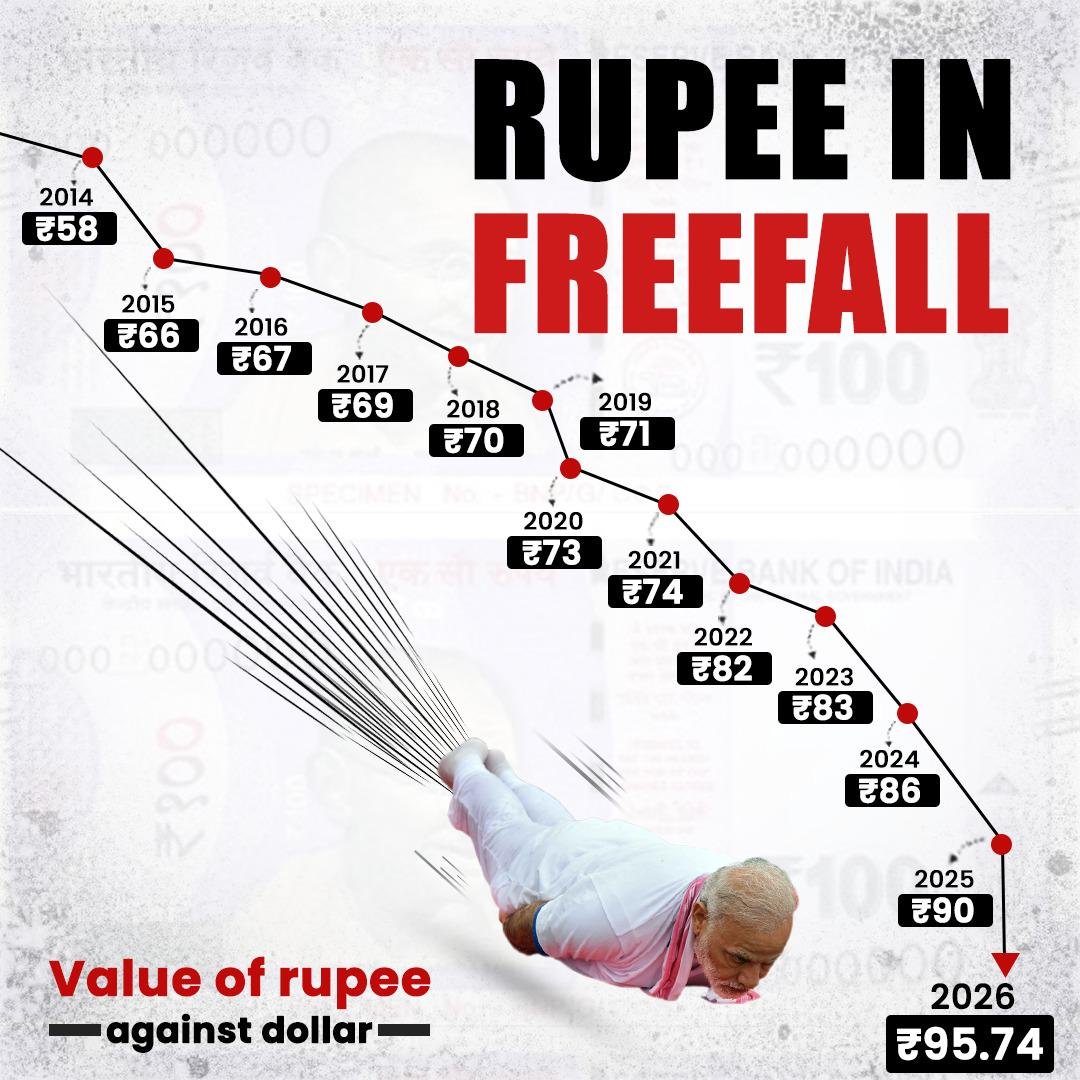
The Indian currency has dipped from 85 to 95, recently touching 96, as per this article by the Business Standard. The slide has been triggered primarily by surging crude oil prices, escalating geopolitical tensions in West Asia, and persistent foreign capital outflows.
India’s vulnerability is straightforward. The country imports more than 85 per cent of its crude oil requirements. Every rise in global oil prices immediately expands the import bill, widens the current account deficit, and intensifies pressure on the rupee.
According to an article by the Business Standard, written by Emkay Global Financial Services, policymakers may soon be forced to adopt more aggressive measures if crude prices remain in the $100–110 range.
That warning is significant because the market has so far treated the rupee’s fall as a temporary geopolitical reaction rather than a structural economic challenge.
The numbers, however, are beginning to paint a worrying picture.
The rupee has already depreciated more than 6 per cent in calendar year 2026, making it one of Asia’s weakest-performing currencies this year.
Meanwhile, India’s foreign exchange reserves have reportedly declined by nearly $33 billion due to RBI intervention aimed at slowing the currency’s fall. Despite reserves remaining relatively comfortable at around $690 billion, the pace of intervention signals that policymakers are increasingly concerned.
Imagine a middle-class family whose monthly expenses suddenly rise because petrol, groceries, electricity, and school transport become more expensive at the same time.
The family initially survives by dipping into savings. Then it starts cutting discretionary spending.
Finally, it borrows money to maintain stability.
That, in many ways, mirrors what happens to an oil-importing economy when crude prices remain elevated for too long.
India first uses forex reserves to stabilise the rupee. Then it raises duties or fuel prices to reduce pressure on public finances.
Eventually, the central bank may tighten liquidity or raise interest rates to prevent inflation from spiralling.
But each step comes with economic pain. Higher fuel prices directly increase transportation and logistics costs.
That eventually feeds into food inflation, manufacturing costs, and consumer prices.
According to Emkay Global estimates, under-recoveries for oil marketing companies have already reached ₹17–18 per litre at current crude levels.
The brokerage estimates quarterly losses of nearly ₹57,000–58,000 crore for oil companies if prices are not adjusted.
That explains why the government recently increased petrol and diesel prices by ₹3 per litre and simultaneously raised import duties on gold and silver from 6 per cent to 15 per cent.
The gold duty hike is designed to discourage imports and reduce dollar outflows.
India remains one of the world’s largest gold consumers, and elevated imports worsen the current account deficit during periods of currency weakness.
*T&C Apply
The RBI may also consider raising interest rates if inflation risks intensify further.
Higher interest rates generally attract foreign capital and strengthen the domestic currency. But they also make loans more expensive for businesses and consumers.
That trade-off is becoming increasingly delicate.
India’s benchmark 10-year government bond yield has already hardened significantly this year, reflecting growing market anxiety over inflation and fiscal pressures.
A sharp increase in rates could weaken credit growth and hurt economic recovery.
That is why economists believe the RBI may continue relying heavily on calibrated intervention rather than dramatic monetary tightening.
There is also historical precedent.
During the 2013 currency crisis, the RBI had introduced a special dollar window for oil marketing companies to reduce pressure on the open market. Similar emergency mechanisms may return if volatility persists.
Another possible step involves tighter rules under the Liberalised Remittance Scheme (LRS), which allows Indians to remit money abroad.
Outbound remittances have surged in recent years, and policymakers may attempt to temporarily discourage excessive dollar outflows.
For ordinary citizens, however, the implications are immediate and visible.
Imported electronics may become more expensive.
Foreign education and travel costs may rise sharply.
Fuel inflation could increase household expenses across sectors.
Even stock markets may remain volatile as foreign investors reassess risks in emerging economies. The larger concern is psychological. Currencies often move not only on economic fundamentals but also on market confidence.
If global investors begin believing that crude prices will remain elevated for months, pressure on the rupee could intensify further.
For now, policymakers appear focused on preventing panic rather than defending a specific exchange rate.
But if oil prices refuse to cool, India may soon find itself fighting a much broader economic battle than just a falling currency.
How many countries have currencies less valuable than the Indian rupee?
There is no fixed number, but many countries (especially in Asia, Africa and Latin America) have currencies weaker than the rupee, and the count changes over time.
Rupee falls to a record low of 95.74 against the US dollar. 100 coming soon?
This is market speculation; exchange rates fluctuate daily and there is no fixed or guaranteed level like 100 soon.









.png&w=3840&q=75)



