
By continuing, you agree to LoansJagat's Credit Report Terms of Use, Terms and Conditions, Privacy Policy, and authorize contact via Call, SMS, Email, or WhatsApp
Disclaimer: The information published on LoansJagat is intended for general informational and educational purposes only and should not be considered financial, legal, or investment advice. Interest rates, loan terms, statistics, and other data may change over time and may vary by lender or source. Please verify the latest information and consult a qualified financial advisor or the respective Bank/NBFC before making any financial decisions.
Subscribe Now
About the author

‘Simplify Finance for Everyone.’ This is the common goal of our team, as we try to explain any topic with relatable examples. From personal to business finance, managing EMIs to becoming debt-free, we do extensive research on each and every parameter, so you don’t have to. Scroll up and have a look at what 15+ years of experience in the BFSI sector looks like.
Related News
Simplify All Your Loans Into One Affordable EMI

Customers Served

Debt Consolidated

1200+ Reviews

Locations in India
Club all Loans & Credit Card Bills into Single EMI

Quick Apply Loan
Consolidate your debts into one easy EMI.

Takes less than 2 minutes. No paperwork.

10 Lakhs+
Trusted Customers

2000 Cr+
Loans Disbursed

4.7/5
Google Reviews

50+
Banks & NBFCs Offers
Other services mentioned in this article
The 16th Finance Commission keeps states’ tax devolution at 41% for 2026-31, adds a GDP contribution criterion, and redraws disaster funding around heatwaves and lightning.
India’s fiscal federalism is back in focus after the Union government accepted the 16th Finance Commission (16th FC) recommendation to retain 41% vertical devolution of the divisible tax pool for FY 2026-27 to FY 2030-31.
The announcement came with the Union Budget on 01 February 2026, when Finance Minister Nirmala Sitharaman said ₹1.4 lakh crore would be provided as Finance Commission grants for FY 2026-27, covering local bodies and disaster management. The same report also recommends recognising heatwaves and lightning as notified disasters.
The headline number is unchanged at 41%, but states have flagged that their effective room to spend narrows when Union revenues shift towards cess and surcharges, which sit outside the divisible pool.
The Finance Commission itself recorded a strong push for a higher share, with 18 of 28 states seeking 50% vertical devolution. Reuters reported that Karnataka and Kerala were among the states demanding 50%, citing rising spending needs.
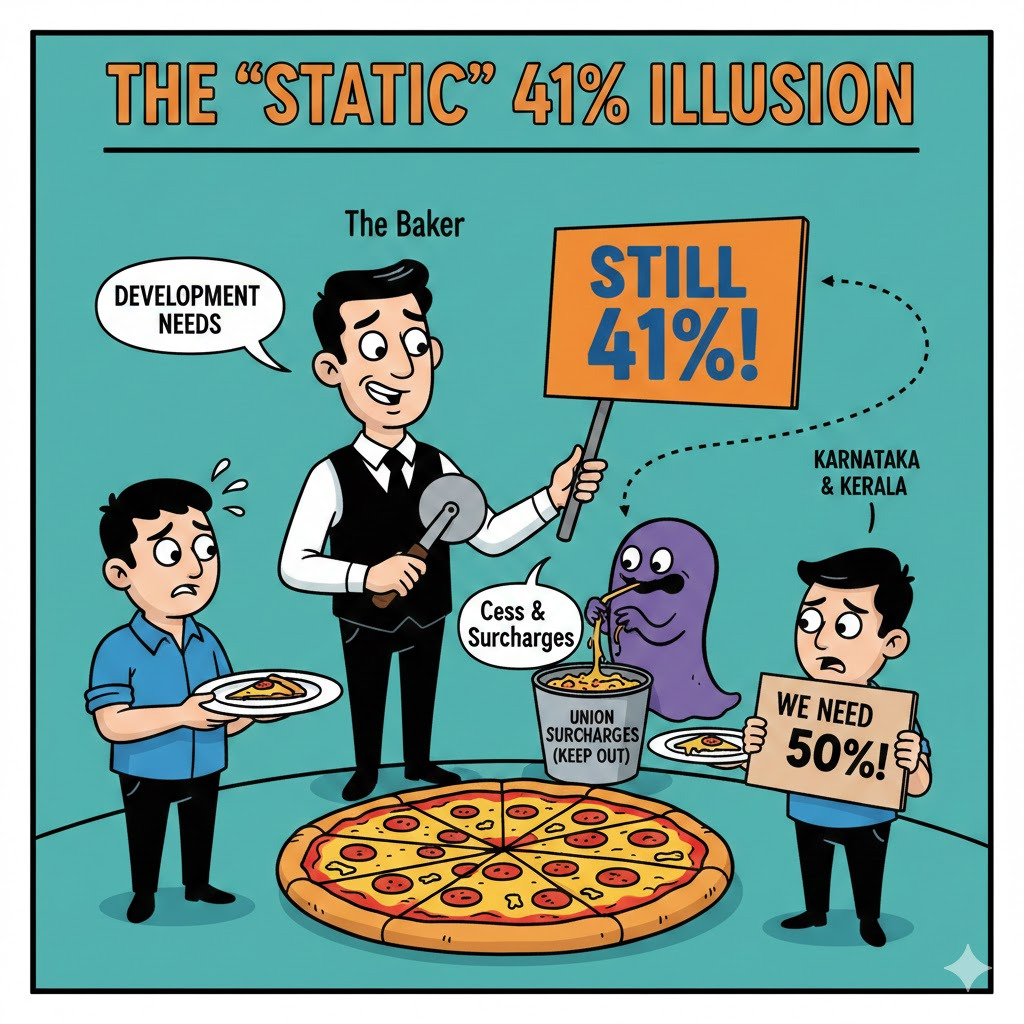
The 16th FC’s real shift is in horizontal devolution, which decides how states share that 41%. It introduces a new 10% “Contribution to GDP” weight, while keeping income distance as the biggest driver. Business Standard reported on 01 February 2026 that the GDP parameter is meant to recognise efficiency and states’ role in growth.
Separately, PRS noted on 01 February 2026 that total grants-in-aid recommended are ₹9.47 lakh crore, and that the Commission has discontinued revenue deficit, sector-specific and state-specific grants, with grants focused on local governments and disaster management.
On disasters, the Commission has recommended treating heatwaves and lightning as notified disasters, a move that could standardise relief norms for hazards that are rising sharply in frequency and impact.
Here is the updated horizontal devolution formula for 2026-31.
This mix keeps redistribution central through 42.5% income distance, but brings in performance signals via the new GDP contribution parameter.
The build-up was political and noisy. Ahead of the award period beginning 01 April 2026, multiple states sought a higher share and looser conditions. Reuters reported on 01 February 2026 that 22 of 28 states supported a higher share, while also pointing to shrinking “real” transfers because cess and surcharges are not shared.
The Budget day announcement locked in the Centre’s acceptance of the 41% recommendation and the ₹1.4 lakh crore grants number for FY 2026-27. On disasters, the Commission’s approach is being read as climate-era recalibration. Down To Earth’s 18 February 2026 analysis flags that the Commission is pairing devolution debate with a disaster framework that counts heatwaves and lightning as serious fiscal events.
A simple explainer from LoansJagat (07 February 2026) captured the same state anxiety : stable % on paper, but concerns over shrinking untied funds in practice.
*T&C Apply
Also Read - 8th Pay Commission Extends Deadline
These figures sit alongside the Commission’s call to expand disaster recognition, including heatwaves and lightning.
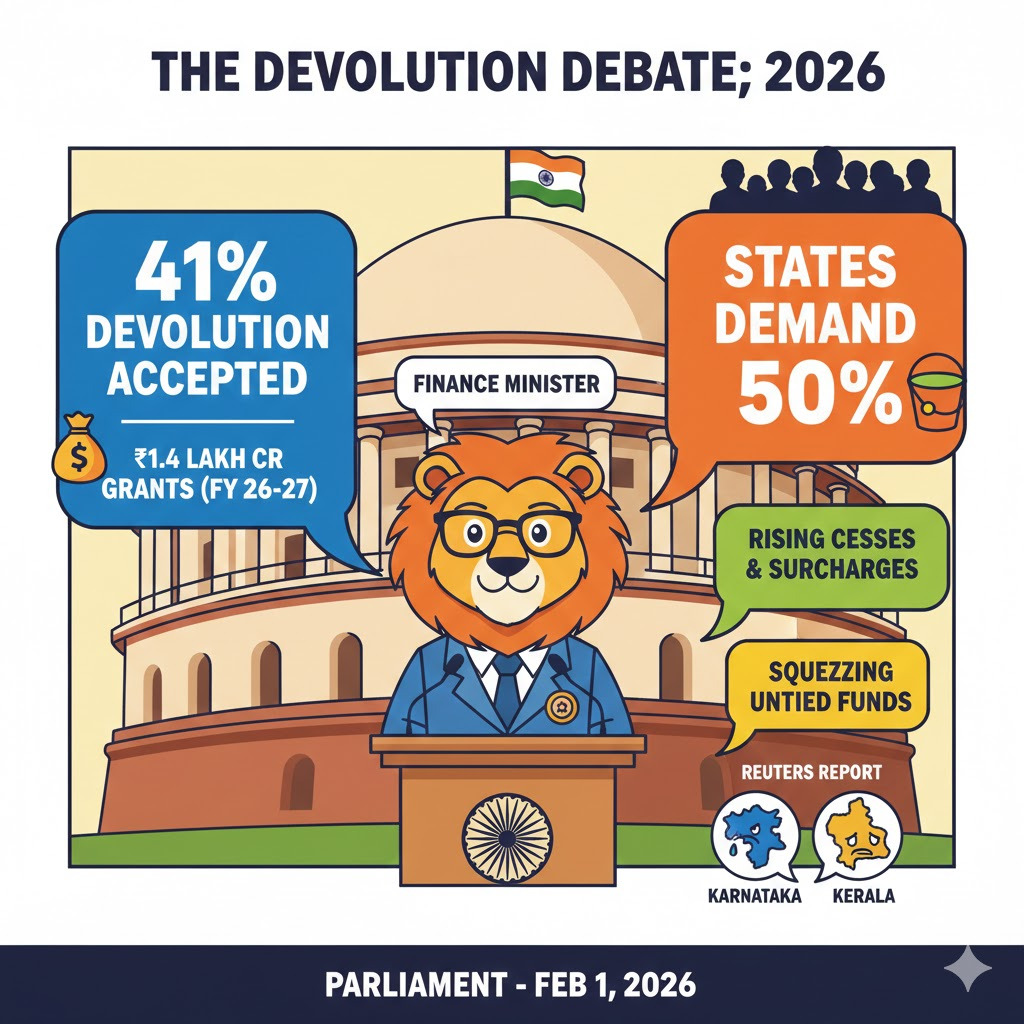
In Parliament on 01 February 2026, the Finance Minister said the government accepted 41% devolution and provided ₹1.4 lakh crore as Finance Commission grants for FY 2026-27. Several states, cited by Reuters the same day, argued for 50% and pointed to rising cesses and surcharges squeezing untied funds.
The 16th FC keeps 41% intact but changes the contest through a GDP-linked formula and a sharper disaster lens. The next debate will be about real fiscal space, not only the headline share.









.png&w=3840&q=75)



