
By continuing, you agree to LoansJagat's Credit Report Terms of Use, Terms and Conditions, Privacy Policy, and authorize contact via Call, SMS, Email, or WhatsApp
Disclaimer: The information published on LoansJagat is intended for general informational and educational purposes only and should not be considered financial, legal, or investment advice. Interest rates, loan terms, statistics, and other data may change over time and may vary by lender or source. Please verify the latest information and consult a qualified financial advisor or the respective Bank/NBFC before making any financial decisions.
Subscribe Now
About the author

LoansJagat Team
‘Simplify Finance for Everyone.’ This is the common goal of our team, as we try to explain any topic with relatable examples. From personal to business finance, managing EMIs to becoming debt-free, we do extensive research on each and every parameter, so you don’t have to. Scroll up and have a look at what 15+ years of experience in the BFSI sector looks like.
Related Blog Post
Simplify All Your Loans Into One Affordable EMI

Customers Served

Debt Consolidated

1200+ Reviews

Locations in India
Club all Loans & Credit Card Bills into Single EMI

Quick Apply Loan
Consolidate your debts into one easy EMI.

Takes less than 2 minutes. No paperwork.

10 Lakhs+
Trusted Customers

2000 Cr+
Loans Disbursed

4.7/5
Google Reviews

50+
Banks & NBFCs Offers
Other services mentioned in this article
Delhi Police arrested 3 accused after aspirants were allegedly cheated through fake Income Tax MTS job promises, forged steps and paid recruitment claims.
Key Highlights
3 people were arrested by the Delhi Police for cheating job seekers by offering them Multi-Tasking Staff positions with the Income Tax Department. Job seekers were charged money with a promise of guaranteed selection. The complaint was filed by an Ajmeri Gate resident at the Hauz Qazi Police Station on May 18, 2026. Police believe the gang was behind the fake offers by conducting fake interviews, designing fake verification forms, and portraying official processes to make the job offers look real.
The damage results in multiple losses, not just one payment. Candidates lose financial savings and resources, and time is lost in preparation. Most importantly, fraud of this nature impacts the confidence of the candidate in honest recruitment drives. One applicant, after dealing with fraud in response to government job notices, will also stop believing in government job vacancies and will stop believing in SSC advertisements. The loss is even more than just financial.
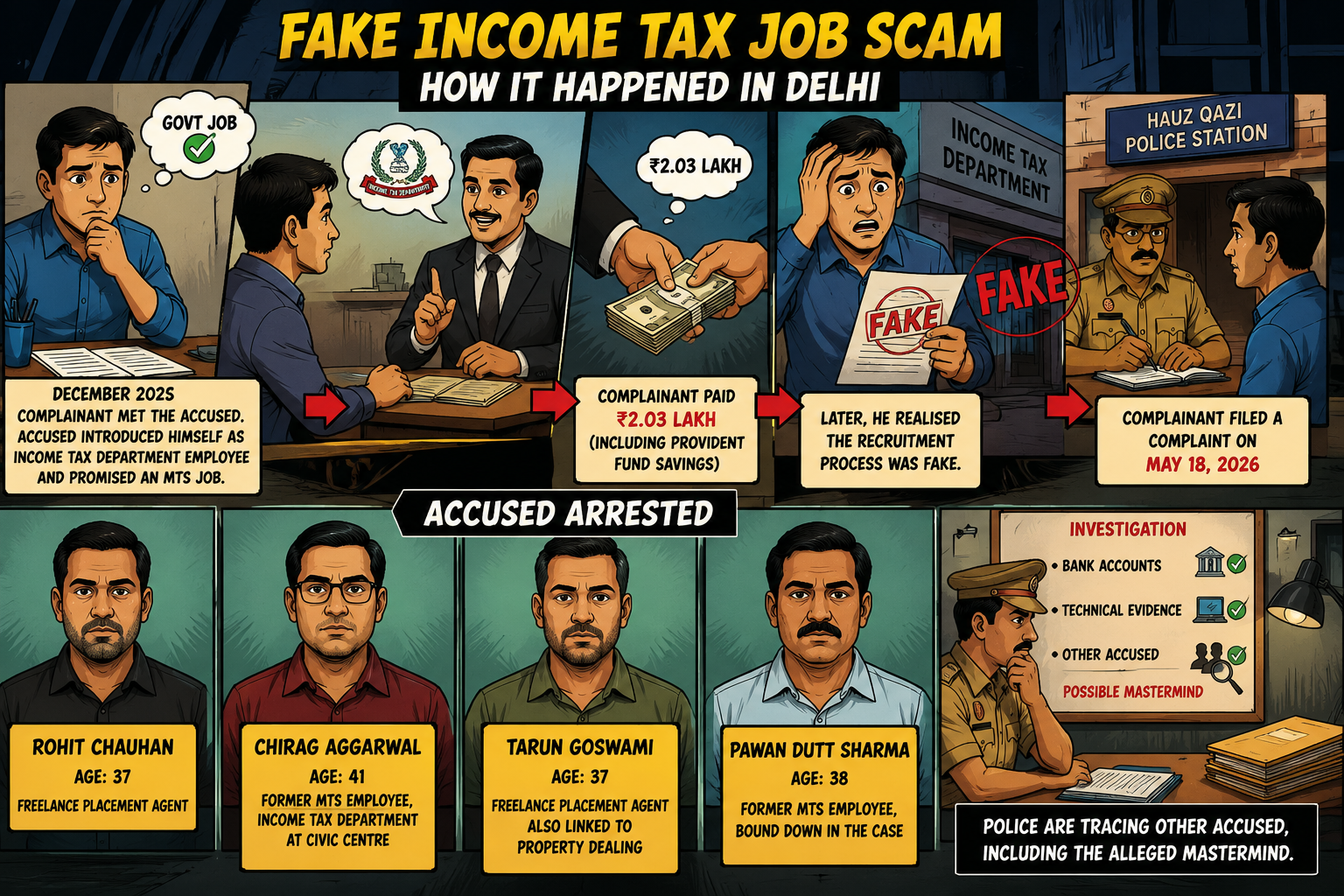
The Delhi case began when the complainant alleged that he met the accused in December 2025. One accused allegedly introduced himself as an Income Tax Department employee and said he could arrange an MTS job. The complainant later paid ₹2.03 lakh, including provident fund savings, before realising that the recruitment process was fake.
Police arrested Rohit Chauhan, 37, Chirag Aggarwal, 41, and Tarun Goswami, 37. Chirag was reported as a former MTS employee of the Income Tax Department at the Civic Centre. Rohit and Tarun were described as freelance placement agents. Tarun was also linked to property dealing. Another former MTS employee, Pawan Dutt Sharma, 38, was bound down in the case. Police are still tracing other accused, including the alleged mastermind.
This case should worry job seekers beyond Delhi because the method is familiar. A fake recruiter first builds trust, then claims access to an office, then asks for documents, then demands payment. For a candidate who has spent 2 or 3 years preparing for a government job, that false hope can feel believable. That is where the trap begins.
There is also one useful signal here. The complainant filed a police complaint, and the investigation moved through bank account checks and technical evidence. That gives other victims a route. Keep payment screenshots. Save chats. Keep fake forms. Report quickly. A complaint with records gives police more to work with than a late verbal claim.
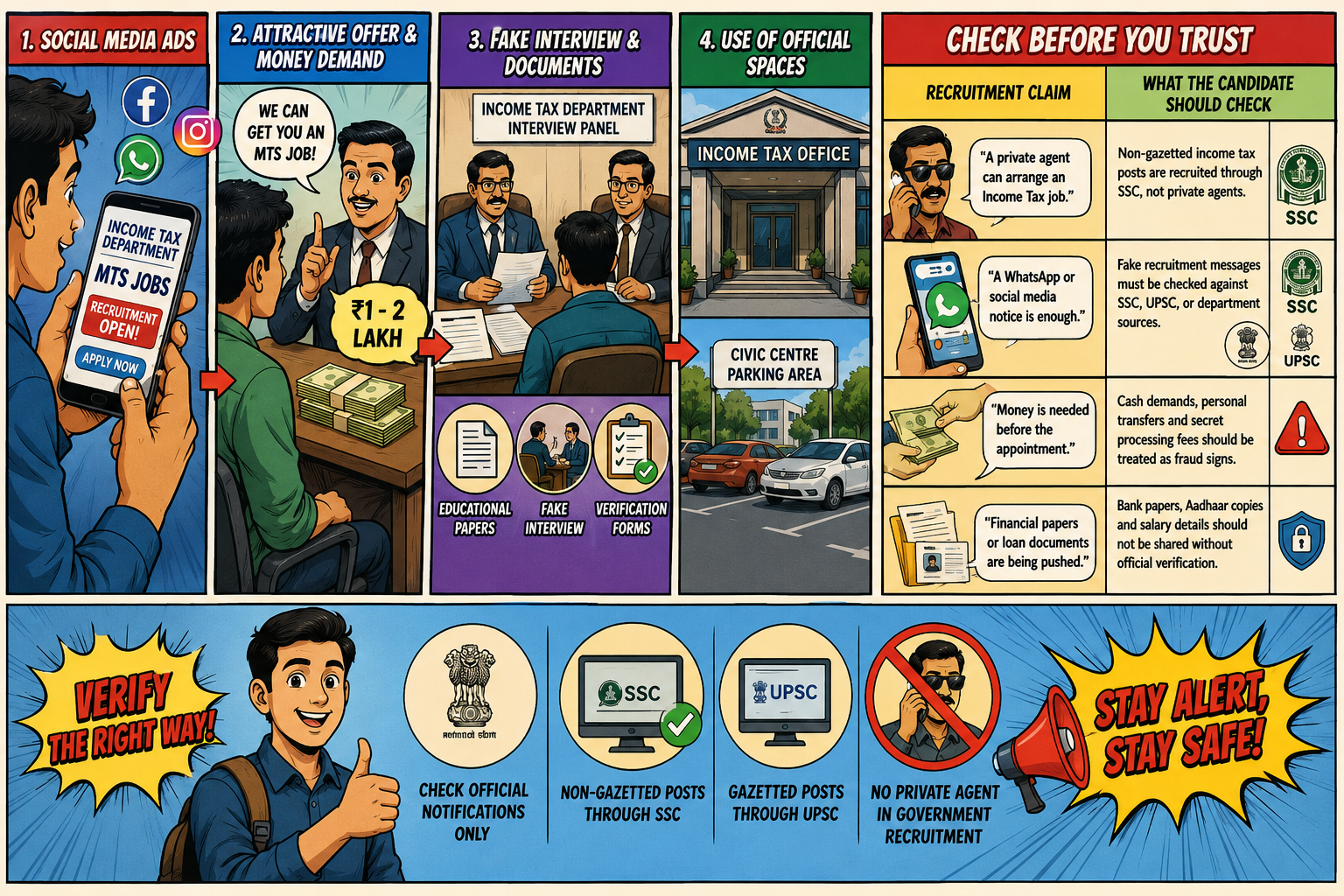
Police said the accused allegedly used social media advertisements to reach unemployed youth. Victims were asked to pay between ₹1 lakh and ₹2 lakh each. Some were made to submit educational papers, attend fake interviews and fill verification forms. The alleged use of income tax office spaces and the civic centre parking area made the setup look more official.
Before trusting any offer like this, candidates should compare the claim with the official recruitment route. The Press Information Bureau had clarified on 26 April 2021 that non-gazetted Income Tax Department recruitment is carried out through SSC, while gazetted posts go through UPSC. A private agent has no place in that route.
The table shows why this case should have raised doubts once the formal hiring route was checked. A real government vacancy leaves a public trail. It has a notification, an application link, a last date, eligibility rules and a result process. A private cash deal does not become genuine because someone uses a government building name.
The government had warned people about fake income tax recruitment messages before this Delhi case. On 26th April 2021, PIB Chennai stated that the position of income tax officer is filled through promotion, and that position cannot be filled through direct recruitment. It further stated that recruitment to non-gazetted posts in the Income Tax Department is done through the SSC, whereas recruitment to the gazetted posts is done through the UPSC.
Another PIB alert on 11th November 2020 stated that a so-called Income Tax Department recruitment notification regarding the posts of inspector, tax assistant, superintendent, and assistant is fake and that people should check the official SSC website or visit the SSC for clarification. That alert is particularly relevant to the Delhi case, as fake job rackets normally use the real department’s names, and they normally do not mention the examination route.
Victims should not delete anything out of panic. UPI IDs, bank transfer records, WhatsApp chats, call logs, fake forms, payment screenshots, and appointment letters can help the police in relating the case to other instances of the racket. Even one transaction number can be useful.
Victims of online financial fraud can lodge an online complaint on the National Cyber Crime Reporting portal or call 1930. Timely reporting helps the bank and the cybercrime police trace the transactions before the money is lost.
*T&C Apply
The safer route is slow checking. A candidate should ask for the official notification number, application portal, exam details, fee payment page and result process. If the answer keeps changing, the offer should be treated as fake. Real government hiring does not ask candidates to transfer money into a personal account.
For wider fraud safety checks, forged paper trails and payment-related alerts, readers can also refer to LoansJagat while covering similar financial fraud cases.
This case worked because it did not look like a random phone call scam. It borrowed the shape of a government process. Forms were used. Interviews were allegedly conducted. Office-linked spaces were mentioned. The accused also included someone who had worked as MTS earlier, which likely made the pitch stronger for anxious aspirants.
For job seekers, the most dangerous part is the fee size. A demand of ₹1 lakh to ₹2 lakh is large enough to look serious but still within reach for families that can borrow, pledge gold or withdraw savings. Fraudsters know that. They price the lie at a level where hope beats doubt. That is why public recruitment awareness cannot stop at official websites alone. Coaching centres, cyber cells, banks and local police stations should keep repeating one line: a government job cannot be bought.
Police said the complainant met the accused in December 2025 and was allegedly promised an MTS post in the Income Tax Department. DCP Central Rohit Rajbir Singh was quoted in the case report as saying that the accused collected money and ran a fake recruitment process. Police later used bank accounts and technical evidence before making the arrests.
The government’s earlier stand is direct. PIB had clarified that income tax recruitment for non-gazetted posts goes through SSC, while UPSC handles gazetted recruitment as per procedure. The cyber fraud reporting route is also available through 1930, where victims are asked to keep transaction details ready.
The Delhi income tax job scam is a sharp warning for aspirants chasing government jobs. Fake recruiters no longer rely only on phone calls and cheap messages. They use forms, office names, fake interviews and payment pressure to appear credible.
The safest rule remains simple. No private agent can sell an Income Tax Department job. If a person asks for cash, private transfer or secret processing fees, the candidate should verify the vacancy through official channels first and report the fraud before more savings disappear.
What happened in the Delhi income tax job scam?
Delhi Police arrested 3 accused for allegedly cheating aspirants through fake income tax MTS job promises.
How much money did aspirants lose in the scam?
Police suspect 6 to 7 aspirants lost around ₹10 lakh in the fake recruitment racket.
Which job post was promised to the victims?
The accused allegedly promised multi-tasking staff posts in the Income Tax Department to job seekers.
How can candidates verify the income tax department recruitment?
Candidates should check the SSC, UPSC, and official Income Tax Department recruitment pages before trusting any offer.
What should a victim do after paying money?
The victim should save chats, payment proof, and forms and report quickly to the police or 1930.
Can a private agent arrange a government job?
No. Genuine government recruitment follows official notifications, exams, selection lists and department-approved procedures.









.png&w=3840&q=75)



