
By continuing, you agree to LoansJagat's Credit Report Terms of Use, Terms and Conditions, Privacy Policy, and authorize contact via Call, SMS, Email, or WhatsApp
Disclaimer: The information published on LoansJagat is intended for general informational and educational purposes only and should not be considered financial, legal, or investment advice. Interest rates, loan terms, statistics, and other data may change over time and may vary by lender or source. Please verify the latest information and consult a qualified financial advisor or the respective Bank/NBFC before making any financial decisions.
Subscribe Now
About the author

LoansJagat Team
‘Simplify Finance for Everyone.’ This is the common goal of our team, as we try to explain any topic with relatable examples. From personal to business finance, managing EMIs to becoming debt-free, we do extensive research on each and every parameter, so you don’t have to. Scroll up and have a look at what 15+ years of experience in the BFSI sector looks like.
Related News
Simplify All Your Loans Into One Affordable EMI

Customers Served

Debt Consolidated

1200+ Reviews

Locations in India
Club all Loans & Credit Card Bills into Single EMI

Quick Apply Loan
Consolidate your debts into one easy EMI.

Takes less than 2 minutes. No paperwork.

10 Lakhs+
Trusted Customers

2000 Cr+
Loans Disbursed

4.7/5
Google Reviews

50+
Banks & NBFCs Offers
Other services mentioned in this article
Key Takeaways
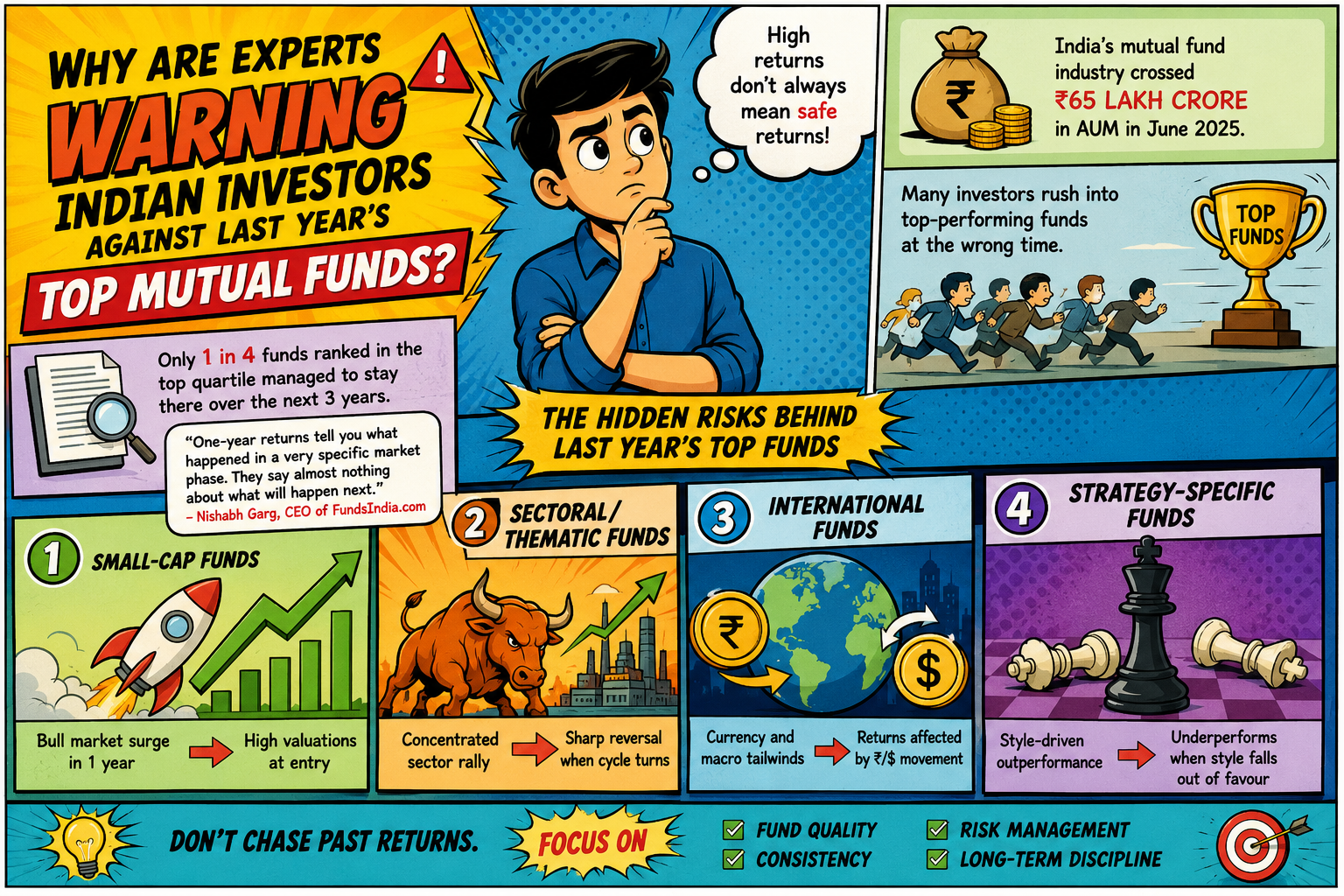
Indian mutual fund investors are making a predictable mistake every January. They scan annual return rankings, spot a small-cap or thematic fund with 30-40% returns, and shift their money there. In June 2025, India's mutual fund industry crossed ₹65 lakh crore in assets under management, per AMFI data. Yet experts say a large share of retail investors are entering top-performing funds at the wrong time.
FundsIndia’s internal research, published in 2025, found that only 1 in 4 funds ranked in the top quartile managed to stay there over the following 3 years.
Rhishabh Garg, CEO of FundsIndia.com, said, “One-year returns tell you what happened in a very specific market phase. They say almost nothing about what will happen next.”
For Indian retail investors running monthly SIPs, performance-chasing is especially damaging. Many stop SIPs in underperforming funds after 12-18 months and redirect money to last year's winner. Garg described a pattern seen repeatedly that is investors exit a fund after 18 months of underperformance, buy the new winner, then watch the original fund recover while the new one stagnates.
Switching also triggers exit loads, short-term capital gains tax at 20% (for equity funds held under 12 months, per the Finance Act 2024), and transaction costs. Debasish Mohanty, Chief Strategy Officer at The Wealth Company Mutual Fund, noted, “Studies worldwide show investor returns often lag fund returns due to poor timing decisions rather than poor fund selection.”
According to LoansJagat’s SIP analysis, a ₹5,000 monthly SIP in a diversified equity fund at 12% annual returns grows to approximately ₹11.6 lakh over 10 years. Interrupting this cycle even once to chase a top fund can disrupt the compounding effect significantly.
Groww Mutual Fund’s CEO Varun Gupta stated that investors miss several crucial aspects if they look only at returns. Such aspects comprise portfolio design, investment approach, risk taking, and performance in different market conditions.
*T&C Apply
Mohanty added that two funds can show identical 1-year returns while one took far greater risks to get there. Garg’s advice is direct, “A major mistake is buying high without realising it. When you enter last year's top fund now, you are entering at the peak of that cycle, not the start.”
Gupta recommended that fund selection be driven by the investor’s long-term financial goals, not annual rankings. All 3 experts agree that discipline inside a well-matched fund beats timing across high-return funds every time.
India’s mutual fund base is growing fast, but so is the temptation to chase annual winners. FundsIndia’s 1-in-4 data point makes the risk concrete. Picking a fund based on last year’s rank is not investing. It is arriving late to a rally that has already ended.
Why did retail investors invest cautiously in mutual funds even when small-cap funds delivered 30-40% returns in 2024?
Retail investors often enter top-ranked funds too late, after valuations peak. FundsIndia data shows 3 in 4 top-quartile funds fail to repeat performance over 3 years. This burned enough investors to make the broader base more cautious about fresh allocations.
Should a small investor continue SIPs in an underperforming fund or switch to last year's top mutual fund?
Continue your SIPs. Stopping and switching to a top-ranked fund means entering at peak valuations. Garg of FundsIndia warns that investors who exit after 12-18 months of underperformance typically miss the original fund's recovery entirely.









.png&w=3840&q=75)



