
By continuing, you agree to LoansJagat's Credit Report Terms of Use, Terms and Conditions, Privacy Policy, and authorize contact via Call, SMS, Email, or WhatsApp
Disclaimer: The information published on LoansJagat is intended for general informational and educational purposes only and should not be considered financial, legal, or investment advice. Interest rates, loan terms, statistics, and other data may change over time and may vary by lender or source. Please verify the latest information and consult a qualified financial advisor or the respective Bank/NBFC before making any financial decisions.
Subscribe Now
About the author

LoansJagat Team
‘Simplify Finance for Everyone.’ This is the common goal of our team, as we try to explain any topic with relatable examples. From personal to business finance, managing EMIs to becoming debt-free, we do extensive research on each and every parameter, so you don’t have to. Scroll up and have a look at what 15+ years of experience in the BFSI sector looks like.
Related News
Simplify All Your Loans Into One Affordable EMI

Customers Served

Debt Consolidated

1200+ Reviews

Locations in India
Club all Loans & Credit Card Bills into Single EMI

Quick Apply Loan
Consolidate your debts into one easy EMI.

Takes less than 2 minutes. No paperwork.

10 Lakhs+
Trusted Customers

2000 Cr+
Loans Disbursed

4.7/5
Google Reviews

50+
Banks & NBFCs Offers
Other services mentioned in this article
Key Takeaways
AMFI estimates that the AUM of India’s mutual fund industry averaged ₹81 trillion during October-December 2025, rose from ₹68.6 trillion in the corresponding period in 2024. A great number of retail investors have joined the market. But most of them compare funds by looking at 1-year or 3-year return figures. That tells only half the story.
Two funds can both post 15% annualised returns over 3 years and still behave very differently. One may have climbed steadily. The other may have crashed and recovered twice in the same period. As of March 2025, individual investors hold 65% of equity fund AUM in India, as per AMFI’s Annual Report 2025. Most of them never check a single risk ratio before putting in money.
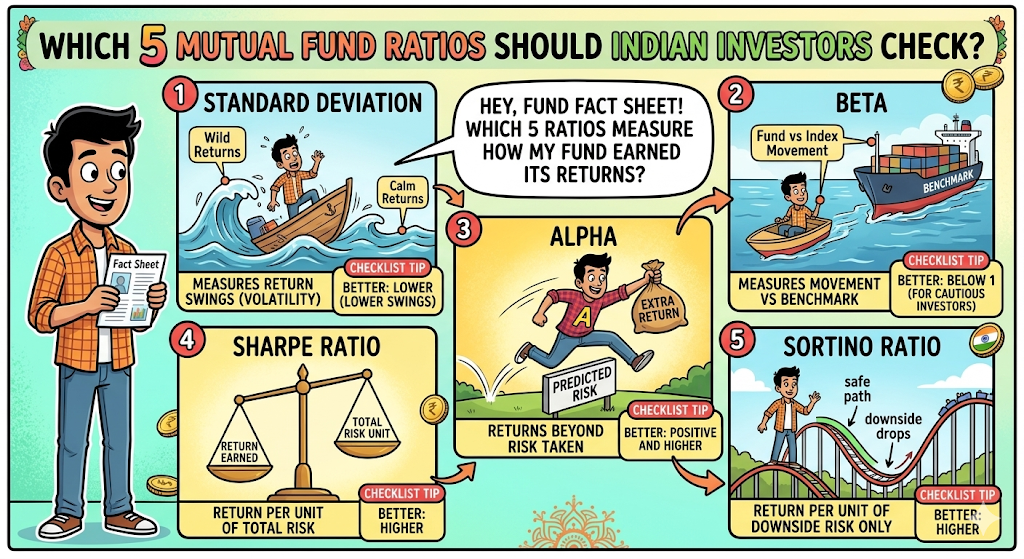
Mutual fund fact sheets carry five ratios that show how a fund earned its returns. Here is what each one measures:
Standard Deviation tells you how bumpy the ride has been. A fund returning 15% with sharp monthly swings carries more risk than one that returns the same 15% on a steadier path.
Beta indicates the extent to which an investment changes in response to market changes. If a fund has a beta coefficient equal to 1.2, its value will be expected to fluctuate 12% for a 10% movement in the value of the benchmark.
Alpha separates manager skill from market luck. A positive alpha means the fund returned more than its risk profile would suggest. A negative alpha means investors took on risk without getting paid for it.
Sharpe ratio is excess return divided by standard deviation. A mutual fund earning 12%, while the risk-free rate equals 5% and the standard deviation equals 10%, its Sharpe ratio will be 0.7. A ratio below 0.5 means investors are not being paid enough for the volatility they are absorbing, as per the Institute for Business and Finance.
Sortino Ratio works like the Sharpe Ratio but counts only downside swings. It ignores months where the fund rose sharply, which most investors don’t mind. A higher Sortino Ratio means the fund protected investors better during bad periods.
Fund’s movement vs benchmark index
*T&C Apply
Most retail investors in India pick funds based on category returns without checking any risk metrics. Very few looked at beta or Sharpe ratios before investing.
At LoansJagat, we found that first-time investors who have never opened a fund factsheet. They do not know what beta or standard deviation means.
The Institute for Business and Finance notes that the Sharpe Ratio is the most practical single number for answering whether risk was worth taking. Its drawback lies in the fact that Sharpe treats positive deviations in the same fashion as negative ones. Therefore, for the purposes of assessing losses, the Sortino ratio is more relevant.
One important caution is that never use these ratios to compare funds across different categories. A small-cap fund will always show a weaker Sortino Ratio than a large-cap fund. These numbers only make sense when comparing funds within the same category.
Chasing the highest return number is a common mistake. Standard deviation, beta, alpha, Sharpe ratio, and Sortino ratio together show whether a fund’s returns came with unnecessary risk. Indian investors, particularly those investing through SIPs, should pull up the factsheet and check these five numbers before choosing any scheme.
Do most retail investors in India consider the risk ratios when selecting a mutual fund?
Most of the retail investors make their decision based on previous returns only without considering any risk ratio. Beta and Sharpe ratio analysis is not considered by most of the retail investors which might cause them problems especially when the markets decline.
What ratio do I need to look into prior to buying a mutual fund?
First, you have to consider the Sharpe ratio. It will tell you whether you got the returns for taking such risks or not. Any number more than 0.5 is good while analysing Sharpe ratio.









.png&w=3840&q=75)



