
By continuing, you agree to LoansJagat's Credit Report Terms of Use, Terms and Conditions, Privacy Policy, and authorize contact via Call, SMS, Email, or WhatsApp
Disclaimer: The information published on LoansJagat is intended for general informational and educational purposes only and should not be considered financial, legal, or investment advice. Interest rates, loan terms, statistics, and other data may change over time and may vary by lender or source. Please verify the latest information and consult a qualified financial advisor or the respective Bank/NBFC before making any financial decisions.
Subscribe Now
About the author

LoansJagat Team
‘Simplify Finance for Everyone.’ This is the common goal of our team, as we try to explain any topic with relatable examples. From personal to business finance, managing EMIs to becoming debt-free, we do extensive research on each and every parameter, so you don’t have to. Scroll up and have a look at what 15+ years of experience in the BFSI sector looks like.
Related News
Simplify All Your Loans Into One Affordable EMI

Customers Served

Debt Consolidated

1200+ Reviews

Locations in India
Club all Loans & Credit Card Bills into Single EMI

Quick Apply Loan
Consolidate your debts into one easy EMI.

Takes less than 2 minutes. No paperwork.

10 Lakhs+
Trusted Customers

2000 Cr+
Loans Disbursed

4.7/5
Google Reviews

50+
Banks & NBFCs Offers
Other services mentioned in this article
Homebuyers taking a ₹50 lakh loan can cut long-term costs by checking the loan rate, tenure, prepayment, subsidy fit and yearly ownership expenses.
Key Highlights
A ₹50 lakh home loan buyer in India can save lakhs by taking 5 decisions before signing the sanction letter. The decision involves the borrower, the bank or housing finance company, the builder, the tax filer and the household that will pay the EMI every month. The financial impact starts from the first EMI and continues till the loan closes. A small rate difference, a longer tenure, or a missed subsidy check can change the final cost of the home.
This affects middle-income families the most. In the short term, a high EMI can reduce savings, insurance cover, school-fee planning and emergency funds coverage. Over many years, the same loan can become heavier if the buyer ignores total interest, maintenance charges, electricity use and tax planning. The warning is simple. A house that looks affordable on booking day may become costly after possession if the buyer checks only the flat price.
Many buyers still judge affordability from 2 lines, flat price and EMI. That is where the problem begins. A builder may quote one attractive price. A lender may offer a 25-year or 30-year repayment option. The buyer signs because the monthly EMI looks within reach. Later, the family discovers a longer interest bill, higher maintenance, tax confusion and repair expenses.
A ₹50 lakh loan at 8.5% for 20 years gives an EMI of around ₹43,391, according to LoansJagat’s home loan EMI calculator. The same loan becomes cheaper if the borrower gets a lower rate, keeps tenure shorter and prepays when income allows. This is the real story for buyers in 2026. The sale price is only one part. The home loan structure carries the bigger cost.
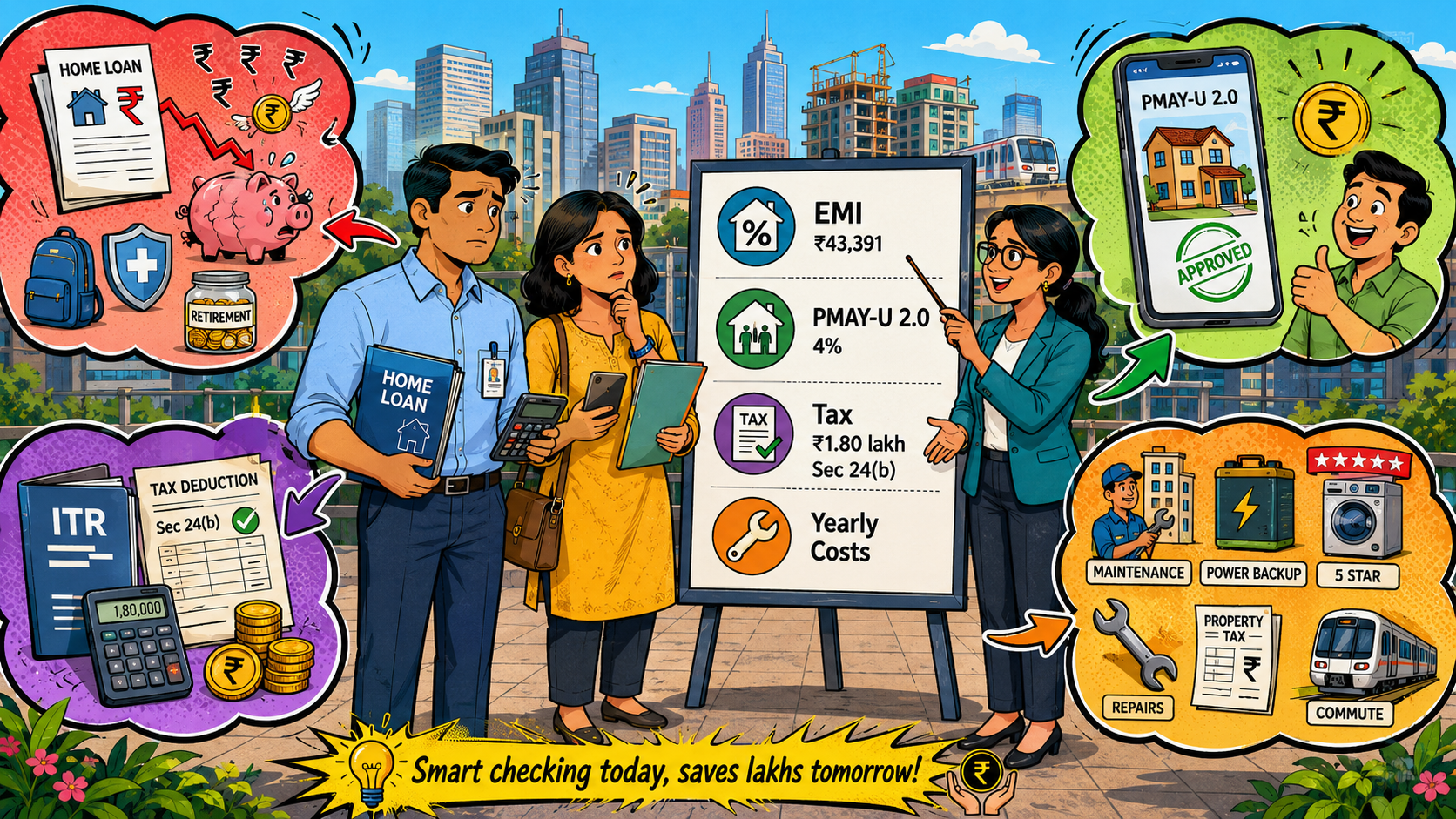
For salaried buyers in Delhi-NCR, Mumbai Metropolitan Region, Pune, Bengaluru, Hyderabad, Chennai, and Ahmedabad, the EMI usually becomes the largest monthly payment. If that EMI is too high, the family may postpone investments, health cover upgrades, children’s tuition planning or retirement savings. If the EMI is too low because tenure is stretched too far, the borrower may pay much more interest across the full loan period.
Public portals now give buyers more checks before booking. PMAY-U 2.0 lists interest subsidy conditions for eligible urban households. The Income Tax Department explains the deduction rules for home loan interest. Energy labels help households choose efficient appliances after purchase. These tools do not remove all risk, but they give buyers a fairer way to compare the true cost of owning a home.
Before making the booking payment, buyers should place the loan and ownership cost on one page. The table below shows where the money can be saved and which source can help with verification.
This table is not a substitute for a legal or tax review. It is a screening tool. A buyer should still ask the lender for an amortisation schedule, the builder for project documents and a tax professional for regime comparison.
Financial planners usually advise buyers to test the loan under 3 conditions. The first is today’s EMI. The second is EMI after a rate increase. The third is EMI if one's income stops for 3 to 6 months. A buyer who passes all 3 checks will handle ownership better than a buyer who only qualifies for bank approval.
The solution is not complicated. Borrowers should compare at least 3 lenders, ask for total interest payable, avoid unnecessary insurance bundling, keep prepayment flexibility and set aside a yearly loan-reduction fund. Even ₹1 lakh paid once a year can reduce the principal faster in the early years. The gain becomes larger when the borrower starts early instead of waiting for the last few years of the loan.
Government housing support has already shifted towards targeted affordability. PMAY-U 2.0 kept subsidy support linked to income, loan value, property value and carpet area. This means the benefit is not automatic for every homebuyer. The buyer has to check eligibility before assuming any discount on the loan.
Tax rules also shaped home-buying decisions earlier. The Income Tax Department’s guidance on house property income explains interest deduction under Section 24(b), subject to property type and conditions. This helps many old-regime taxpayers, but the result changes if the taxpayer chooses the new tax regime or buys an under-construction home.
Tax Deduction
*T&C Apply
The older lesson is still useful. Buyers who checked only EMI often discovered hidden pressure after possession. Maintenance deposits, parking charges, shifting, interiors, society funds, water charges and higher power bills appeared later. That is why a homebuyer should calculate the first-year cost and charges at the bank EMI.
LoansJagat’s ₹50 lakh EMI example gives a useful borrower-level warning. At ₹43,391 EMI for 20 years, the buyer is not only repaying the principal. A large part of early EMIs goes towards interest. That is why early prepayment changes the loan faster than late prepayment.
A simple borrower analysis shows this. A family that receives an annual bonus, rental income or business surplus can keep one fixed rule, pay part of it into the home loan every year. The amount does not have to be huge. The timing is more important. Prepayment in years 2, 3, and year 4 gives better savings than the same amount paid near the end of the loan.
Another useful point is tax planning. A borrower should not buy only for tax deductions. The home must remain affordable even without the expected tax benefit. Tax rules can change. Salary can change. Household expenses rarely stay fixed. A sensible buyer treats tax savings as support, not as the main reason to stretch the loan.
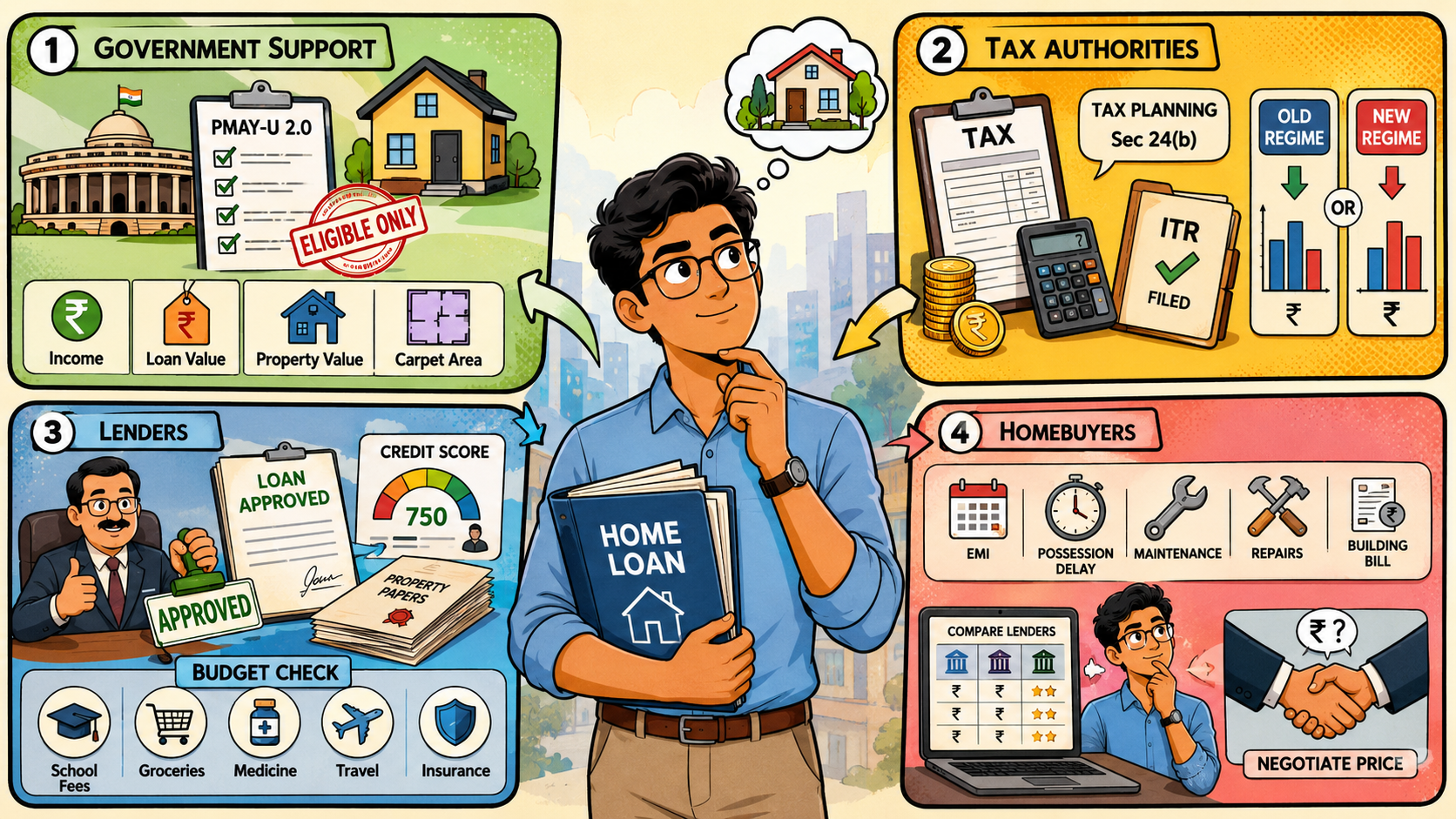
Government housing portals show that subsidy support is meant for eligible households, not for every urban buyer. PMAY-U 2.0 gives a route for interest subsidy, but income, loan value, property value and carpet area decide the final benefit.
Tax authorities give a different signal. The Income Tax Department’s house property guidance helps taxpayers check interest deduction rules before filing. That creates a need for early planning, because the tax regime selected by the borrower can change the final result.
Lenders focus on repayment capacity, credit score and property papers. Their approval does not mean the home is comfortable for the family budget. A bank may approve a loan, but the borrower still has to pay school fees, medical bills, groceries, insurance, travel and repairs.
Homebuyers have the strongest stake. They face the EMI every month. They also face possession delays, maintenance hikes and repair bills. For them, the safest route is to negotiate the price, compare lenders and calculate the ownership cost together.
A ₹50 lakh home loan can stay affordable when the buyer controls the big 5 decisions early. Rate, tenure, prepayment, subsidy fit and running cost decide how much the family really pays after booking.
The smarter buyer does not rush after seeing a low EMI. The buyer checks the full repayment figure, asks for written cost details, verifies public benefits and prepares for yearly expenses after possession. That is where the long-term saving begins.
How Can A ₹50 Lakh Home Loan Buyer Save Up To ₹18 Lakh?
A buyer can save through lower rates, shorter tenure and yearly prepayments that reduce principal during the early loan years.
Should Buyers Choose A 30-Year Home Loan?
A 30-year loan lowers the monthly EMI, but it can increase the total interest sharply. Buyers should compare the full repayment costs.
Is PMAY-U 2.0 Available For Every Homebuyer?
No. PMAY-U 2.0 has income, loan value, property value and carpet-area conditions. Buyers must verify eligibility first.
Does Section 24(b) Help All Taxpayers?
No. It mainly helps eligible taxpayers under the old tax regime, subject to the Income Tax Department rules.









.png&w=3840&q=75)



