.png&w=3840&q=65)
By continuing, you agree to LoansJagat's Credit Report Terms of Use, Terms and Conditions, Privacy Policy, and authorize contact via Call, SMS, Email, or WhatsApp
The information published on LoansJagat is intended for general informational and educational purposes only and should not be considered financial, legal, or investment advice. Interest rates, loan terms, statistics, and other data may change over time and may vary by lender or source. Please verify the latest information and consult a qualified financial advisor or the respective Bank/NBFC before making any financial decisions.
Subscribe Now
About the author

LoansJagat Team
‘Simplify Finance for Everyone.’ This is the common goal of our team, as we try to explain any topic with relatable examples. From personal to business finance, managing EMIs to becoming debt-free, we do extensive research on each and every parameter, so you don’t have to. Scroll up and have a look at what 15+ years of experience in the BFSI sector looks like.
Related News
Simplify All Your Loans Into One Affordable EMI

Customers Served

Debt Consolidated

1200+ Reviews

Locations in India
Club all Loans & Credit Card Bills into Single EMI

Quick Apply Loan
Consolidate your debts into one easy EMI.

Takes less than 2 minutes. No paperwork.

10 Lakhs+
Trusted Customers

2000 Cr+
Loans Disbursed

4.7/5
Google Reviews

50+
Banks & NBFCs Offers
Other services mentioned in this article
High-income salaried taxpayers may save more under the new tax regime, but the old regime can still win with large rent and investment claims.
Key Takeaways
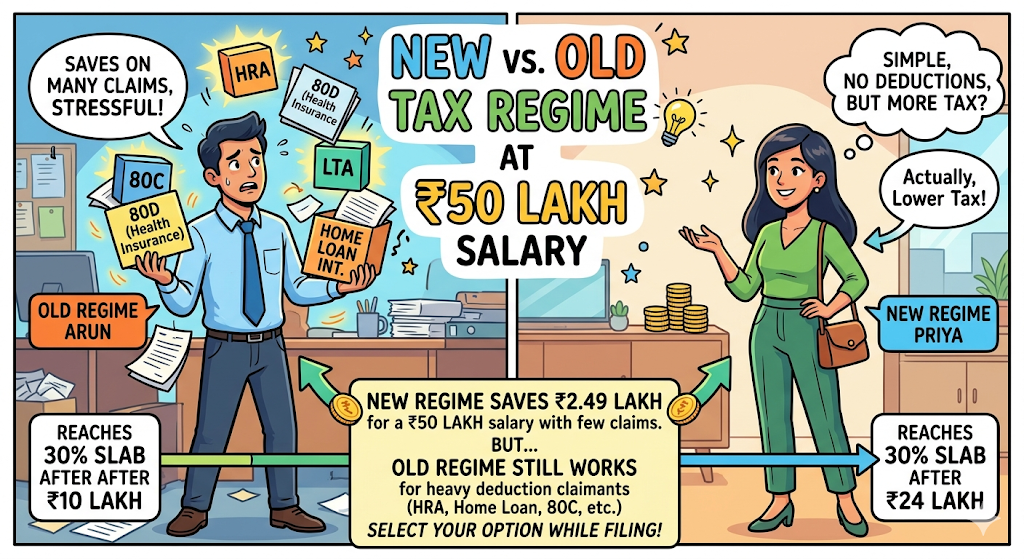
For salary earners around ₹50 lakh, the tax regime choice is no longer a routine filing option. It changes take-home pay, investment planning, rent declarations and home-loan decisions. The new regime is the default option for individuals, but the old regime can still be selected while filing returns, as per the Income Tax Department’s AY 2026-27 tax guidance.
The negative side is simple. Employees who shift to the new regime lose many popular deductions like HRA, 80C, 80D and LTA. But those with fewer claims may pay much less tax because the new regime reaches the 30% slab only after ₹24 lakh, while the old regime applies 30% after ₹10 lakh.
Read More : New Income Tax Forms From April 1, 2026
₹50 Lakh Salary Tax Split
The basic comparison below assumes a salaried individual below 60 years, no extra deductions, and only standard deduction.
The gap is ₹2,49,600 in favour of the new regime. That is why a ₹50 lakh employee without big exemptions may find the new regime cheaper and easier.
For metro employees, the answer may change. A high HRA exemption, home-loan interest, NPS contribution, 80C investments, medical insurance under 80D and LTA can pull the old-regime taxable income down. ClearTax’s FY 2025-26 comparison says that for income above ₹25 lakh, the old regime becomes beneficial only when deductions exceed ₹8 lakh.
This is also relevant for families managing EMIs and tax-linked cash flow. Loan calculators and finance tools on LoansJagat may help borrowers review repayment outgo before choosing investments only for tax saving.
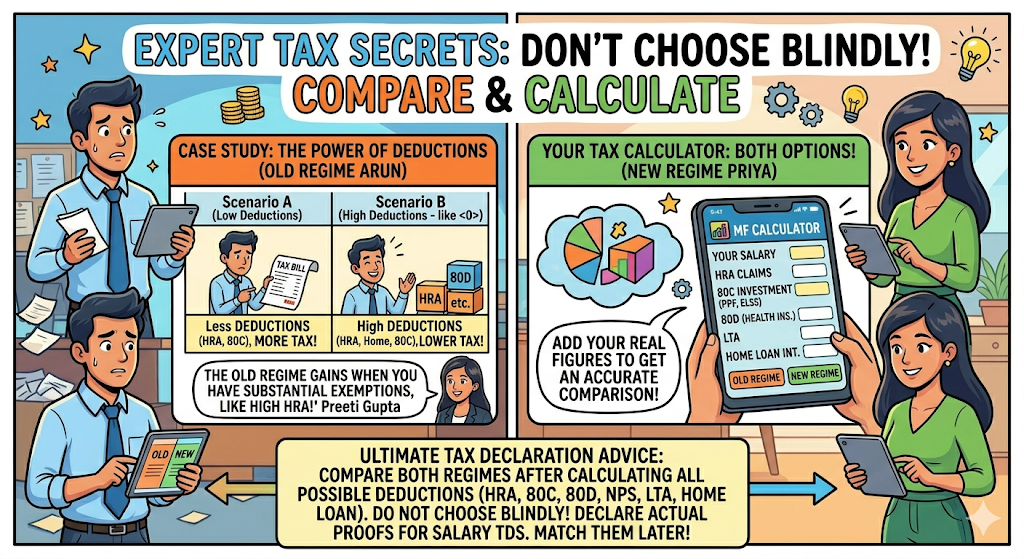
Moneycontrol’s May 12, 2026 report used a ₹56.05 lakh CTC case where old-regime benefits brought taxable income down sharply. The report quoted Deloitte India’s Preeti Gupta saying the old regime can gain when taxpayers have substantial exemptions such as high HRA.
*T&C Apply
The solution is not to follow one regime blindly. Employees should calculate both options after adding real HRA, 80C, 80D, NPS, LTA and home-loan claims. Tax declarations at the start of the year should match actual proofs, or salary TDS may rise later.
For most ₹50 lakh salary earners, the new regime is likely cheaper. The old regime deserves a look only when genuine deductions go beyond about ₹8 lakh.
Should A Salaried Person With HRA, 80C And 80D Claims Choose The Old Or New Tax Regime?
A salaried person should not choose the tax regime only by looking at salary. The total deductions decide the better option. In this Reddit case, the user earns below ₹12 lakh, pays rent, has ₹2 lakh insurance premium under 80C and ₹49,000 medical insurance under 80D.
The Reddit discussion also suggests comparing both regimes through the official tax calculator before filing. The old regime may work better if HRA exemption and deductions are high. The new regime may be better if taxable income falls within the rebate benefit and deductions are limited.
What Are The Basic Parts Of India’s Tax System For Individual Earners?
India’s tax system mainly works through direct and indirect taxes. For individuals, income tax is the most common direct tax. Salary, business income, capital gains, house property income and other income are added, then eligible deductions are reduced.
The final taxable income is taxed as per slab rates. Taxpayers can choose between the old and new tax regimes, depending on deductions and exemptions. Indirect taxes like GST are paid when people buy goods or services. Overall, the system collects revenue from income, spending and transactions.









.png&w=3840&q=75)



