By continuing, you agree to LoansJagat's Credit Report Terms of Use, Terms and Conditions, Privacy Policy, and authorize contact via Call, SMS, Email, or WhatsApp
Disclaimer: The information published on LoansJagat is intended for general informational and educational purposes only and should not be considered financial, legal, or investment advice. Interest rates, loan terms, statistics, and other data may change over time and may vary by lender or source. Please verify the latest information and consult a qualified financial advisor or the respective Bank/NBFC before making any financial decisions.
Subscribe Now
About the author

LoansJagat Team
‘Simplify Finance for Everyone.’ This is the common goal of our team, as we try to explain any topic with relatable examples. From personal to business finance, managing EMIs to becoming debt-free, we do extensive research on each and every parameter, so you don’t have to. Scroll up and have a look at what 15+ years of experience in the BFSI sector looks like.
Related Blog Post
Simplify All Your Loans Into One Affordable EMI

Customers Served

Debt Consolidated

1200+ Reviews

Locations in India
Club all Loans & Credit Card Bills into Single EMI

Quick Apply Loan
Consolidate your debts into one easy EMI.

Takes less than 2 minutes. No paperwork.

10 Lakhs+
Trusted Customers

2000 Cr+
Loans Disbursed

4.7/5
Google Reviews

50+
Banks & NBFCs Offers
Other services mentioned in this article
Bank of Baroda wants faster corporate lending in FY27, backed by a ₹50,000 crore pipeline and stronger Q4 FY26 asset quality.
Key Takeaways
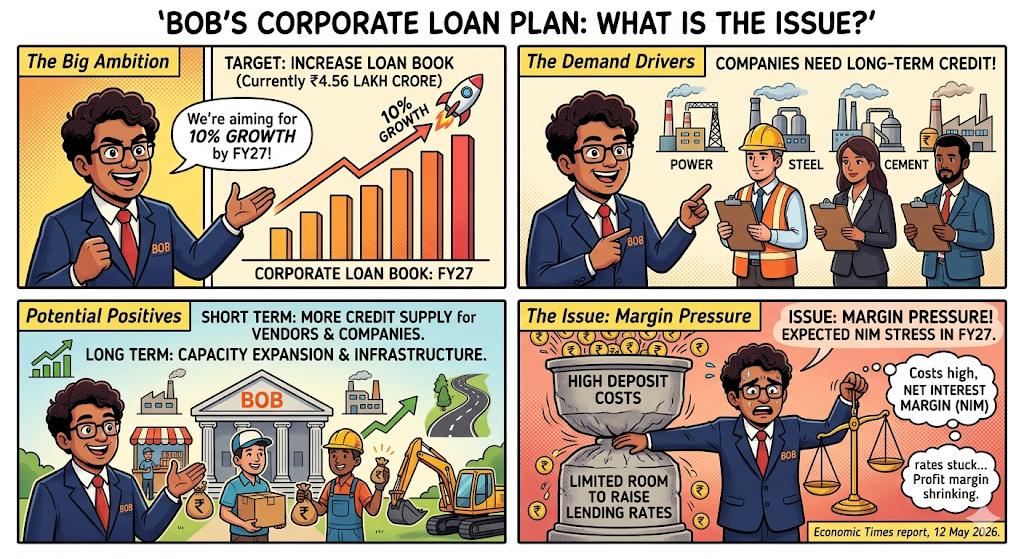
Bank of Baroda is aiming to expand its corporate loan book by 10% in FY27. The public sector lender’s corporate loan book is currently around ₹4.56 lakh crore, and the fresh push comes at a time when companies in power, steel and cement are looking for long-term credit. Business Standard reported this on 11 May 2026, citing PTI.
In the short term, this can improve credit supply to large companies and their vendors. In the long term, it can support capacity expansion and infrastructure-linked activity. The negative side is margin pressure, as deposit costs remain high and banks have limited room to raise lending rates. The Economic Times reported on 12 May 2026 that BoB expects pressure on net interest margin in FY27.
The bank has a corporate loan pipeline of ₹50,000 crore. Around 50% of this has already been sanctioned but not disbursed, while the rest is under discussion. BoB MD and CEO Debadatta Chand also said nearly two-thirds of the proposals are term loans, while the remaining are working capital loans.
These figures show that the bank is not only chasing short-term working capital loans. A higher share of term loans points to corporate borrowers planning project expansion, fresh assets or capacity addition.
For common people, corporate loan growth may not directly cut EMIs or change savings rates. But it can help indirectly. When companies receive long-term funds, they can build factories, expand power projects, buy equipment and pay suppliers faster.
This can support jobs, local contractors, logistics players and small vendors linked to large companies. The risk is that if corporate loans are priced too cheaply, bank margins may weaken. BoB has guided for 12-14% overall advances growth and 10-12% deposit growth in FY27, while aiming to keep net interest margin in the 2.75-2.95% band, according to The Economic Times on 12 May 2026.
Debadatta Chand said BoB has enough base to support growth but may also look beyond deposits for funding. He said the bank is seeing proposals from renewable power, steel and cement, with term loans forming a bigger share of the pipeline.
The likely solution for BoB is selective growth, stronger fee income and better pricing. The bank also plans to step up treasury and wealth business to offset weaker margins, as reported by The Economic Times on 12 May 2026.
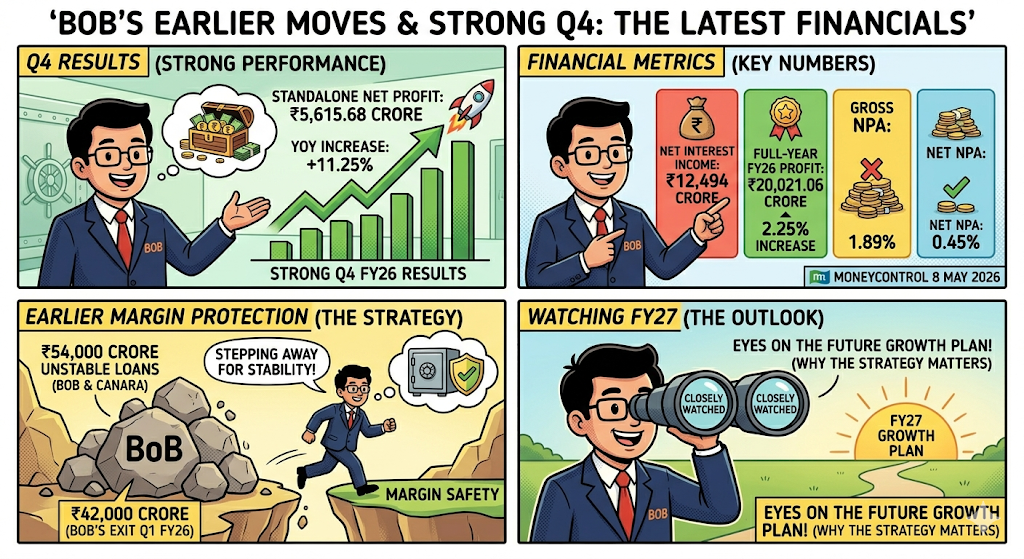
Before this FY27 loan target, BoB had reported strong Q4 FY26 numbers. Moneycontrol reported on 8 May 2026 that standalone net profit rose 11.25% YoY to ₹5,615.68 crore, while full-year FY26 standalone profit increased 2.25% to ₹20,021.06 crore.
There was also an earlier margin-protection move. LoansJagat reported that BoB and Canara Bank together stepped away from ₹54,000 crore of loans, with BoB exiting about ₹42,000 crore in Q1 FY26, citing margin safety. This shows why the FY27 corporate growth plan will be watched closely.
Bank of Baroda’s FY27 plan is a strong corporate credit push built on a ₹50,000 crore pipeline and better asset quality. The challenge is simple: grow faster, but keep margins and bad loans under control.
*T&C Apply
Yes, a first-time business owner can get a business loan, but approval depends on documents, credit score, business plan, income proof and collateral. Banks usually prefer existing businesses because they can check sales, GST returns and repayment capacity.
For a new business, the borrower should prepare a proper project report, expected revenue, investment details and use of funds. A good personal credit score also helps. New entrepreneurs can also check government-backed schemes, NBFC loans or small-ticket business loans before applying for a large loan. Avoid borrowing without knowing EMI pressure and cash flow.
What happens to a bank’s money when a company fails to repay its loan?
When a corporate firm defaults on a loan, the bank first tries to recover the money from the company itself. It may use collateral, sell pledged assets, restructure the loan, or take legal action under recovery laws. If recovery is not enough, the bank must absorb the loss by making provisions from its profits.
In serious cases, the loan becomes a non-performing asset, or NPA. Depositors do not directly pay for the default, but large defaults can reduce a bank’s profit, weaken lending capacity and affect shareholders. That is why banks carefully check corporate borrowers before giving large loans.
Related Finance News | |||









.png&w=3840&q=75)



