
By continuing, you agree to LoansJagat's Credit Report Terms of Use, Terms and Conditions, Privacy Policy, and authorize contact via Call, SMS, Email, or WhatsApp
Disclaimer: The information published on LoansJagat is intended for general informational and educational purposes only and should not be considered financial, legal, or investment advice. Interest rates, loan terms, statistics, and other data may change over time and may vary by lender or source. Please verify the latest information and consult a qualified financial advisor or the respective Bank/NBFC before making any financial decisions.
Subscribe Now
About the author

Arshathul Afia
Arshathul Afia is a journalism graduate and fintech content writer with 4+ years of experience in digital publishing and research-led writing. She has written 200+ articles covering personal finance, lending, banking, digital payments, credit, insurance, and major financial developments in India. At LoansJagat, she focuses on simplifying complex fintech news, RBI updates, loan-related changes, policy developments, and industry trends for everyday readers. Her journalism background helps her approach stories with research, context, and clarity, while her SEO experience ensures content remains discoverable and relevant. She aims to make financial news easier to understand, practical, and useful for readers across India.
Related Blog Post
Simplify All Your Loans Into One Affordable EMI

Customers Served

Debt Consolidated

1200+ Reviews

Locations in India
Club all Loans & Credit Card Bills into Single EMI

Quick Apply Loan
Consolidate your debts into one easy EMI.

Takes less than 2 minutes. No paperwork.

10 Lakhs+
Trusted Customers

2000 Cr+
Loans Disbursed

4.7/5
Google Reviews

50+
Banks & NBFCs Offers
Other services mentioned in this article
Banks are rejecting more personal loan files after deeper checks on income, EMIs, documents, credit behaviour and lender-specific risk rules before approval in India now.
Key Highlights
A rejected personal loan can stop a family plan in 1 day. The money may be needed for a hospital bill, rent deposit, school fee, wedding booking, home repair or credit-card payoff. When the bank says no, many borrowers do the quickest thing possible. They apply somewhere else.
That quick second application can create fresh trouble. More enquiries may enter the credit file. The same document error may reach another lender. A high EMI burden may again get flagged. In the short term, the borrower loses access to urgent money. In the long term, repeated rejection can make the credit profile look weaker than before.
Personal loans are unsecured, so lenders do not hold gold, property or fixed deposits against the money. That makes the bank stricter. A borrower with a regular salary can still get rejected if existing EMIs already take away too much of their monthly income. A shop owner with good earnings may fail because deposits in the account look uneven.
The impact is visible in smaller cities too. A teacher in Bhopal, a delivery worker in Bengaluru or a trader in Surat may use personal loans for short cash gaps. Rejection delays that plan. Still, stricter checks can also protect borrowers from taking a loan that becomes difficult after 3 or 4 EMIs.
Credit professionals usually ask borrowers to stop guessing. The first job is to find out why the bank rejected the file. It may be due to late payments, a high loan amount, unstable income, too many recent enquiries or a mismatch in PAN, Aadhaar, salary slip and bank statement.
LoansJagat’s borrower guidance on CIBIL score and loan rejection says missed EMIs, high card usage and repeated applications can hurt access to future personal loans, home loans, car loans and credit cards. The useful fix is not another hurried application. It is a corrected file.
The main story is simple. Banks are not rejecting only low-score borrowers. They are rejecting incomplete, risky or mismatched files. A person may have a 750+ credit score and still fail if income proof is weak, EMIs are heavy, documents do not match or the lender’s internal policy does not accept the profile.
This is where borrowers get caught. They often treat approval as a score game. Lenders treat it as a full-file check. That gap creates confusion after rejection.
Before going to another lender, the borrower should compare 4 things: credit report, monthly obligations, income record and document accuracy. If these 4 areas are weak, the next application may fail too.
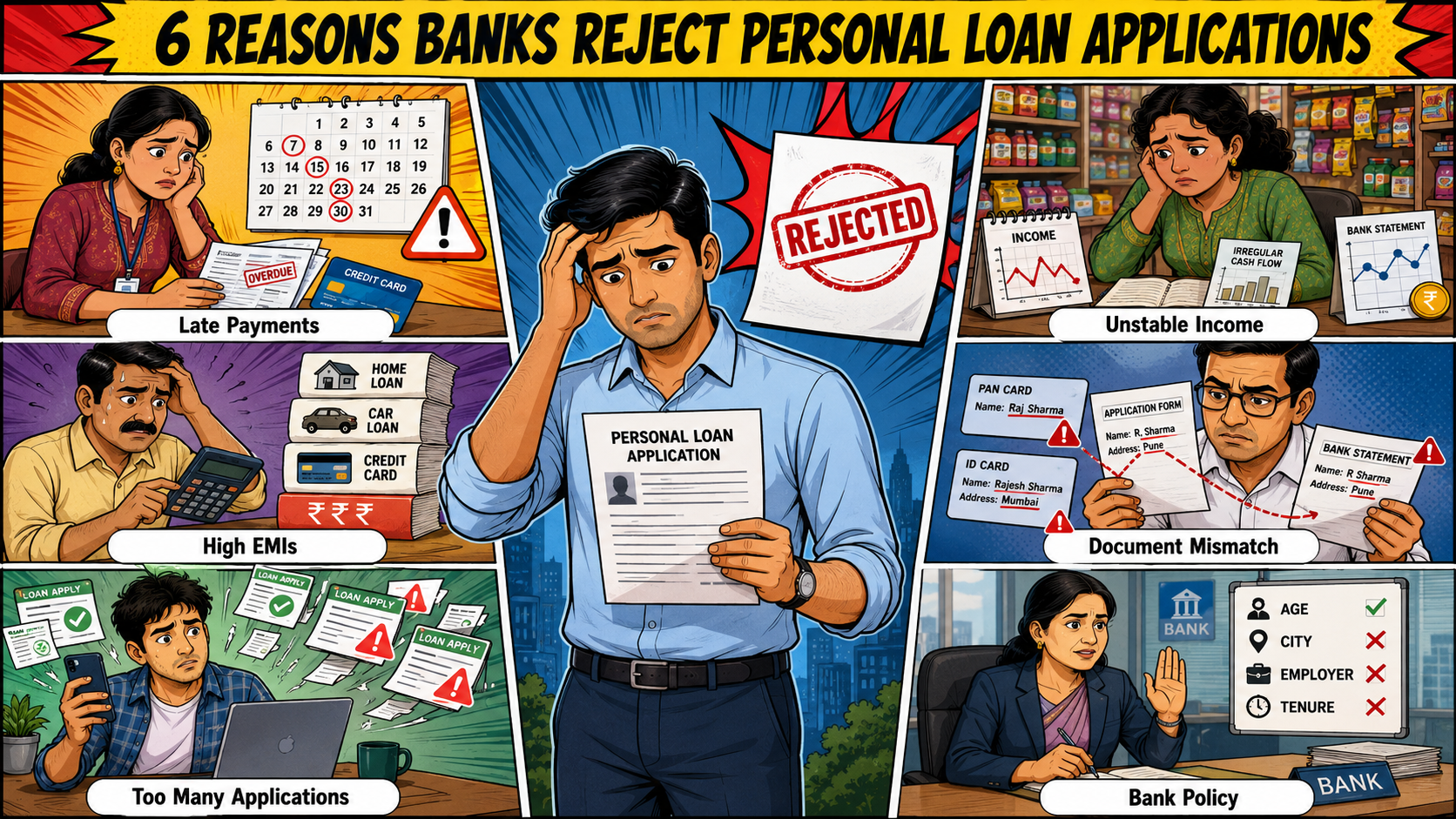
A personal loan file can fail for more than 1 reason. Banks check the borrower’s repayment record, income flow, current EMIs, documents and recent credit activity before giving approval. A good salary or a 750+ score may help, but the full file still has to look reliable.
Late EMIs, unpaid credit-card bills, written-off loans and settled accounts can hurt a file. A settled account is especially risky because it tells the lender that the borrower did not repay the full agreed-upon amount.
A borrower may earn ₹80,000 a month and still look stretched if a home loan, car loan, app loan, and card EMIs already take a large share. Banks check whether the new EMI can fit without pushing the borrower into stress.
The appearance of a borrower hungry for credit may result from the submission of 5 loan applications in 10 days. Loan eligibility checks may be more prudent. Full applications may create unnecessary inquiries and reasons for concern.
The absence of consistent salary/bank credits or consistent business income may lead to concerns. If a borrower has recently changed jobs, is on employment probation, or has a cash-heavy income or bank deposits that are difficult to explain, there will be greater cause for concern.
A spelling difference in the name, old address, wrong PAN, missing bank statement page or salary mismatch can block approval. Banks may not spend extra time fixing confusion in an unsecured loan file.
Some lenders reject based on age, city, employer type, income band, loan amount, tenure or internal risk grade. Another lender may approve, but only when the borrower chooses carefully.
Official data shows why lenders are paying closer attention to retail credit. Personal loans are no longer a small product category. They are a large share of credit, and that makes screening important for banks.
The table below gives the short official trail. It also shows where a borrower can go if a service issue arises after a loan rejection, closure delay or unresolved complaint.
These official updates show why borrowers need cleaner loan files before applying again. If a lender delays closure, gives poor service or does not respond properly after rejection, borrowers can use the National Consumer Helpline complaint portal to raise a complaint through its website, app, WhatsApp or helpline route.
The previous public signal came from the growth of retail credit and stronger bank balance sheets. When personal loans grew faster and public sector banks reported lower gross NPAs, lenders had 2 reasons to stay careful. They had demand. They also had better loan books to protect.
That is why many lenders now screen unsecured borrowers in layers. First comes the basic eligibility check. Then comes bureau history. After that, the lender studies income, bank statements, employer details, existing loans and internal policy fit. Rejection can happen at any layer.
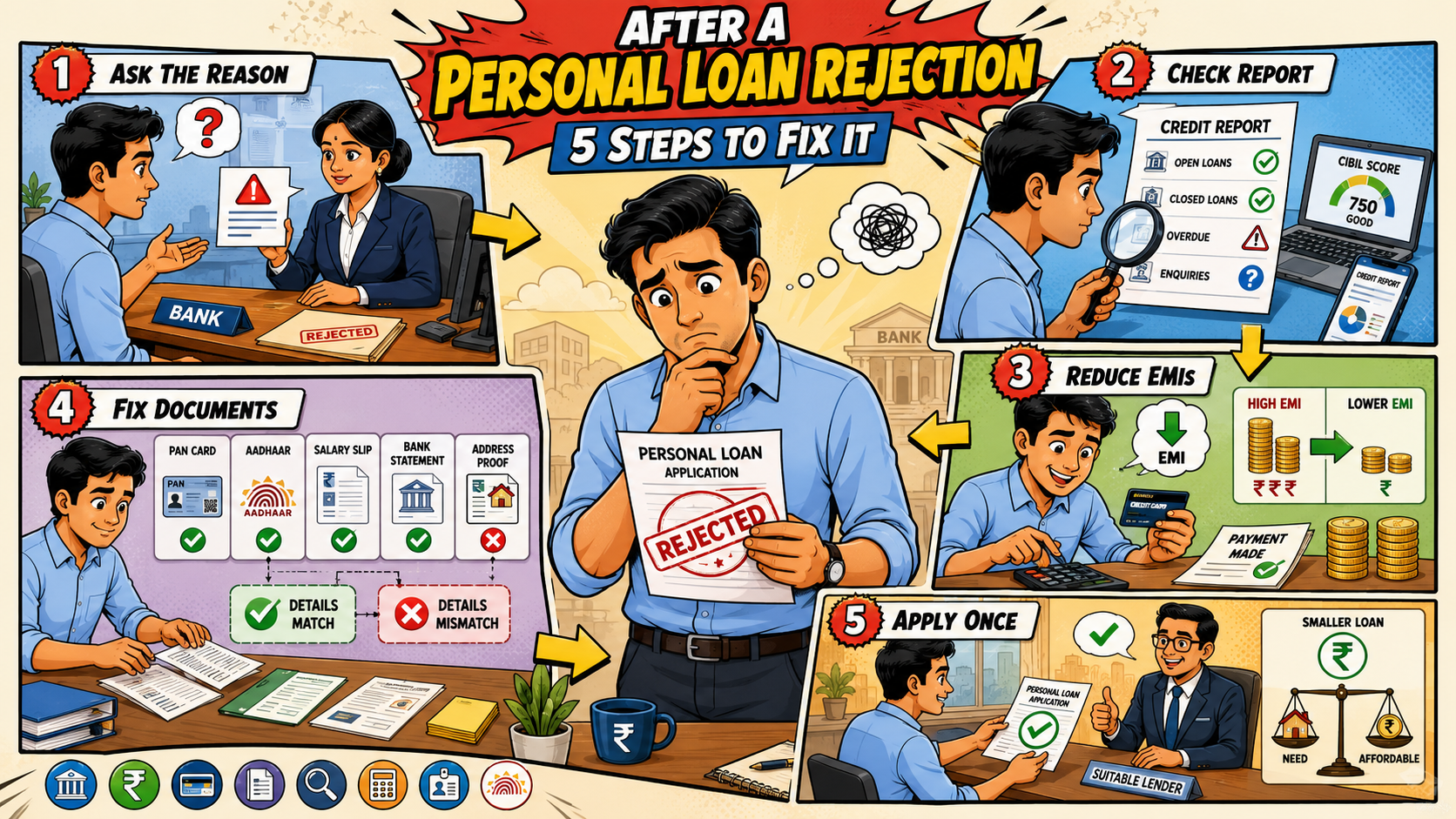
A rejection should not push a borrower into another quick application. The first job is to find the weak spot. It may be a delayed EMI, a high card balance, a wrong PAN detail or income proof that does not match the bank statement. Fix that first, then apply again.
The borrower should ask the bank for the exact rejection reason. Even a short answer helps. “High obligations” and “document mismatch” need different repairs.
The report should be checked for open loans, closed loans, overdue amounts, wrong personal details, old enquiries and unknown accounts. Any wrong entry must be disputed with proof.
High card balances can scare lenders. Closing a small expensive loan or reducing card dues may improve the next application. The borrower should avoid taking another app loan during this period.
PAN, Aadhaar, bank statement, salary slip, employer name and address proof should tell the same story. Self-employed borrowers should keep tax records, business proof and bank statements ready.
The borrower should pick 1 lender after checking eligibility. A smaller amount and realistic tenure can work better than a large request that strains monthly income.
Data from banks and other lenders is essential for credit bureaus. If something like overdue status appears, the borrower will have to show proof of payment and get confirmation from the lender to have it changed. Keeping closure letters and no-dues certificates is not paperwork for the drawer. It can protect the next loan application.
Banks check a borrower's ability to pay back a loan before offering credit. A borrower may get a loan rejection even with a good score if the lender’s salary, job type, city, age or EMI load doesn’t fit the lenders internal policy.
Borrowers also need to slow down after rejection. Many people apply again because they feel the first bank made a mistake. Sometimes it did. Quite often, the file had a weak point that the next bank will also see.
A personal loan rejection is a warning sign, not a dead end. The borrower’s file has a weak point. It could be a late EMI, heavy card balance, job change, document mismatch, high requested amount or a lender policy block.
The safer move is to pause. Get the reason. Check the credit report. Lower debt pressure. Correct documents. Then send 1 fresh application to a lender that fits the profile. That gives the borrower a better chance than applying again in frustration.
Why was a personal loan rejected despite a good credit score?
The bank may reject due to high EMIs, unstable income, document mismatch or internal policy rules.
Does a 750+ credit score guarantee personal loan approval?
No. A 750+ score helps, but banks also check income, repayment capacity and documents.
Should borrowers apply again immediately after rejection?
No. They should first find the rejection reason, correct the issue and then apply once.
Can too many applications reduce approval chances?
Yes. Several fresh enquiries in a short period can make the borrower look dependent on credit.
What is the best first step after rejection?
The borrower should ask the lender for the reason and then check the full credit report.









.png&w=3840&q=75)


