
By continuing, you agree to LoansJagat's Credit Report Terms of Use, Terms and Conditions, Privacy Policy, and authorize contact via Call, SMS, Email, or WhatsApp
Disclaimer: The information published on LoansJagat is intended for general informational and educational purposes only and should not be considered financial, legal, or investment advice. Interest rates, loan terms, statistics, and other data may change over time and may vary by lender or source. Please verify the latest information and consult a qualified financial advisor or the respective Bank/NBFC before making any financial decisions.
Subscribe Now
About the author

LoansJagat Team
‘Simplify Finance for Everyone.’ This is the common goal of our team, as we try to explain any topic with relatable examples. From personal to business finance, managing EMIs to becoming debt-free, we do extensive research on each and every parameter, so you don’t have to. Scroll up and have a look at what 15+ years of experience in the BFSI sector looks like.
Related News
Simplify All Your Loans Into One Affordable EMI

Customers Served

Debt Consolidated

1200+ Reviews

Locations in India
Club all Loans & Credit Card Bills into Single EMI

Quick Apply Loan
Consolidate your debts into one easy EMI.

Takes less than 2 minutes. No paperwork.

10 Lakhs+
Trusted Customers

2000 Cr+
Loans Disbursed

4.7/5
Google Reviews

50+
Banks & NBFCs Offers
Other services mentioned in this article
Fast refunds for income tax can happen as soon as the return is e-verified, augmented with the right records, along with the right ITR form and an already validated bank account.
Key Highlights
The income-tax refund processed in about a week is feasible for easy cases. Having the ITR linked to a validated bank account that is already verified, e-verified, and submitted in the right way is vital. The Ministry of Finance update of December 24, 2024, states that over 3.87 crore tax returns were processed within seven days. These were processed, and it does not mean that all taxpayers will receive their refunds in seven days.
For many salaried employees, pensioners, and freelancers, the refund is money already expected for rent, fees, bills, or a pending loan payment. A delay can be frustrating, especially when the return appears complete. In many cases, the hold-up comes from something small, such as a TDS mismatch, missing interest income, the wrong ITR form, or an old bank account still selected on the portal. E-verification starts the process. The rest depends on how clean the return looks when the system checks it.
Tax refunds for Indian taxpayers can be issued within 7 days, given the case is simple and the taxpayer opts for e-verification. The 7-day period starts only when the taxpayer e-verifies, as opposed to when the return is uploaded. Payment can also be delayed due to unmatched TDS, unreported income, an incorrect TDS ITR form, or bank verification failure.
The Press Information Bureau is the source of official information. In the Ministry of Finance Year Ender published on the 24th of December 2024, the government stated that more than 3.87 crore ITRs were processed in a 7-day period and refunds of more than ₹2.35 lakh crore were issued. The statement referred to the volume of the processing and not that all the refunds would reach the banks in that time.
It would be great to have an early refund to pay rent and bills or to cover a loan installment. Refunds that are more complex due to capital gains, Foreign income, or large deductions may require more time for processing.
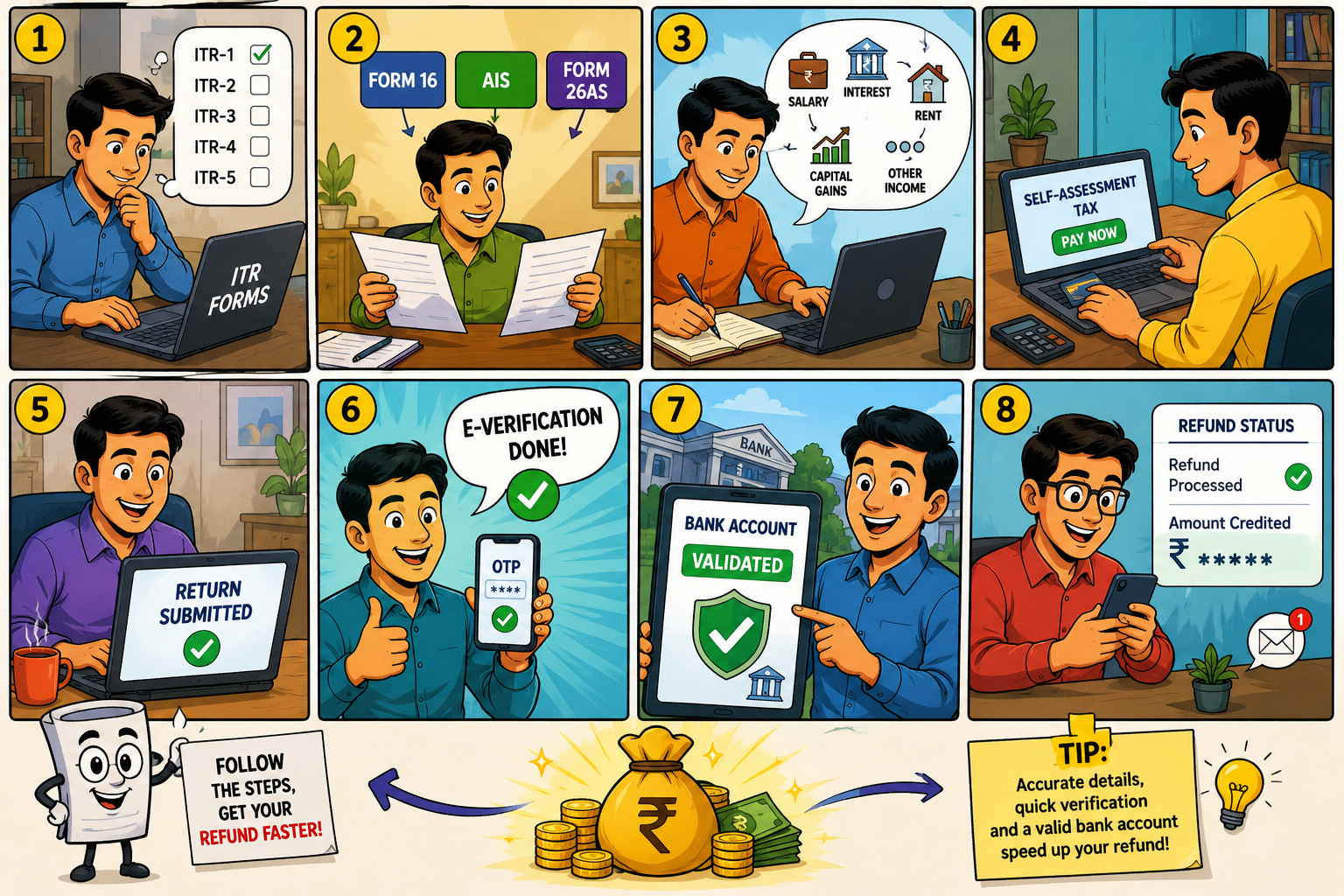
A refund moves faster when each step is completed in order. The taxpayer must choose the correct ITR form, match income with Form 16, AIS, and Form 26AS, report all earnings, and pay any balance tax. After filing, e-verification starts processing, while a validated bank account allows the approved amount to be credited.
Select the correct ITR form
↓
Compare Form 16, AIS, and Form 26AS
↓
Report every source of income
↓
Pay pending self-assessment tax
↓
Submit the return.
↓
Complete e-verification immediately
↓
Use a validated bank account
↓
Track the refund status.
The taxpayer should then check the filed return status and registered email. A mismatch, old tax demand or failed bank credit can add several days to the wait.
A faster refund cycle helps people recover excess TDS sooner. Salaried employees, senior citizens and freelancers can all face over-deduction.
A filer with 1 employer and matching TDS presents a simpler case than someone reporting shares, rent, foreign assets or income from several employers.
E-verification is the first gate. Notification No. 2/2024, dated 31 March 2024 and effective from 1 April 2024, gives taxpayers 30 days from filing to verify the return or submit ITR-V. A return uploaded on 10 July and verified on 18 July enters processing only after 18 July.
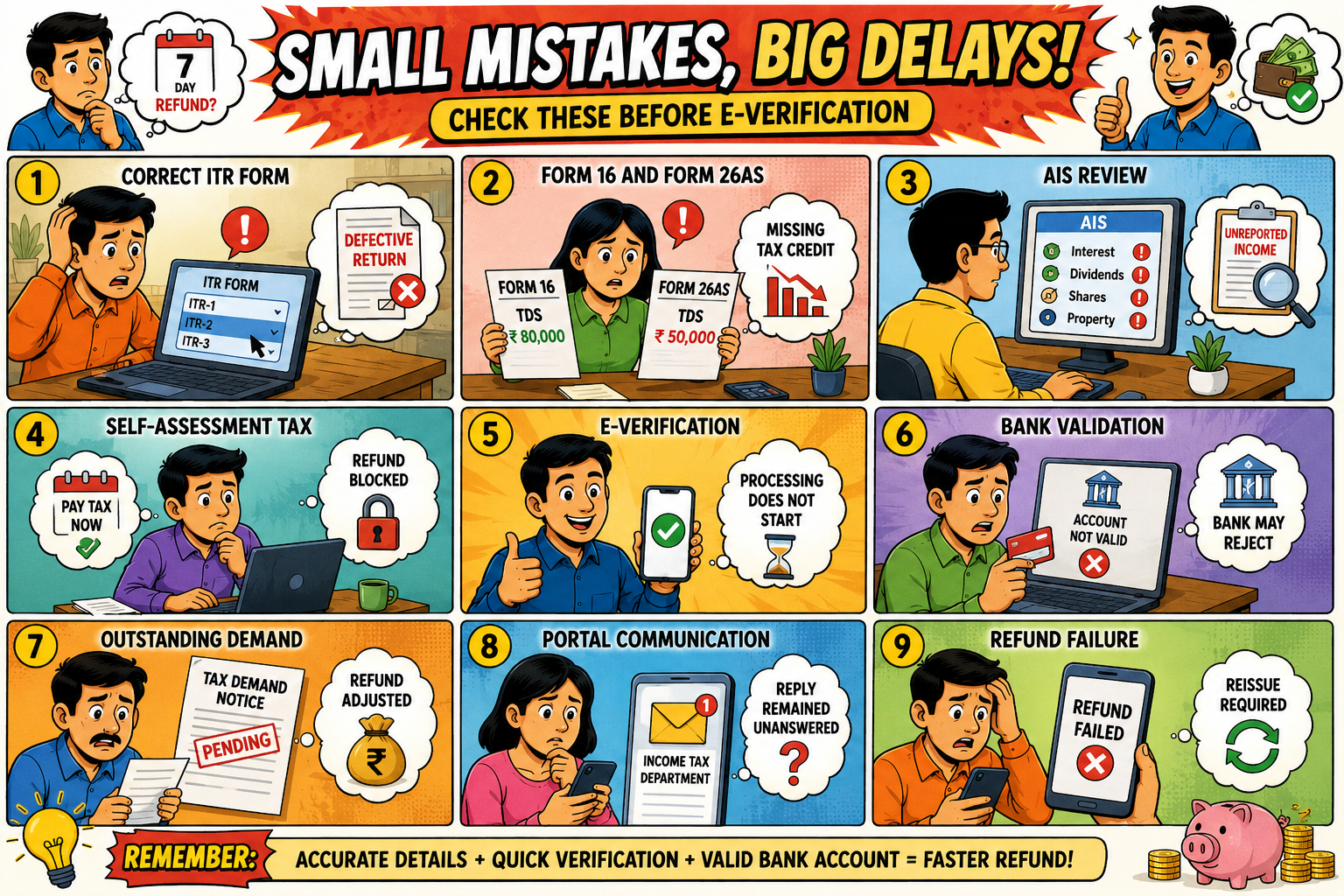
Most delays begin with a basic filing error. A salary entry may be missing, bank interest may appear in AIS but not in the return, or TDS shown in Form 16 may not appear correctly in Form 26AS.
A bank account can also block payment. The refund may be approved, yet the transfer can fail because the account is closed, the IFSC has changed or the taxpayer’s name does not match bank records.
The checklist below covers the main checks before e-verification.
The Income Tax Department states that processing begins only after e-verification. Its refund manual says the normal credit period may be around 4 to 5 weeks, so 7 days is not a fixed deadline.
After checking the table, the taxpayer should review the acknowledgement. “Successfully e-Verified” confirms completion. “Submitted and Pending for e-Verification” means processing has not started.
The government’s 3.87 crore figure shows that many returns can be processed within a week. It does not show that every return carried a refund or that every approved refund reached the bank within 7 days.
Processing checks, declared income, deductions, TDS, and taxes paid. Refunds may still be delayed even if a taxpayer receives a notice under Section 143(1) requesting them. Refunds may still be delayed even if a taxpayer receives a notice under Section 143(1) requesting them
As per the same Ministry of Finance update, ITRs processed in a week represented 26.35% in FY 2024-25, as compared to 22.56% in FY 2023-24. Processing time improved; however, a majority of returns continued to fall outside the 7-day processing group.
*T&C Apply
According to the 24 December 2024 review, about 98.35% of the returns filed up to 22 November 2024 were e-verified, and 96% of the filers in the Assessment Year 2024-25 verified via EVC.
Taxpayers should e-verify without delay, and match Form 16 with Form 26AS and review the AIS.
Form 16 is issued by the employer, Form 26AS reflects tax credits, and AIS may include interest, dividends, and trades. In case of missing TDS, the employer, bank, or deductor may need to make the correction. Improper entries in the AIS may be contested.
A 7-day result is most likely when the return needs little intervention. A salaried filer with 1 employer, matching TDS, limited interest income, no disputed deductions, and an active bank account has fewer points of failure.
The taxpayer must verify the return, the tax system must process it, and the bank must accept the payment instruction. A delay at any stage extends the wait.
The LoansJagat ITR verification guide lists Aadhaar OTP, net banking, bank-account EVC, demat-account EVC, and digital signature certificates among the online verification routes. It also explains that filing alone does not complete the return process.
Taxpayers should not plan an EMI or essential purchase around a promised 7-day refund. The wider official period remains safer.
A “Refund Failure” status usually means the return has been processed, but the bank could not credit the payment. Common reasons include an inactive account, name mismatch, wrong account number or changed IFSC.
The taxpayer should validate the correct bank account and submit a refund reissue request where required. Updating the account alone may not restart payment.
An outstanding demand also needs attention. Taxpayers can review it under Pending Actions and accept, dispute or pay the amount. A valid demand may be adjusted against the current refund.
Seven-day income tax refunds are real for some taxpayers, and official data confirms that crores of returns have moved through processing within that period. Processing within 7 days and receiving money within 7 days remain different events.
The taxpayer should select the correct ITR form, match income and TDS records, pay any balance tax, e-verify immediately, and use an active bank account. One ignored mismatch can stretch the wait.
Can every taxpayer receive an income tax refund within 7 days?
No. The period depends on e-verification, return complexity, data matching, departmental checks and bank credit.
Does the refund period start on the ITR filing date?
Processing begins after successful e-verification, not merely after uploading the return.
How long does the tax department normally take to issue a refund?
Official guidance says refunds may generally take around 4 to 5 weeks after e-verification.
Why is the refund lower than the amount claimed?
The department may correct a calculation, reject unavailable TDS credit or adjust an earlier demand.
Can a wrong bank account delay the refund?
Yes. An inactive, incorrect or non-validated account can cause payment failure after processing.
What should a taxpayer do if AIS contains incorrect information?
The taxpayer can submit AIS feedback and retain supporting records.









.png&w=3840&q=75)



