By continuing, you agree to LoansJagat's Credit Report Terms of Use, Terms and Conditions, Privacy Policy, and authorize contact via Call, SMS, Email, or WhatsApp
Disclaimer: The information published on LoansJagat is intended for general informational and educational purposes only and should not be considered financial, legal, or investment advice. Interest rates, loan terms, statistics, and other data may change over time and may vary by lender or source. Please verify the latest information and consult a qualified financial advisor or the respective Bank/NBFC before making any financial decisions.
Subscribe Now
About the author

LoansJagat Team
‘Simplify Finance for Everyone.’ This is the common goal of our team, as we try to explain any topic with relatable examples. From personal to business finance, managing EMIs to becoming debt-free, we do extensive research on each and every parameter, so you don’t have to. Scroll up and have a look at what 15+ years of experience in the BFSI sector looks like.
Related News
Simplify All Your Loans Into One Affordable EMI

Customers Served

Debt Consolidated

1200+ Reviews

Locations in India
Club all Loans & Credit Card Bills into Single EMI

Quick Apply Loan
Consolidate your debts into one easy EMI.

Takes less than 2 minutes. No paperwork.

10 Lakhs+
Trusted Customers

2000 Cr+
Loans Disbursed

4.7/5
Google Reviews

50+
Banks & NBFCs Offers
Other services mentioned in this article
Arvind Panagariya compelled the Center, for the first time in a long time, to continue the privatization of PSUs and banks to reinstate the stalled reforms.
Key Highlights
Arvind Panagariya, the former Vice Chairman of NITI Aayog, advocated the Union government to recommence the privatization of public sector undertakings and the majority of public sector banks. His comments on the issue appeared in Business Standard on June 15, 2026, following an interview to PTI.
The timing has drawn attention. Public sector banks are no longer in the weak position seen during the bad-loan crisis. They now report stronger profits, lower NPAs and better capital levels. That can help the government seek a better price. It can also raise a basic question: should profitable banks be sold when they are already giving the Centre steady dividend income?

The Finance Ministry published these figures through the PIB report on May 12, 2026.
Over the year, net profit rose by 11.1%. Deposits grew by 10.6% and advances by 15.7%. Retail loans grew by 18.1%, as did agricultural loans. MSME loans grew by 18.2%. PSBs also recovered ₹86,971 crore and raised ₹50,551 crore in capital.
These are not small changes. They show why the ownership debate is different now from what it was a few years ago.
For customers, ownership changes are felt through everyday banking. A private buyer may close weak branches, raise some service charges or move more work online. Loan approvals may become quicker in profitable segments. Rural and low-income customers could face a different experience.
A pensioner in a small town may care less about faster apps and more about keeping a branch nearby. A small shop owner may depend on regular contact with a bank manager. Farmers and MSMEs also rely heavily on priority-sector credit. Any sale agreement would need firm conditions on these areas before management control changes hands.
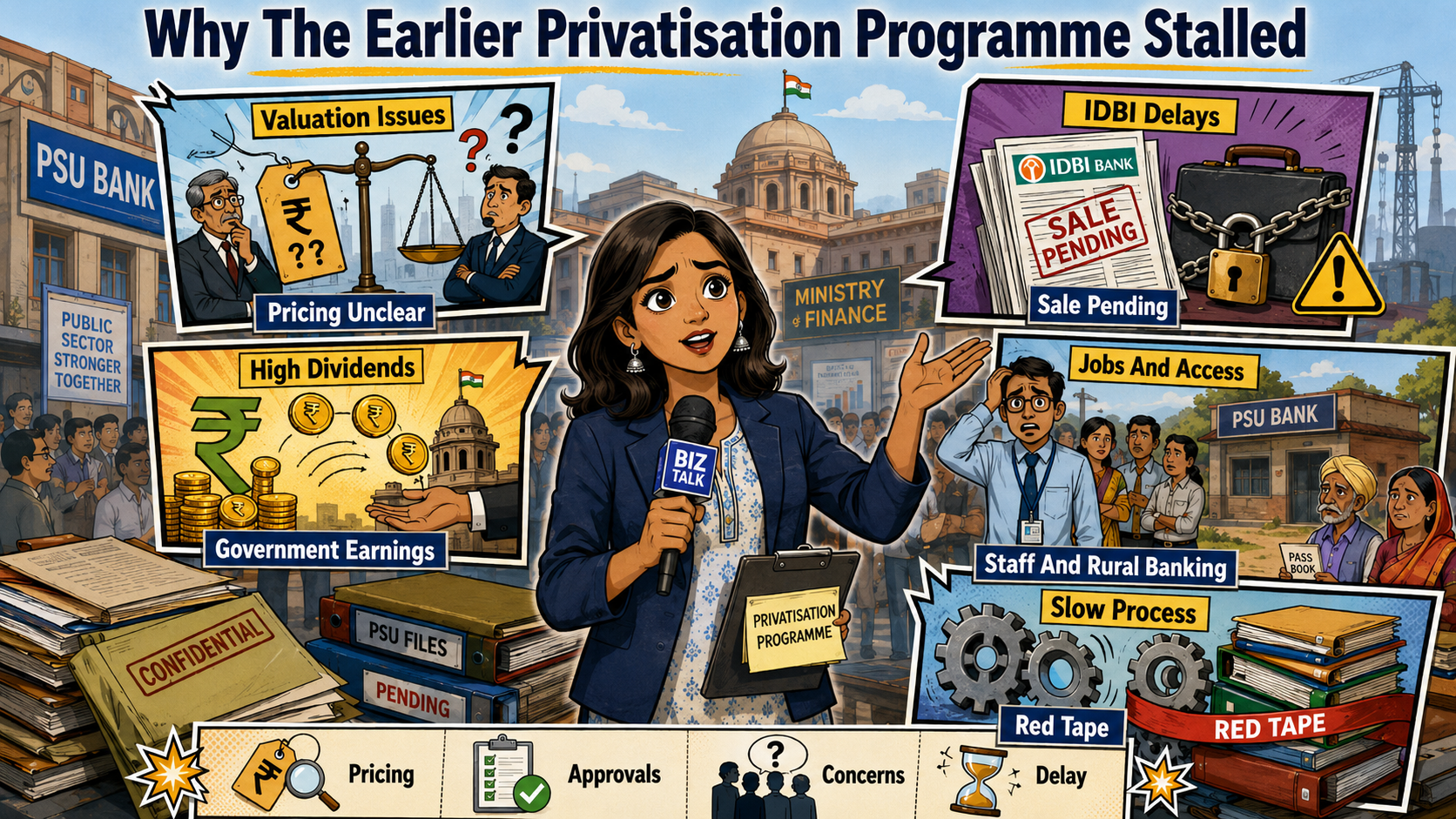
NITI Aayog began preparing a list of probable privatisation candidates in the year 2016. In addition to IDBI Bank, the Union Budget of 1st February 2021 mentioned the sale of 2 PSBs and 1 General Insurance Company, as per PIB.
The flow of government receipts also explains why selling profitable assets is not a simple decision.
*T&C Apply
Dividend receipts were about 4.6 times the money collected through disinvestment. A sale gives the government cash once. Retaining a profitable bank can keep dividend income flowing year after year.
A LoansJagat report published on April 30, 2026, looked at the proposed 60.72% IDBI Bank stake sale and the reported ₹72,000 crore involved. It also highlighted pricing, pension costs and management control as hurdles in the transaction.
According to Panagariya, the West Asia crisis, fiscal problems, and geopolitical tensions should not continue to delay the privatization program. He recommended that the government create a separate ministry for privatization, claiming that the pace of privatisation in India was unacceptably slow.
Gradual privatization would be better for public sector bank customers. The government should publish methods of privatization, require certain conditions to be met by prospective bank buyers, and provide safeguards for bank customers.
The Centre now has to weigh a one-time sale price against recurring dividends and public banking duties. Any fresh privatisation push will need fair valuation, rural branch protection and firm rules for depositors and borrowers.
Has There Been Any Government Announcement Regarding The PSB Privatization Policy?
No, Panagariya made the recommendations on June 15, 2026.
What was the Target of PSB Privatization in 2021?
The Union Budget proposed the sale of 2 public sector banks.
Are Public Sector Banks Profitable Now?
Yes. Their combined net profit reached ₹1.98 lakh crore in FY 2025-26.
What are the advantages and risks of privatising Indian banks?
Privatisation may improve efficiency and technology but could reduce rural access, jobs and affordable lending.
Will PSU Privatisation Benefit India’s Economy in the Long Run or Create New Risks?
It may improve efficiency and investment, but weak safeguards could hurt jobs, access and public accountability.









.png&w=3840&q=75)



