
By continuing, you agree to LoansJagat's Credit Report Terms of Use, Terms and Conditions, Privacy Policy, and authorize contact via Call, SMS, Email, or WhatsApp
Disclaimer: The information published on LoansJagat is intended for general informational and educational purposes only and should not be considered financial, legal, or investment advice. Interest rates, loan terms, statistics, and other data may change over time and may vary by lender or source. Please verify the latest information and consult a qualified financial advisor or the respective Bank/NBFC before making any financial decisions.
Subscribe Now
About the author

Arshathul Afia
Arshathul Afia is a journalism graduate and fintech content writer with 4+ years of experience in digital publishing and research-led writing. She has written 200+ articles covering personal finance, lending, banking, digital payments, credit, insurance, and major financial developments in India. At LoansJagat, she focuses on simplifying complex fintech news, RBI updates, loan-related changes, policy developments, and industry trends for everyday readers. Her journalism background helps her approach stories with research, context, and clarity, while her SEO experience ensures content remains discoverable and relevant. She aims to make financial news easier to understand, practical, and useful for readers across India.
Related News
Simplify All Your Loans Into One Affordable EMI

Customers Served

Debt Consolidated

1200+ Reviews

Locations in India
Club all Loans & Credit Card Bills into Single EMI

Quick Apply Loan
Consolidate your debts into one easy EMI.

Takes less than 2 minutes. No paperwork.

10 Lakhs+
Trusted Customers

2000 Cr+
Loans Disbursed

4.7/5
Google Reviews

50+
Banks & NBFCs Offers
Other services mentioned in this article
The Bank of Baroda expects customers to have relatively stable borrowing costs in the near future because changes in the RBI's repo rate are unlikely before October. Although inflation keeps the repo rate a threat, increased borrowing costs from the RBI due to poor rainfall are expected to come after October.
Key Highlights
Borrowing costs are unlikely to be changed by the Bank of Baroda for the next 16 months and are expected to remain at 5.25%. This estimate was included in the Bank of Baroda's Economic Outlook: FY26 report, which was published on 24 June 2026. Potential rate changes for the rest of the year have not been ruled out.
For borrowers, that may mean no sudden repo-linked EMI rise for the next few months. Another rate cut, though, looks less likely now. Food prices, fuel costs and uneven rainfall could still change the rate outlook after October.
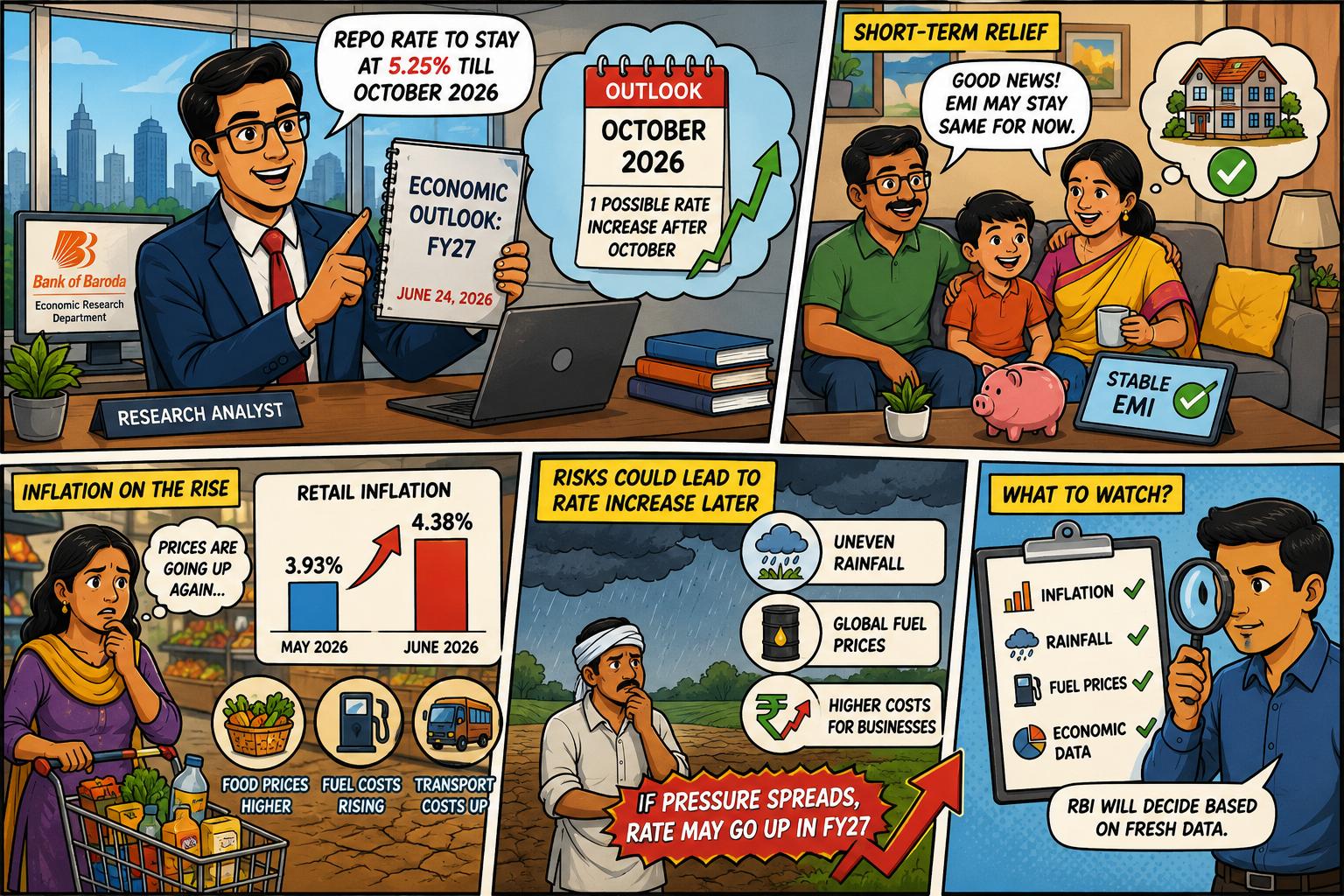
Bank of Baroda expects no change in India’s 5.25% repo rate at least until October 2026. Its Economic Research Department issued the forecast in the Economic Outlook: FY27, released on 24 June 2026, through the bank’s Economic Scenario portal. The report leaves room for 1 rate increase after October, depending on inflation, rainfall, fuel prices and fresh economic data.
For households, the forecast points to stable repo-linked borrowing costs in the short term. Borrowers should not expect another broad EMI reduction soon, though. The longer-term risk has also increased after retail inflation rose to 4.38% in June 2026 from 3.93% in May. Higher food, fuel and transport costs could support a rate increase later in FY27 if the pressure spreads to more goods and services.
A pause at 5.25% may prevent an immediate repo-led rise in home loan, vehicle loan and business loan repayments. A borrower whose loan directly tracks the repo rate would usually see a change only after the benchmark moves and the lender applies its reset. That gives families some room to plan expenses without preparing for another sudden EMI revision.
The positive effect is limited, however. Stable policy rates do not freeze every lending rate in India. Banks may still revise their product spreads, processing terms or MCLR-based rates according to deposit costs and internal funding needs. New applicants may also receive different offers based on income, credit history, employer profile and existing debt.
The table below separates the main rate signals from their likely household impact. It also shows why the October forecast should be treated as an economic estimate, not a confirmed future decision.
Existing borrowers should check the benchmark written in their sanction letter. Repo-linked loans usually pass rate changes faster. MCLR-linked loans follow the lender’s reset schedule, which may be every 6 or 12 months. Fixed-rate borrowers generally continue with their contracted rate unless their agreement contains a reset clause.
Depositors face another calculation. A later rate increase may lead some banks to offer higher fixed-deposit returns, but that outcome is not automatic. Families with upcoming school fees, medical costs or property payments may prefer deposits with different maturity dates instead of placing all available money into 1 long tenure.
Economists remain divided over how long the pause can last. Aditi Nayar, chief economist at ICRA, said after the June inflation release that the policy rate was likely to remain unchanged at the August 2026 meeting. Vikram Chhabra, senior economist at 360 ONE Asset, also expected an August pause while policymakers assess rainfall, crude oil and the growth-inflation position. Reuters published both views on 13 July 2026.
Other economists see an earlier increase as possible. Upasna Bhardwaj, Chief Economist at Kotak Mahindra Bank, expected a cumulative 50 bps increase during the second half of FY27. Shilan Shah of Capital Economics said an increase could arrive as early as August and projected 75 bps of increases by early 2027. These are forecasts, not announced decisions, and the wide gap shows how quickly changing fuel and food prices can alter expectations.
The immediate solution for borrowers is fairly basic. A customer should check the current benchmark, reset date, outstanding principal and lender spread before refinancing. Switching a loan only for a small advertised rate difference may fail to save money once processing charges, legal fees and the remaining tenure are included.
Families carrying credit-card balances or expensive app loans should also avoid waiting for a repo change to solve the problem. Those products may not pass policy reductions quickly, and unsecured borrowing remains priced mainly on repayment risk. Paying down the costliest debt can provide a quicker benefit than waiting for another policy move.
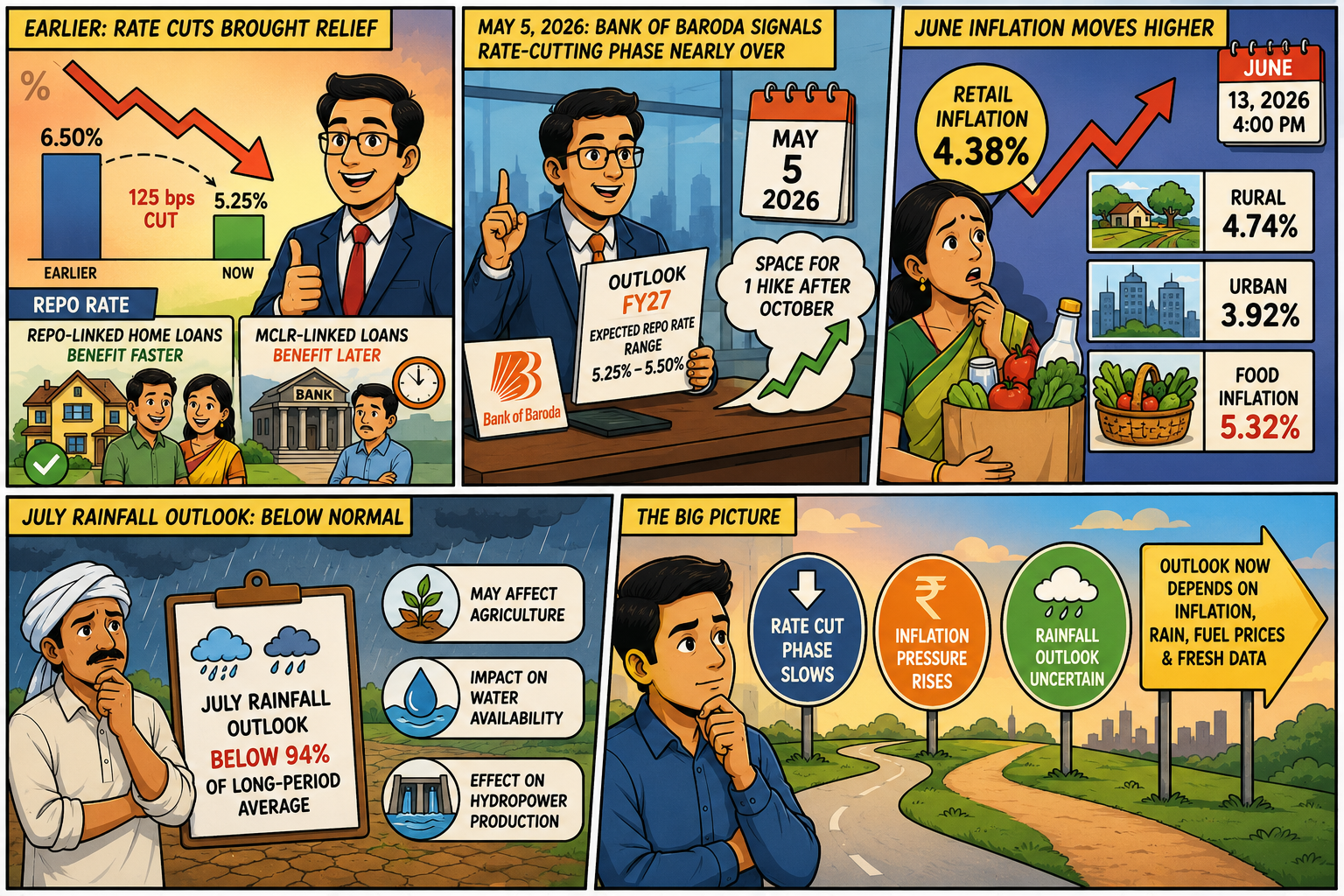
The repo rate had earlier declined from 6.50% to 5.25%, a cumulative reduction of 125 bps. That easing phase lowered benchmark-linked lending rates, although customers received the benefit at different times. Repo-linked home loans moved faster, while older MCLR-linked accounts waited for their contracted reset dates.
By 5 May 2026, Bank of Baroda’s Economic Research Department had indicated that the rate-cutting phase was close to its end for the time being. Its later FY27 outlook placed the expected repo rate in a 5.25% to 5.50% range, which allows for 1 increase from the present rate.
Inflation then moved higher. The official Consumer Price Index release published by PIB Delhi at 4:00 PM on 13 July 2026 put June retail inflation at 4.38%. Rural inflation stood at 4.74%, while the urban reading was 3.92%. Food inflation rose to 5.32%, adding pressure to household grocery budgets.
Rainfall has made the outlook harder to predict. The India Meteorological Department’s monthly outlook, dated 30 June 2026, forecast July rainfall at below 94% of the long-period average. The department warned that weak rainfall could affect agriculture, water availability and hydropower production in several areas.
Bank of Baroda identified 2 direct inflation risks in its June report. A weaker monsoon could raise the prices of pulses and cereals. Higher fuel and business input costs may also pass into restaurant bills, transport charges, packaged products and other services after a delay.
Sakshi Gupta, principal economist at HDFC Bank, linked the June increase partly to food and fuel prices. She also pointed to uneven rainfall and West Asia tensions as risks for the months ahead. Dipti Deshpande of CRISIL expected price pressure to rise as fuel and transportation costs pass through the economy. Both assessments were published by Reuters on 13 July 2026.
Housing representatives generally prefer stable borrowing rates because higher EMIs can weaken property demand. Small businesses also benefit from predictable repayment costs when they prepare inventory, salary and working-capital budgets. Savers may see the position differently, since a later increase could improve returns on selected deposits.
The next few inflation readings will carry greater weight than a single monthly number. A temporary vegetable or fuel increase may fade. A broader rise across food, transport, rent, services and manufactured products would create a stronger case for higher rates after October.
The earlier LoansJagat policy analysis, published on 19 May 2026, explained the difference between a temporary supply shock and price pressure that spreads through the economy. That distinction now becomes more relevant after June inflation moved above 4%.
LoansJagat’s borrower analysis is that the October forecast changes the timing of a possible rate revision, not the basic repayment decision. A borrower with a manageable EMI does not need to refinance only because a later increase is possible. The first check should be the lender spread. A high spread above the benchmark may offer more room for negotiation than waiting for a lower repo rate.
Borrowers near the end of their loan tenure should also calculate the actual savings before paying a switching fee. For a new applicant, improving the credit profile, reducing card utilisation and comparing the final annual cost may produce a better result than focusing only on the advertised interest rate.
Bank of Baroda expects the 5.25% repo rate to continue until October 2026. That forecast offers short-term stability for floating-rate borrowers, though it also lowers the chance of another early EMI reduction. The bank has kept the door open for 1 increase later in FY '27.
June inflation, weak rainfall and food-price pressure have made the period after October harder to predict. Borrowers should track their own loan reset dates instead of reacting to every rate forecast. A policy pause may hold the benchmark steady, but the cost of an individual loan still depends on the lender, the borrower’s credit profile and the spread charged above the benchmark.
What is the current repo rate in India?
The repo rate is 5.25% as of July 2026.
Will home loan EMIs fall before October?
Bank of Baroda expects a pause, so another repo-led EMI reduction appears unlikely before October.
Can banks raise loan rates during a repo rate pause?
Yes. Banks may revise MCLR rates or lender spreads based on funding costs and borrower risk.
Does Bank of Baroda expect a rate increase?
Its 24 June 2026 report allows for 1 possible increase after October, subject to fresh data.
What should borrowers check first?
They should check the loan benchmark, reset date, lender spread, switching fee and remaining tenure.










.png&w=3840&q=75)


