
By continuing, you agree to LoansJagat's Credit Report Terms of Use, Terms and Conditions, Privacy Policy, and authorize contact via Call, SMS, Email, or WhatsApp
Disclaimer: The information published on LoansJagat is intended for general informational and educational purposes only and should not be considered financial, legal, or investment advice. Interest rates, loan terms, statistics, and other data may change over time and may vary by lender or source. Please verify the latest information and consult a qualified financial advisor or the respective Bank/NBFC before making any financial decisions.
Subscribe Now
About the author

LoansJagat Team
‘Simplify Finance for Everyone.’ This is the common goal of our team, as we try to explain any topic with relatable examples. From personal to business finance, managing EMIs to becoming debt-free, we do extensive research on each and every parameter, so you don’t have to. Scroll up and have a look at what 15+ years of experience in the BFSI sector looks like.
Related News
Simplify All Your Loans Into One Affordable EMI

Customers Served

Debt Consolidated

1200+ Reviews

Locations in India
Club all Loans & Credit Card Bills into Single EMI

Quick Apply Loan
Consolidate your debts into one easy EMI.

Takes less than 2 minutes. No paperwork.

10 Lakhs+
Trusted Customers

2000 Cr+
Loans Disbursed

4.7/5
Google Reviews

50+
Banks & NBFCs Offers
Other services mentioned in this article
Key Takeaways
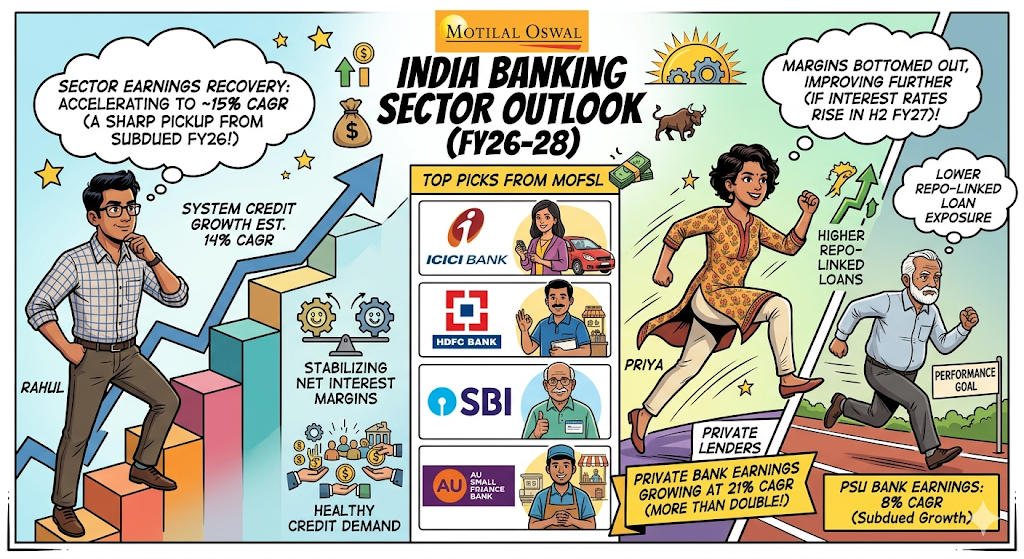
Motilal Oswal Financial Services expects India’s banking sector earnings to accelerate to about 15% CAGR over FY26-28, a sharp pickup from a subdued FY26. The brokerage named ICICI Bank, HDFC Bank, State Bank of India, and AU Small Finance Bank as its top picks. Stabilising net interest margins and healthy credit demand are the 2 main reasons behind this recovery. System credit growth is estimated at 14% CAGR over the same 3-year window.
Private lenders are set to outperform their public sector peers by a wide margin. MOFSL projects private bank earnings growing at 21% CAGR, more than double the 8% CAGR expected for PSU banks over FY26-28. The brokerage said private bank margins have largely bottomed out and could improve further if interest rates rise in the second half of FY27, given their higher exposure to repo-linked loans.
This earnings recovery is not just a stock market story. It directly shapes how easily Indians can borrow. Loan growth at large private banks is being driven by corporate, retail, and MSME demand together. Stress in unsecured retail and MSME portfolios has already started easing, and improving microfinance disbursements are expected to support profitability, especially at mid-sized lenders.
For salaried borrowers, this translates into real numbers. LoansJagat data shows SBI offers personal loans up to ₹20,00,000 at rates starting from 11.45%. ICICI Bank offers up to ₹50,00,000 at
For State Bank of India and other PSU banks, MOFSL expects earnings growth to moderate from recent strong levels. The reason is margin pressure from loan repricing and a higher share of corporate lending on their books. Asset quality, however, remains stable, supported by limited exposure to unsecured lending and healthy provision coverage.
MOFSL also flagged that the RBI’s recent FCNR(B) deposit mobilisation measures could support funding inflows into the banking system, though large private banks may compete aggressively for these deposits. The brokerage’s suggested path forward is straightforward: as asset-quality stress eases and margins stabilise, investor sentiment toward banking stocks should improve, even as geopolitical risks and sector-specific stress pockets remain near-term concerns.
MOFSL’s 15% CAGR earnings forecast for FY26-28 signals a clear recovery path for Indian banks. Private lenders like ICICI and HDFC Bank are positioned to lead, while SBI and PSU peers stay steady on asset quality. For borrowers, healthier bank balance sheets should mean easier access to credit ahead.
Why did India fall to 6th place in global GDP rankings as per the IMF’s April 2026 outlook?
*T&C Apply
Can a 15% CAGR over 20 years be achieved, and where to invest to achieve the same?
Yes, but takes both patience and smart investment. Historically, diversification in equities, index funds and small and mid-cap segments has delivered this over long economic cycles.
Related News Updates | |||









.png&w=3840&q=75)



