
By continuing, you agree to LoansJagat's Credit Report Terms of Use, Terms and Conditions, Privacy Policy, and authorize contact via Call, SMS, Email, or WhatsApp
Disclaimer: The information published on LoansJagat is intended for general informational and educational purposes only and should not be considered financial, legal, or investment advice. Interest rates, loan terms, statistics, and other data may change over time and may vary by lender or source. Please verify the latest information and consult a qualified financial advisor or the respective Bank/NBFC before making any financial decisions.
Subscribe Now
About the author

LoansJagat Team
‘Simplify Finance for Everyone.’ This is the common goal of our team, as we try to explain any topic with relatable examples. From personal to business finance, managing EMIs to becoming debt-free, we do extensive research on each and every parameter, so you don’t have to. Scroll up and have a look at what 15+ years of experience in the BFSI sector looks like.
Related News
Simplify All Your Loans Into One Affordable EMI

Customers Served

Debt Consolidated

1200+ Reviews

Locations in India
Club all Loans & Credit Card Bills into Single EMI

Quick Apply Loan
Consolidate your debts into one easy EMI.

Takes less than 2 minutes. No paperwork.

10 Lakhs+
Trusted Customers

2000 Cr+
Loans Disbursed

4.7/5
Google Reviews

50+
Banks & NBFCs Offers
Other services mentioned in this article
Key Takeaways
The Indian government is now looking at a new move after raising import duty on gold. India is considering a significant reduction in the taxes paid by foreign investors on its bonds to attract inflows and align policies with global norms.
The RBI has recommended this move, which is being seriously considered by the Finance Ministry. Deliberations to ease the tax burden have gathered pace as authorities try to curb the rupee’s depreciation. One concern, however, is that this relief may not be enough. High US interest rates could still keep foreign investors away from Indian bonds.
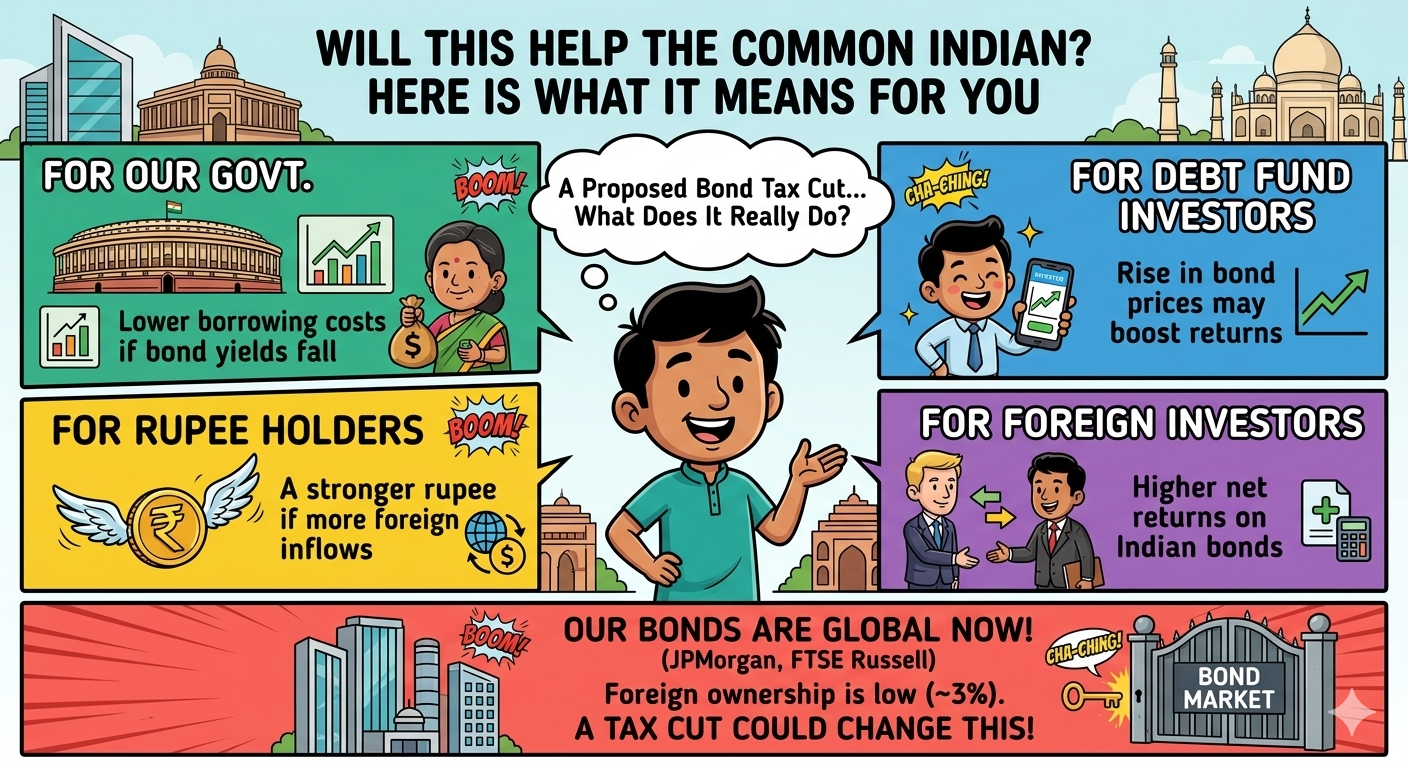
Here is how the proposed bond tax cut could affect different groups in India and why it matters for the broader economy:
Even though Indian government bonds are now part of major global indices managed by JPMorgan and FTSE Russell, foreign ownership remains very low at around 3% of India’s $1.3 trillion bond market. A tax cut could change that.
If introduced, stronger overseas interest in Indian bonds could help reduce the government’s borrowing expenses. When bond demand increases, yields move lower, making it easier and cheaper for both the government and businesses to raise funds. Over time, this may also translate into more affordable loans for ordinary Indians.
Financial markets responded positively to the development. The rupee recovered from earlier declines, while government bonds strengthened. The benchmark 10-year bond yield dropped by as much as five basis points to 7% before trimming some of those gains.
Still, experts are taking a measured view. Bloomberg cited Edwin Gutierrez, Head of Emerging Market Sovereign Debt at Aberdeen Investments, who described the proposal as encouraging.
However, he noted that broader issues, especially inflation worries, are still affecting investor appetite for Indian debt.
Analysts have also pointed out that currency swings and the possibility of US interest rates staying elevated for longer could reduce the overall advantage of the proposed tax relief for foreign investors.
Stronger rupee if foreign inflows increase
*T&C Apply
The solution lies in combining this tax cut with exchange rate stability and continued index inclusion. Global investors have often complained that India’s tax structure is higher than that of many other emerging markets, including Indonesia, Malaysia, Mexico, and South Africa.
India is walking a tightrope. The rupee is under pressure, gold imports are being curbed, and now bonds are being used as a tool to pull in foreign money. The tax cut on bond interest is a smart move, but it is not a magic fix.
Stable currency, lower global rates, and consistent policy will matter just as much. The direction is right. The execution will decide the outcome.
1. Does the RBI print money based on how much gold India holds in reserves?
No, the RBI does not issue notes at a constant ratio based on gold reserves. In India, we operate on the basis of a fiat currency system wherein the value of the Indian rupee is based on the economic strength of the nation, its foreign exchange reserves, etc., and not on gold alone.
2. Why is India increasing import duty on gold and precious metals now?
The increase in import tax on gold, silver, and other precious metals was aimed at making imports more expensive and decreasing the demand for them. This measure has been taken in order to regulate the trade deficit, ease the pressure on the rupee, and prevent foreign exchange outflows from India.









.png&w=3840&q=75)



