By continuing, you agree to LoansJagat's Credit Report Terms of Use, Terms and Conditions, Privacy Policy, and authorize contact via Call, SMS, Email, or WhatsApp
Disclaimer: The information published on LoansJagat is intended for general informational and educational purposes only and should not be considered financial, legal, or investment advice. Interest rates, loan terms, statistics, and other data may change over time and may vary by lender or source. Please verify the latest information and consult a qualified financial advisor or the respective Bank/NBFC before making any financial decisions.
Subscribe Now
About the author

LoansJagat Team
‘Simplify Finance for Everyone.’ This is the common goal of our team, as we try to explain any topic with relatable examples. From personal to business finance, managing EMIs to becoming debt-free, we do extensive research on each and every parameter, so you don’t have to. Scroll up and have a look at what 15+ years of experience in the BFSI sector looks like.
Related News
Simplify All Your Loans Into One Affordable EMI

Customers Served

Debt Consolidated

1200+ Reviews

Locations in India
Club all Loans & Credit Card Bills into Single EMI

Quick Apply Loan
Consolidate your debts into one easy EMI.

Takes less than 2 minutes. No paperwork.

10 Lakhs+
Trusted Customers

2000 Cr+
Loans Disbursed

4.7/5
Google Reviews

50+
Banks & NBFCs Offers
Other services mentioned in this article
Key Takeaways
BlackRock Investment Institute put out its weekly note on June 9, 2026. The message was blunt. “The full breadth of the shock has yet to show and will depend on how it evolves,” the firm said. May CPI data was due the very next morning, June 10, at 8:30 am ET. BlackRock called it the first real test of how the U.S.-Iran conflict is feeding into prices.
Reuters polled economists and found a consensus forecast of 4.2% year-on-year for May CPI. That would be the sharpest jump since April 2023, up from 3.8% in April. It also sits well above the Fed’s 2% target. A hike, not a cut, is now back on the table. Markets were not pricing that in at the start of 2026.
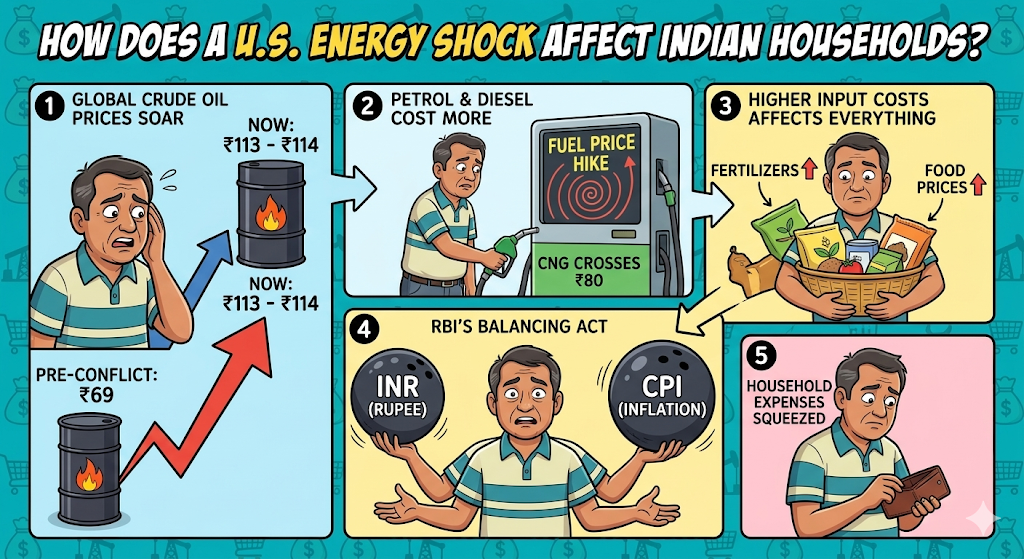
Approximately 80% of India’s crude oil is imported from other countries. Prices are spiraling out of control after the Russia-Ukraine war started. India’s crude oil basket was well within the ₹69 per barrel range pre-conflict, but quickly hit the ₹113 to ₹114 per barrel range.
RBI-controlled Public Sector Refinery Oil Marketing Companies (OMCs) increased prices on petrol and diesel sold to consumers, the first hike since May 2022. It comes on the heels of Delhi’s CNG breaking through ₹80 per kg for the first time ever.
Next comes food. In its own experience, the RBI has found that a 10% increase in crude prices leads to about a 20-basis-point increase in the headline CPI of India. But crude prices haven’t risen by just 10%. They’re well above 40%. This is already seeping into fertilizers, petrochemicals, and consumer products.
Now, the RBI will have to juggle two balls that are the rupee and the CPI.
*T&C Apply
BlackRock’s biggest stated concern is timing. The firm warned, “We think a prolonged closure of the Strait of Hormuz into July could bring the impact of the shock to the fore more prominently, especially as U.S. oil inventories potentially hit four-decade lows.”
Saudi Aramco Chief Executive Officer (CEO), Amin Nasser, pointed out on May 11, 2026, that there would be a decrease of 100 million barrels of oil supply in the market for every single week that the Hormuz Strait remains shut down. The total net loss is already at 880 million barrels.
Mark Zandi, chief economist at Moody’s Analytics, told CBS News, “We’re going to be paying the price for this through much of the year. We should see a bit of a bump in airline tickets. Grocery prices will probably be a bit higher.”
For India, the clearest near-term relief signal would be a negotiated reopening of Hormuz.
India’s Oil Minister Hardeep Singh Puri has publicly stated that oil prices cannot remain elevated for an extended period. India’s foreign ministry has formally called for immediate de-escalation and diplomatic resolution.
The May U.S. CPI report is the first real stress test of how a geopolitical energy shock translates into sustained inflation. The stakes extend well beyond Wall Street for India, where every 10% crude spike adds 20 basis points to retail inflation. Whether Hormuz reopens before July will determine whether this remains a warning or becomes a prolonged economic crisis.
What events during the U.S.-Iran conflict influenced world oil supplies?
There was a start of the U.S.-Iran war in February 2026. The nation of Iran closed down the Hormuz Strait in March 2026. The weekly decrease in oil supply becomes 100 million barrels if the strait is shut down. The Brent crude reached as high as $126 per barrel, with losses reaching up to 880 million barrels.
Will cheaper oil in the U.S. below $90 ease inflation concerns raised by BlackRock?
This would help, but not straightaway. BlackRock had noted on June 9, 2026, that the full impact of the energy shock had yet to manifest in data. Continued Hormuz blockade through July could see U.S. oil stockpiles dropping to decades' lows, which would sustain inflation despite lower prices temporarily.









.png&w=3840&q=75)



