By continuing, you agree to LoansJagat's Credit Report Terms of Use, Terms and Conditions, Privacy Policy, and authorize contact via Call, SMS, Email, or WhatsApp
Disclaimer: The information published on LoansJagat is intended for general informational and educational purposes only and should not be considered financial, legal, or investment advice. Interest rates, loan terms, statistics, and other data may change over time and may vary by lender or source. Please verify the latest information and consult a qualified financial advisor or the respective Bank/NBFC before making any financial decisions.
Subscribe Now
About the author

LoansJagat Team
‘Simplify Finance for Everyone.’ This is the common goal of our team, as we try to explain any topic with relatable examples. From personal to business finance, managing EMIs to becoming debt-free, we do extensive research on each and every parameter, so you don’t have to. Scroll up and have a look at what 15+ years of experience in the BFSI sector looks like.
Related News
Simplify All Your Loans Into One Affordable EMI

Customers Served

Debt Consolidated

1200+ Reviews

Locations in India
Club all Loans & Credit Card Bills into Single EMI

Quick Apply Loan
Consolidate your debts into one easy EMI.

Takes less than 2 minutes. No paperwork.

10 Lakhs+
Trusted Customers

2000 Cr+
Loans Disbursed

4.7/5
Google Reviews

50+
Banks & NBFCs Offers
Other services mentioned in this article
Key Takeaways
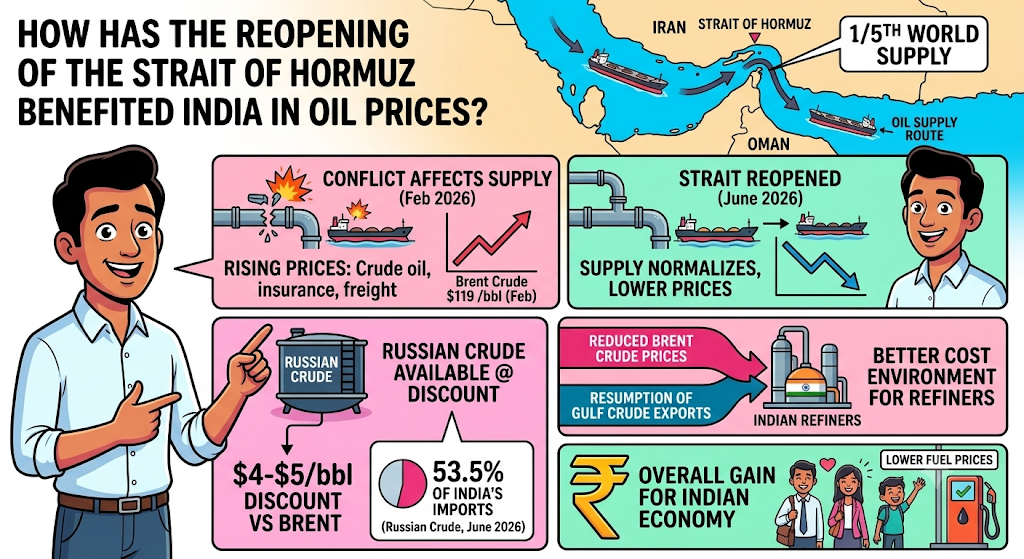
The Strait of Hormuz is a strait separating Iran and Oman and is responsible for transporting approximately 1/5th of the world’s entire oil requirements. This is an important strait because it is a vital route for the export of oil from oil-producing countries like Saudi Arabia, Iraq, Kuwait, the UAE, and Qatar.
Oil supply via the strait has been affected since the inception of the Iran conflict in late February 2026. This results in riseing prices of crude oil, insurance rates of ships, and rising the prices of freight. Brent crude reached an all-time high of $119 per barrel due to the increase in prices during this war, from $70-$72 per barrel in February.
India’s oil imports have normalised and are back to normal levels by June 2026, touching the 5 million barrels per day (mbd). The Russian crude is available at a discount of about $4 to $5 per barrel against Brent, thus making it economically viable.
India is estimated to import record Russian crude oil of 2.35 million bpd in June 2026, with Russia being the source of 53.5% of oil imports into India. The combination of reduced prices of Brent crude and resumption of Gulf crude oil exports will improve the cost environment for Indian refiners.
During the war period, the government held off on revising retail rates till mid-May. Then, slashed excise duty on petrol and diesel by ₹10 per litre each on March 27 to avoid a retail price increase before five state elections.
However, the recovery is uneven. Indian drivers saw four price hikes at the pump over a single month during the crisis. LPG disruption initially led to the suspension of supplies to commercial users such as hotels and restaurants, with a gradual restoration to 70% of their needs.
LoansJagat noted that fuel transitions based on subsidies have become a factor in loan approvals, with rising interest in EV two-wheeler loans. As petrol prices spiked four times during the Hormuz crisis, consumer preference for EV loans accelerated.
*T&C Apply
Sumit Ritolia, Manager of Modelling and Refining at Kpler, said, “India’s imports remained strong through June, supported by continued discounts and steady refinery demand.”
Fitch Ratings expects Indian oil companies’ gross refining margins to hover around $5 per barrel to $6.8 per barrel and for marketing margins to remain healthy in 2025-26. IOC, BPCL, and HPCL had reported margins of $3.7 to $6.0 per barrel in the first nine months of FY2024-25, per Fitch.
Middle Eastern producers have approached Indian buyers to resume volumes under long-term contracts, but Indian refiners have not been eager to commit. With 2 months of crude inventory on hand and Brent near pre-war levels, Indian refiners are in a strong negotiating position for the first time since February 2026.
The Hormuz reopening and falling Brent prices are a clear near-term positive for India’s refining sector. However, the major question remains as to how long this cease-fire agreement lasts and if supply from the Middle East becomes normalized.
When will the price of oil slide if the Strait of Hormuz is reopened after closure?
When this route is opened, and oil from Gulf countries flows out at the normal pace, Brent and insurance costs of ship-owners and freight are reduced. After June’s US-Iran peace Accord for a ceasefire in the conflict, Brent lost the wartime high of $119 to trade at $74 a barrel, a decline to 2004 levels.
How did India mitigate harm to the general public amid the Hormuz crisis with four hikes in petrol prices and an 81.6% surge in India’s oil import bill?
India absorbed the shock by means of reductions in excise duties by ₹10 per litre on March 27, 2026, crude diversity from five sources, and efficient inventory management. Russian crude, which was priced at a $4-5 per barrel discount to Brent in June 2026, was beneficial for refineries to maintain cost competitiveness.









.png&w=3840&q=75)



