
By continuing, you agree to LoansJagat's Credit Report Terms of Use, Terms and Conditions, Privacy Policy, and authorize contact via Call, SMS, Email, or WhatsApp
Disclaimer: The information published on LoansJagat is intended for general informational and educational purposes only and should not be considered financial, legal, or investment advice. Interest rates, loan terms, statistics, and other data may change over time and may vary by lender or source. Please verify the latest information and consult a qualified financial advisor or the respective Bank/NBFC before making any financial decisions.
Subscribe Now
About the author

LoansJagat Team
‘Simplify Finance for Everyone.’ This is the common goal of our team, as we try to explain any topic with relatable examples. From personal to business finance, managing EMIs to becoming debt-free, we do extensive research on each and every parameter, so you don’t have to. Scroll up and have a look at what 15+ years of experience in the BFSI sector looks like.
Related News
Simplify All Your Loans Into One Affordable EMI

Customers Served

Debt Consolidated

1200+ Reviews

Locations in India
Club all Loans & Credit Card Bills into Single EMI

Quick Apply Loan
Consolidate your debts into one easy EMI.

Takes less than 2 minutes. No paperwork.

10 Lakhs+
Trusted Customers

2000 Cr+
Loans Disbursed

4.7/5
Google Reviews

50+
Banks & NBFCs Offers
Other services mentioned in this article
Key Takeaways
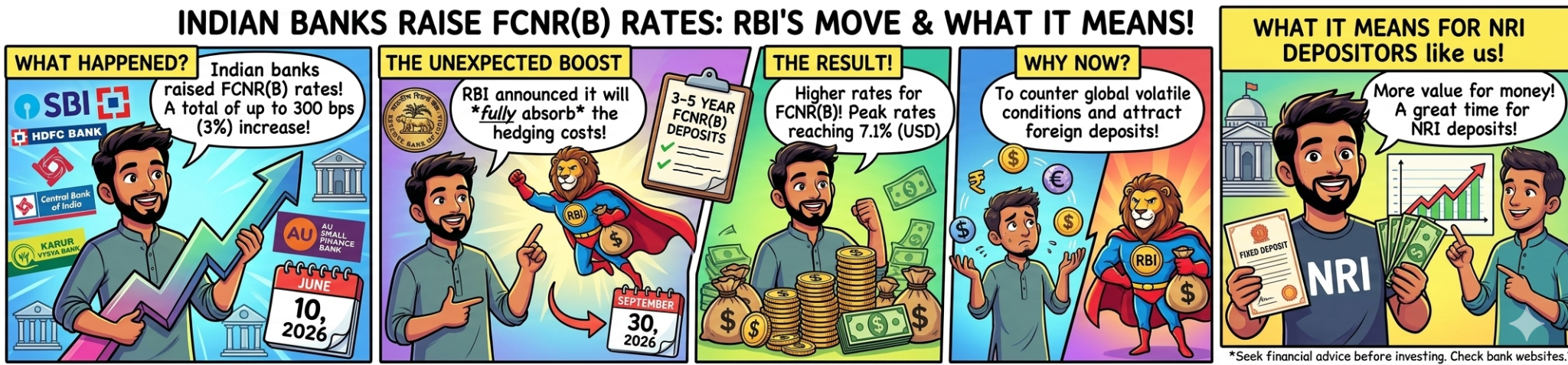
On June 10, 2026, SBI increased FCNR(B) deposit rates by 295 bps. HDFC Bank also increased FCNR(B) deposit rates by 260 bps. Karur Vysya Bank raised peak rates by over 300 bps, and it reaches 7% for 3 to 5 year USD deposits. AU Small Finance Bank offers 7.1% on 3 to 4 year deposits.
SBI launched a special product called “SBI Advantage FCNR(B) Deposit,” which offers 6% for deposits above $1 million for a 5-year term. SBI offers 5.25% for deposits below $1 million in the 3 to 4 year bucket. Rates were increased by 255 bps for the 4 to 5 year bucket. These are USD-denominated deposit rates for NRIs, OCIs, and Persons of Indian Origin (POIs).
Before this scheme, SBI offered just 3.05% and HDFC Bank 3.4% on 5-year FCNR(B) deposits. With hedging costs previously around 2.5% per year, banks could not offer competitive rates without bearing a heavy cost. The new RBI facility removes that barrier entirely.
SBI Research now expects inflows of $40-45 billion via the FCNR(B) route. MUFG Bank estimates $20 billion as a base case. The current outstanding FCNR(B) deposit balance as of March 2026 stands at $33.8 billion, up from $32.8 billion a year ago. A flood of NRI dollars could strengthen the rupee and ease India’s pressure on forex reserves.
P D Singh, CEO for India and South Asia at Standard Chartered Bank, said the scheme could materially improve foreign currency inflows into India.
*T&C Apply
SBI Research stated that banks can now offer FCNR(B) pricing in the range of 5.5% and above. FCNR(B) deposits could easily attract inflows exceeding the $34 billion mobilised during the 2013 scheme.
According to a Senior Financial Analyst at Loans Jagat, NRIs with idle foreign currency savings should compare rates across at least 3-4 banks before locking in. “The window is open only until September 30, 2026. Acting early matters,” she said.
The RBI’s June 5, 2026, decision to absorb hedging costs has triggered a sharp rate war among Indian banks. FCNR(B) deposit flows in FY26 were only $946 million, versus $7 billion in FY25. This scheme is a direct attempt to reverse that gap. For NRIs holding US dollars, UK pounds sterling, Euros, Australian dollars, Canadian dollars, or Japanese yen, FCNR(B) deposit rates have jumped sharply. Check your bank’s revised rates before September 30, 2026, which is the last date to mobilise deposits under this scheme.
Why did RBI grant permission to banks to raise interest rates for FCNR(B) and NRE deposits from June 2026 onwards?
The rupee was under stress owing to lower foreign portfolio investments. The RBI decided to abolish the interest rate ceiling and absorb the cost of hedging in order to bring in NRIs’ dollars.
Are FCNR(B) deposits actually worth opening now, given the new RBI scheme?
Yes, if you hold foreign currency savings. Banks like AU Small Finance Bank are offering 7.1% on USD deposits. The hedging cost is fully covered by RBI until September 30, 2026. Returns are tax-free in India. The window is short, so act soon.









.png&w=3840&q=75)



